
To research a topic before you write, settle what the piece must deliver, narrow it to one question, read around it and vet your sources, fill your knowledge gaps, then outline your notes. Most weak posts fail because the writer drafted from a broad topic instead of a narrow question backed by checked evidence.
Here is the routine as five steps you can run for every piece:
- Settle who the piece is for, what format it takes and how deep it must go.
- Narrow the subject to one angle and phrase it as a question you can answer.
- Read overviews first, then check that enough solid evidence exists and find the gap the ranking pages leave.
- Fill what you don't know with AI brainstorming you verify and a quick check from someone in the field.
- Sort your notes under the question and build the outline from them.
These topic research steps stay the same for a 600-word answer post and a 3,000-word pillar page. Only the time you give each one changes.
What to settle before you start the research
Before you research a topic, pin down the brief, because it sets how deep the reading goes. Library guides tell students to check the assignment first, since a five-page paper and a thesis need very different reading. For a content writer, the assignment is the brief.
Write down the brief
Write down four things at the top of your notes:
- Who the reader is and what they already know
- The search intent and the format, such as a how-to, a comparison or a definition
- The planned length and whether the piece is a pillar or a supporting article
- What the page should do for the business, if anything
Length and position set the scope. A 1,500-word supporting piece goes deep on one angle and leaves the wider ground to its pillar, while the pillar covers breadth and links out to the details. Knowing this early stops you from collecting notes for three pieces when you're writing one.
Then decide whether the piece is exploratory or practical. An exploratory piece walks a newcomer through ideas and needs more background, while a practical one needs exact steps, settings and quantities, so its sources have to be more specific. That choice shapes the whole topic research process that follows.
If the topic was handed to you, find the part of it you're curious about. Curiosity carries you through the third hour of reading, and it often becomes what sets your piece apart.
Note what you already believe about the topic, too, and the assumptions behind it. The source check later should test those beliefs, not just collect support for them.
Narrow your subject into one question you can answer
A question gives your reading a direction, and a subject never does. "Email marketing" tells you nothing about what to read, while "what should a bakery send in the first week after someone subscribes?" tells you exactly. This is the step writers skip most often.
Cut a broad subject down to one angle
Before you pick a limit, brainstorm for ten minutes. List the related concepts, the people the topic affects, who has a stake in it and the debates around it. The item that keeps pulling you back usually points to the limit that narrows your question best.
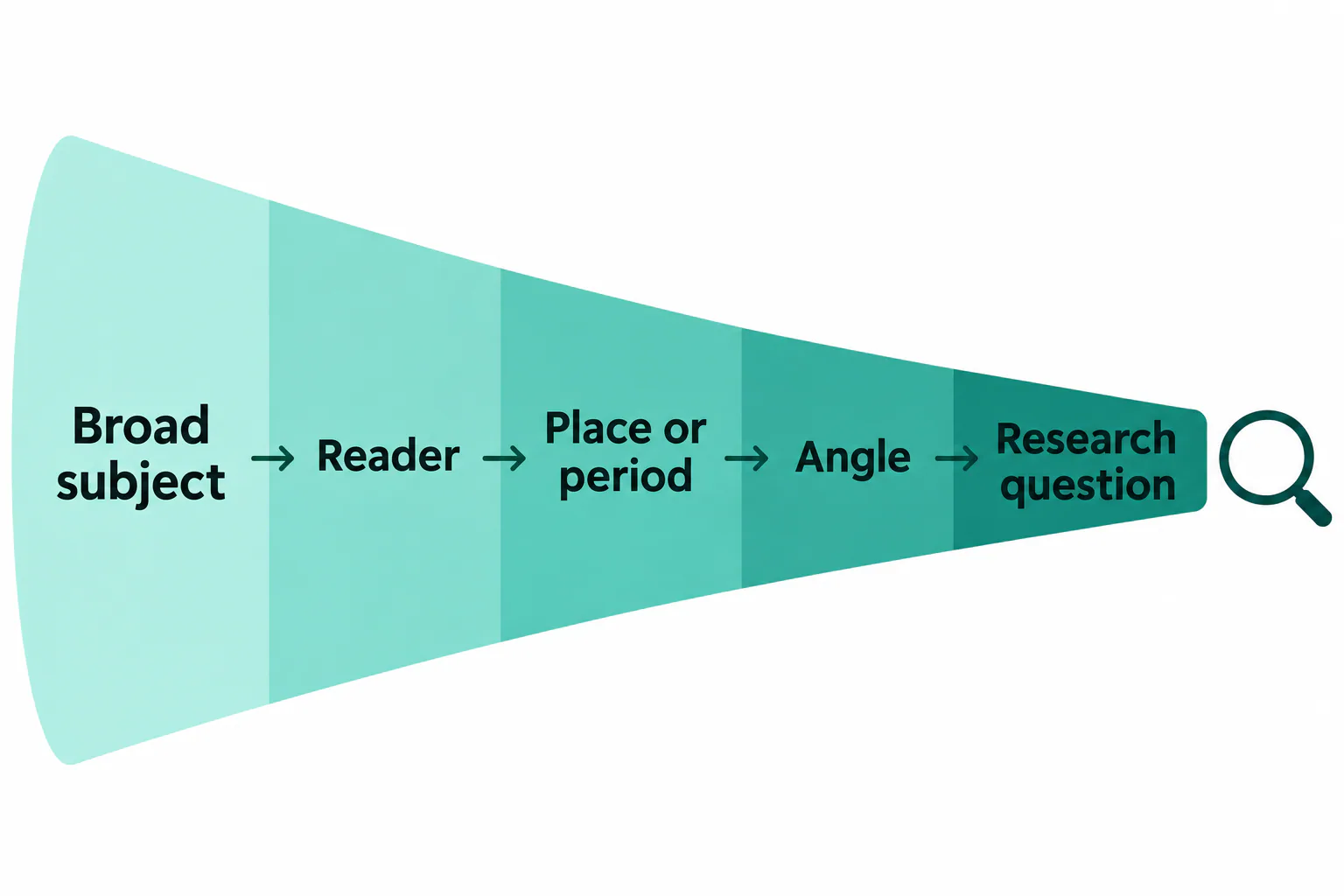
A broad topic is one you could fill a book with. Cut it down by fixing one or more of these limits:
- The reader, such as first-time buyers, agency owners or night-shift nurses
- The place, such as one city, one country's rules or one platform
- The period or moment, such as the first month, winter or the week before a launch
- The situation, such as a slow site, a rejected application or a small budget
Library guides call these levers population, place and period, and they work just as well for web content. Stop cutting when the scope fits the length in your brief. For a supporting article that usually means two limits, for a short answer post three.
Turn the angle into a research question
Write the angle as one question a reader would actually ask, then test it. Can you answer it in two sentences, within the intent and scope of your brief, from a source you can name? If not, you still have a broad topic, so refine it again.
A good research question also tells you what you can ignore. "How should a local bakery welcome new email subscribers?" rules out list growth, design tools and deliverability, which keeps the process short. Put it at the top of your notes and hold every source up against it.
Read around the topic and test your sources
When you research a topic, reading comes in two passes. The first is wide and shallow, to learn the field, and the second is narrow and checks that you can back up what you'll write.
Start with overviews to learn the terms and debates
Begin your background research with overviews, not specialist material. An encyclopedia entry, a textbook's introduction, an industry glossary and the ranking pages give you the vocabulary, main debates and recurring names. List terms you didn't know. Academic databases can wait until you have the question.
While you read the top results, find the gap they leave open. Compare the top five pages in a sheet, note which sub-questions each answers, and add questions from People Also Ask and forum threads. A question no page answers well, or answers without a source, is your gap.
Check that enough solid sources exist before you commit
Before you commit to the angle, spend half an hour making sure you can support it. For most blog posts you want at least three independent sources you'd be happy to cite, with at least one primary: official documentation, a law or regulation, original data or peer-reviewed studies.
Check each one quickly. Who published it, and what do they gain from the claim? When was it last updated, and does that matter in your field? Does it show where its numbers come from? A figure you only find quoted, never at its origin, doesn't count.
If the check fails, refine the question instead of writing around the hole. A thin source base gets a research paper sent back, and it fills a blog post with vague claims.
How to research a topic you know little about
Start further back and slow your research process down. Do more background research than usual, read two or three overviews, then write a one-paragraph summary of the field in your own words before you pick the angle. If you can't write that paragraph, you're not ready to narrow.
The research process for an unfamiliar field takes longer, so plan extra time for the source check and expect to rewrite the question. A newcomer's first question is usually a broad topic in disguise or aimed at the wrong reader.
Let AI brainstorm with you but verify every claim yourself
An AI assistant is useful at the edges of the work. Ask it to brainstorm reader sub-questions, list expert terms, name the main schools of thought, argue against your angle or suggest ways to refine your question. Treat the output as prompts for your own reading, not as findings.
Facts, figures, dates and citations stay off that list. Assistants can invent papers and numbers with no origin. Next to each useful item, note where you'll check it, open that source yourself and keep only what you've seen there.
Ask someone who knows the field to check your angle
Students take their topic to a professor or a subject librarian. You can ask a client's staff, a practitioner or a forum specialist. Describe the reader, the research question and your main sources in three lines, and ask what is wrong or missing.
A ten-minute reply can save hours, because an expert spots a wrong assumption or an outdated rule in the first line, and you can refine the angle before drafting. On health, money or legal topics, make this check every time.

How to research a topic for a blog and turn your notes into an outline
A blog post answers first and proves second, the reverse of a research paper, so sort your notes by the reader's questions rather than by the sources you found them in. Turn the pile into an outline in this order:
- Write each note as one claim with where it came from and its date, so you never reopen a tab to find a citation.
- Break the research question into the three to six sub-questions a reader would ask next, in the order they'd ask them.
- Sort every note under one sub-question. Each group becomes an H2, and a group with a single note is probably a paragraph, not a section.
- Mark any claim with nothing behind it. Verify it before drafting or cut it.
- Put the direct answer at the top and slot the gap you found into the place where the reader would look for it.
Match each claim to its source
Evergreen fundamentals are often explained best in books and long guides, while current figures and rules need recent primary sources, official pages or the databases your library offers. Let the outline show weak support, so the gap gets filled before the draft.
If you write for several sites, RankFlow drafts from your content profile, your authors and what currently ranks, and labels numbers as measured, calculated or estimated, so you see which claims you need to check. Next time you research a topic, build the outline first and let the draft follow it.
Frequently Asked Questions
What are the 5 C's in research?
What are the 5 C's in research?
There's no single standard list, but a version often taught for literature reviews is cite, compare, contrast, critique and connect. You cite what each source says, compare where sources agree, contrast where they differ, critique their methods and limits, and connect them to your own question. For a blog article, critique and connect matter most, because they decide which sources you trust.
What are the main types of research questions?
What are the main types of research questions?
Most guides use three groups. Descriptive questions ask what something is or how often it happens, comparative questions ask how two or more things differ, and relational or causal questions ask whether one thing affects another. Blog articles mostly answer descriptive and comparative questions, plus practical "how do I" questions. Causal claims need the strongest evidence, so check your sources twice before writing one.
What is a topic sentence in a research article?
What is a topic sentence in a research article?
It's the sentence, usually the first in a paragraph, that states the paragraph's main point, while the rest supports it. In an academic research paper it also links the paragraph back to the thesis. On the web it does extra work, because many readers skim only the first sentences, so each one should make sense on its own.
How long should you spend researching a topic before you write?
How long should you spend researching a topic before you write?
It depends on the piece and on what you already know. As a working range, a short answer post on a familiar subject needs an hour or less, a 1,500-word supporting article two to three hours, and a pillar page or an unfamiliar field a full day or more. If the source check keeps failing, change the question rather than reading longer.
Is Google Scholar useful for researching blog articles?
Is Google Scholar useful for researching blog articles?
Yes, when your claim rests on research rather than practice. Google Scholar finds peer-reviewed studies, theses and conference papers, and the abstracts are usually free to read. Read past the abstract when you can, check the date and whether later work challenges the findings, and prefer reviews that sum up many studies. For how-to or product topics, official documentation usually serves readers better.