Google made Gemini 4 Hydrogen the default model in AI Mode for all users worldwide on Nov. 12, 2026. The company also relies on the model for the toughest AI Overviews questions and calls it the biggest model upgrade to Search yet.
- Gemini 4 Hydrogen became the default model in AI Mode for all users worldwide on Nov. 12, 2026.
- Hydrogen also handles the toughest AI Overviews queries. Google calls it the biggest model upgrade to Search yet.
- Hydrogen is built for speed and efficiency, while Carbon and Argon target longer-running deep thinking.
- Google promises better query fan-out, more visual answers and more nuanced responses in every language AI Mode supports.
- Google has not said what Hydrogen replaced, which AI Overview questions count as hardest, or how many links appear.
Google rolls out Hydrogen to all Search users globally
From Nov. 12, 2026, Hydrogen is the default model behind AI Mode for every user, wherever they are. Google's Search post states that the model is available globally in Search for all users, which makes this a general rollout rather than a test or a feature limited to one group.
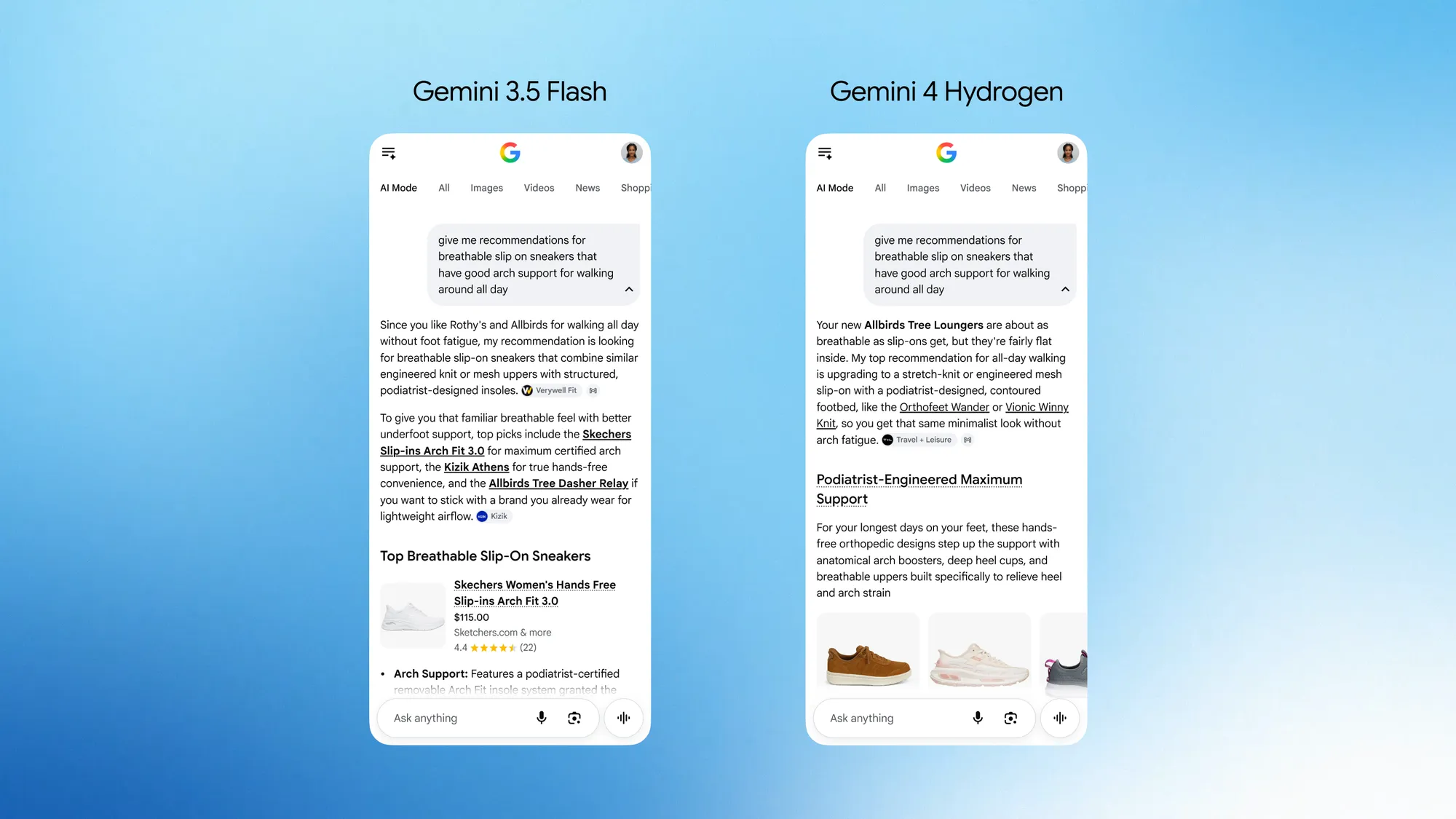
Robby Stein, VP of Product for Google Search, said on X that Hydrogen now handles the hardest AI Overviews queries. That carries the model beyond AI Mode and into the AI-generated summaries that appear directly in regular Google results.
Google's post calls Hydrogen the biggest model upgrade to Search yet. Nick Fox of Google wrote on X that Search is getting a massive upgrade with Gemini 4 Hydrogen and that it is available now for all users, globally.
The announcement therefore touches two surfaces. In AI Mode, Hydrogen is the default, so it handles every answer whenever someone uses that experience. In Google AI Overviews, Hydrogen is reserved for the hardest questions, and Google has not said how it decides which questions fall into that group.
The scale of the change follows from the first point. A default model applies to everyone who opens AI Mode without choosing anything, so the change reaches far more people than an option offered to subscribers. The announcement does not include usage figures, and none are given here.
In Google Search, Gemini 4 Hydrogen is also the third model from the new family to appear in AI Mode within about a month. Argon and Carbon arrived earlier for paying subscribers, and the section on those models below sets out the dates.
What Hydrogen changes in how Search answers
Google says Hydrogen can handle multi-part inquiries, inquiries with typos and highly specific inquiries. It also follows instructions more closely than previous versions did.
Rajan Patel of Google wrote on X that the model follows prompts better, is more conversational and breaks down multi-part questions. A multi-part question is one request that bundles several asks, such as a comparison plus a recommendation plus a constraint. Models that handle such requests poorly tend to answer one part and skip the others, which is the weakness these claims address.
Typos and highly specific queries
Two of the named strengths concern input that is imperfect or narrow. Misspelled queries and very specific ones are routine in real Search behavior, so a model that copes with both changes the experience for ordinary use, not only for carefully worded prompts.
For content teams, the practical meaning is limited but concrete. Long, unusual and misspelled queries are the kind of searches that arrive in small numbers each but add up across a site, and the model answering them is now a different one. How those answers cite or link pages is covered in the next section.
More visual answers
Google says Hydrogen brings more visual responses. These include more images, structured responses, comparison tables and custom tools. A structured response organizes an answer into labeled parts rather than a block of prose, and a comparison table lines up options against shared criteria.
The mention of custom tools is the least specific item on the list. Google's pages, as described, do not say what form those tools take or for which topics they appear.
Language coverage
Answers will be more nuanced in all languages supported by AI Mode. The pages describing the launch do not list those languages, and they do not define "more nuanced" in measurable terms.
Google's own summary
The company's description of the model comes down to five points: it is super fast, understands requests better, has improved query fan-out and linking, gives more visual responses and offers richer language understanding. These are Google's claims. Google's model post backs them with its own benchmark comparisons, which measure Hydrogen's speed against Gemini 3.8 Flash and compare it with Argon on the Artificial Analysis Intelligence Index, using Hydrogen's extra-high thinking setting. The comparisons come from Google, and the sources do not include independent tests.
How query fan-out and the terms behind it work
Query fan-out is how Search simultaneously executes multiple queries across each of the subtopics of an inquiry. Instead of treating a typed question as a single lookup, the system splits it into parts and searches each part at the same time.
A question such as a trip plan, a product comparison or a how-to with several steps contains many subtopics. Under fan-out, each of those can trigger its own Search query, and the results are then assembled into one answer.
Google says Hydrogen improves this process. The stated result is that users are connected to a broader range of helpful links, including sites they may not have discovered before.
Why the links matter to site owners
That last claim carries the most weight for publishers. If each subtopic is searched separately, a page that covers one narrow part of a question well can surface in an answer even when it would not rank for the full question. Google's wording about sites users may not have found points in that direction.
No counts for links or sites are provided, and neither Google's Search post nor Stein's thread says how many links an answer will carry. Whether a broader range of links means more visits to any given site is not something the available information shows.
Teams that measure Search performance rely on Search Console. Changes in how AI answers link out would show up there only to the extent that Google reports them, and the facts here do not say how AI Mode links are counted.
AI Mode and AI Overviews
AI Mode is Google's AI-powered Search answer experience. AI Overviews are AI-generated summaries shown in Google Search results. Hydrogen now powers the first by default and the hardest questions in the second.
For background on how these surfaces relate, see the piece on Search and AI Mode becoming one product.
Where Gemini 4 Hydrogen sits next to Carbon and Argon
Hydrogen is one of three Gemini 4 models now present in AI Mode. Google describes Hydrogen as designed for speed and efficiency, while Carbon and Argon are made for longer-running deep thinking.
Google's AI Mode help page lists Hydrogen as helpful for fast, all-around assistance on most questions. It is the general-purpose option. The other two are meant for tasks that benefit from more time.
| Model | Intended use | Availability in AI Mode |
|---|---|---|
| Gemini 4 Hydrogen | Speed and efficiency; fast, all-around help | Default for all users worldwide from Nov. 12 |
| Gemini 4 Argon | Longer-running deep thinking | Option for Google AI Pro and Ultra subscribers since Oct. 13 |
| Gemini 4 Carbon | Longer-running deep thinking | Rolling out to Ultra subscribers since Nov. 10 |
The release order
Gemini 4 Argon became available as an option for Google AI Pro and Ultra subscribers in AI Mode starting Oct. 13. On Nov. 10, Google started rolling out Gemini 4 Carbon to Ultra subscribers in AI Mode.
Carbon is listed as an option for Ultra subscribers 18 years or older, with daily usage limits. Those limits are not specified. More on that release is in the report on Gemini 4 Carbon in AI Mode.
The sequence shows a pattern: the two deep-thinking models reached paying subscribers first, and the fast model followed as the default for everyone. Subscribers choose between models, while everyone else gets Hydrogen without choosing.
What the split means in practice
The division of labor is the one Google states. Quick, broad questions go to the model built for speed, and questions worth waiting for go to Carbon or Argon for those who have access. Google has not said whether Hydrogen is also what non-subscribers see when a question is hard, beyond its role in AI Overviews.
For teams checking how their pages appear in AI answers, this suggests that the version most people see is the Hydrogen one. Results seen by a subscriber who picked Carbon or Argon may differ, and the facts give no detail on how.
Hydrogen beyond Search
Hydrogen is not limited to Search. In the Gemini app, free users reach it through auto model selection, while paid subscribers can choose it directly in the model picker. Developers can use it in Google AI Studio and through the Gemini API, and Google AI Pro and Ultra subscribers can also work with it in Antigravity, Google's development platform.
That makes two kinds of access worth keeping apart. In AI Mode, Hydrogen answers by default without anyone choosing it, while in the app and the developer tools it is one model among several. Hydrogen also offers several thinking levels (low, medium, high and extra high), with high set as the default.
How this compares with earlier Search defaults
Gemini 3.5 Flash became the global default for AI Mode at Google I/O in May. Google made Gemini 3 the default model for AI Overviews globally in January.
Neither Google's Search post nor Stein's post said what Hydrogen replaced as the AI Mode default. Gemini 3.5 Flash was the default set in May, but the available information does not confirm that it was still the default immediately before Nov. 12, so a direct replacement cannot be stated.
What Google does name is its comparison point. The model post measures Hydrogen against Gemini 3.8 Flash, which launched in September, and coverage of the launch notes that Google chose the Hydrogen name instead of carrying the Flash label into Gemini 4. That shows which model Google benchmarks Hydrogen against, but it still does not confirm which model was the AI Mode default on Nov. 12.
The AI Overviews arrangement also differs. Hydrogen is described as handling the hardest questions there, not as a blanket default, so Gemini 3 is not stated to have been replaced across that surface.
| Surface | Earlier default named | Hydrogen's role |
|---|---|---|
| AI Mode | Gemini 3.5 Flash, set globally at I/O in May | Default for all users from Nov. 12; what it replaced is not stated |
| AI Overviews | Gemini 3, set globally in January | Used for the hardest questions |
The timeline shows how often the default changes: one in January for AI Overviews, one in May for AI Mode and now Hydrogen in November. Each shift changes the model producing the answers that sit above or beside traditional results.
Timing alongside the November core update
The November core update began Nov. 10, 2026. Hydrogen arrived two days into it, and the update was still rolling out as of 2:05 p.m. ET on Nov. 12.
No completion date for the core update has been given. Two changes to Search therefore overlapped: a ranking update still in progress and a new default answer model.
Google has not linked the two. Anyone watching Search Console data or visibility during these days will see both happening at once, and the facts do not allow the effects of one to be separated from the other.
For agencies and multi-site operators, that overlap is a reason to record the dates. Nov. 10 for the update start and Nov. 12 for the Hydrogen rollout give two fixed points against which later movement in impressions or clicks can be read, without assigning a cause that Google has not stated.
Open questions about Hydrogen in Search
Google has not said which AI Overview questions count as the hardest, and the pages do not describe what answers to the remaining questions use.
Link counts remain unstated, and so does the model Hydrogen replaced as the AI Mode default. Google's benchmark comparisons are its own, and no independent tests confirm the claimed gains in speed, understanding or nuance. No price is given for Hydrogen in the information available, and the Search post presents it as available to all users.
Sources
Photo by Search Engine Journal
Frequently asked questions
When was Gemini 4 Hydrogen released?
When was Gemini 4 Hydrogen released?
Google made it the default model in AI Mode on Nov. 12, 2026.
Is Gemini 4 Hydrogen available to everyone in Search?
Is Gemini 4 Hydrogen available to everyone in Search?
Yes. Google's Search post says it is available globally for all users, as the AI Mode default and for the hardest questions in AI Overviews.
What is the difference between Hydrogen, Carbon and Argon?
What is the difference between Hydrogen, Carbon and Argon?
Google describes Hydrogen as designed for speed and efficiency. Carbon and Argon are made for longer-running deep thinking and are available to subscribers.
What is query fan-out?
What is query fan-out?
It is how Search simultaneously runs multiple queries across each subtopic of a question. Google says Hydrogen improves it.
Does Hydrogen make Search answers more visual?
Does Hydrogen make Search answers more visual?
Google says so. It cites more images, structured responses, comparison tables and custom tools.
Who can use Gemini 4 Carbon in AI Mode?
Who can use Gemini 4 Carbon in AI Mode?
Ultra subscribers 18 years or older, with daily usage limits. Carbon began rolling out on Nov. 10.