Google Search is being merged with AI Overviews and AI Mode into one unified product, executives said on the Google Q3 2026 earnings call on 28 October 2026. Alphabet shares dropped sharply as Search revenue growth slowed.
- Google said on its Q3 2026 call that AI Overviews, AI Mode and traditional Search are becoming one unified product.
- Search & other revenue grew more slowly than analysts expected and well below the pace of Q1.
- Schindler ranked AI Mode’s lower monetization third among the causes of the slowdown, after currency and Asia-Pacific retail advertisers.
- Advertisers cannot opt out of placements in AI Mode and AI Overviews, and results are not reported separately.
- Alphabet stock lost significant ground after the results. In the same quarter, capex rose steeply and free cash flow turned negative.
Google tells investors Search and AI are becoming one product
According to Search Engine Journal, executives said on the call that AI Mode, AI Overviews and traditional Search are becoming a single product rather than separate surfaces.
Sundar Pichai put it this way:
“We are building one seamless experience across AI Overviews, AI Mode, and Traditional Search.”
Philipp Schindler framed it as a matter of how Google thinks about the business:
“We think of Search holistically, a unified product spanning traditional results and AI powered Search.”
Alphabet shares fell about 13% on the day to about $283 after the results, according to Yahoo Finance and SEORCE.
For SEO teams and agencies, the practical point is that results pages are no longer something that can be tracked as one list of blue links. The sections below cover how the experience works, what the revenue figures show and what changes for advertisers and publishers.
How the unified Search experience works
Every Search surface starts from the same pipeline. Google’s web crawlers find and fetch pages, those pages are stored in Google’s Search index, and ranking systems then serve results from it when someone searches. Google states that it does not accept payment to rank pages in organic results, which keeps organic ranking separate from the ad placements covered further below. AI Overviews and AI Mode draw on that same index of crawled pages, so the merger changes how answers are presented rather than where the material comes from.
AI Mode is Google’s conversational Search experience. Pichai said its queries are on average three times longer than traditional searches, and that one in five AI Mode searches globally uses voice, images or documents. Google Lens is the entry point for image queries, while Search Live lets users ask questions out loud and hear spoken answers.
He also said year-over-year query growth on Google Search is the highest in five years, driven by AI investments and including commercial queries. Google gave no growth rate, so the claim cannot be checked against a number.
Google Search said AI Mode queries are growing fast and that the company is putting the Search experience first and monetization second. Pichai compared this with the earlier shift to mobile, a period when the new format also came before the revenue model.
Longer, multimodal queries matter for content planning. A Search query made with an image or a spoken question rarely resembles a short keyword, and the three-times-longer average suggests that questions are phrased as full requests. Google did not say how the merged product will rank or cite pages, and no details were given on when the separate surfaces will become one.
Search revenue grew 12%, well below the pace of earlier quarters
Google Search & other revenue was $63.35 billion in Q3 2026, up 12% year over year, according to SEORCE and AIO Copilot. Analysts had expected faster Search advertising growth.
| Quarter of 2026 | Search revenue growth |
|---|---|
| Q1 | 19% |
| Q2 | 17% |
| Q3 | 12% |
Underneath the headline, paid clicks grew more slowly in Q3 than in Q2, while cost per click rose slightly. In other words, advertisers paid slightly more per click but received noticeably fewer additional clicks than a quarter earlier.
Google Network revenue rose slightly, driven by AdMob and partly offset by falling AdSense revenue. Network impressions dropped sharply.
AdSense is the program through which publishers show Google ads on their own sites, so the decline there is one figure worth watching for anyone who monetizes web content. The sources do not explain the cause of the impressions drop.
Management blames currency, trade rules and tougher comparisons before AI Mode
Asked about the deceleration, Schindler acknowledged an AI Mode effect:
“The strong growth in AI Mode queries had an impact [on decelerating Google Search growth] because of the lower monetization we are seeing in AI Mode.”
He did not, however, put it first. According to AIO Copilot, he named currency as the largest reason for the slowdown from Q2. Next came Asia-Pacific retail advertisers hit by the end of the EU duty-free threshold for small parcels, then media and entertainment spending settling after a World Cup lift in Q2. AI Mode’s lower monetization came third in his ranking.
CFO Anat Ashkenazi added a comparison effect. Search was lapping its own acceleration in late 2025, which cost about three points of growth this quarter, with a couple more points to come in Q4.
Taken together, the explanations give a mixed picture. Some factors are external and may fade, while the AI Mode factor is tied to a product Google is actively expanding. The sources give no figure for how much of the slowdown AI Mode accounts for.
What advertisers get as AI Mode ads expand
Google is expanding ads in AI Mode to 10 additional markets and to follow-on questions in the United States. According to a Google Ads post cited by AIO Copilot, AI Mode ads are scaling in Australia, Canada, India, Kenya, Malaysia, New Zealand, Nigeria, Pakistan, the Philippines and Singapore.
Brazil, Mexico and the UK are among the markets planned for Q4.
Controls and reporting
Existing Search, Shopping and Performance Max campaigns serve automatically in AI Mode and AI Overviews. Advertisers cannot opt out of these placements separately or target them alone.
Match type determines how broadly an ad can serve. Broad match and AI Max for Search can match on context from the AI response, while exact and phrase match only match direct commercial queries.
Reporting does not split the traffic out. AI Mode ad results appear in standard campaign and Search terms reports, with no separate line for AI Overviews or AI Mode. Agencies that need to show clients what AI placements delivered will therefore have to work with blended figures.
Google’s click-through claim
Google’s post claims click-through rates for sponsored and organic product listings inside AI Mode are similar. The claim rests on internal US data from 20 August to 3 September, which outsiders cannot verify, and it covers product listings only.
Connected Apps Platform lets third-party services work inside Search and Gemini
Google announced the Connected Apps Platform on 28 October 2026 as a preview, giving developers one place to build and manage Apps for Search and the Gemini app. A separate RankFlow report covers the Connected Apps Platform preview for Search.
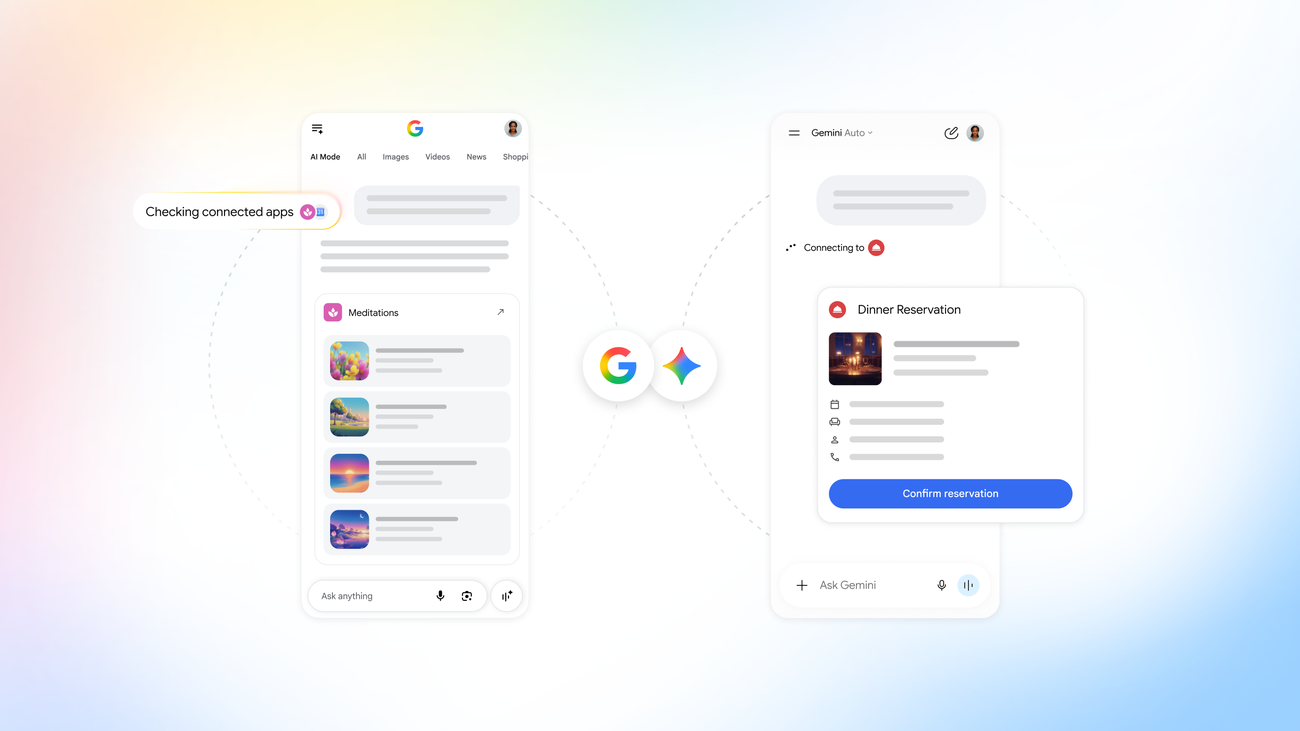
Connected Apps are third-party services that users can link once and then use directly inside Search or the Gemini app. Partners Adobe, Calm, Peloton, Experian and Localiza have Connected Apps. Integrations are live in Gemini and will arrive in Search in the coming weeks, including a new Calm integration across both. Google has launched more than 50 Connected Apps between Search and Gemini, in areas from productivity and event ticketing to health and fitness.
How developers build one
Developers integrate with a cloud-hosted MCP server, or with Android MCP using the AppFunctions APIs. They then register, test and submit the app through the Google Connected Console.
Model Context Protocol (MCP) is an open-standard protocol for connecting tools and authorized data to AI applications. AppFunctions are Android’s MCP solution, letting apps share their functions with agents such as the Gemini app through the Jetpack AppFunctions SDK. The Connected Apps Platform requires OAuth 2.1. That is how the Gemini app gets authorized to interact with a service on behalf of users.
Before review, developers choose whether the app goes live in Search, the Gemini app, or both. Once live, they can track traffic, latency and error rates and keep control of brand identity, including verified logos and authenticated accounts.
Access opens in phases, with more developers, markets and Google products to be added over the coming months.
What publishers and sites can expect as AI answers take over results
On the Q2 call, Pichai said Google was sending billions of clicks to websites every week through its AI features. The Q3 call gave no figure on clicks to websites, so that comparison is missing this quarter.
Outside studies, collected by AIO Copilot, point in one direction:
- Pew Research found people clicked a regular result far less often when an AI summary appeared than when there was none.
- Ahrefs found an AI Overview was associated with a much lower click-through rate for the top-ranked page.
- Seer Interactive measured organic click-through of 2.36% on queries with an AI Overview versus 3.82% without, in February 2026.
Seer also found a counterpoint. On informational queries in 2025, brands cited inside the AI Overview got more than twice the organic click-through of uncited brands.
For site owners, the figures suggest that being cited in the answer is worth more than ranking beneath it. The studies use different methods and periods, so the numbers should not be compared directly with one another.
Because the studies cannot be compared and the Q3 call gave no site-click figure, a site’s own data is the most reliable guide. Google’s free Search Console shows the clicks, impressions, average position and click-through rate a site earns in Search, and comparing periods lets site owners see how their own traffic is moving as AI answers spread.
The rest of the quarter covers cloud growth, heavy spending and new models
Alphabet revenue was $127.6 billion in Q3 2026 versus $102.3 billion in Q3 2025, according to Yahoo Finance. Google Cloud revenue roughly doubled from a year earlier, and the unit was solidly profitable. Management said Cloud capacity is constrained as demand surges and that it is working to bring more online.
Spending and cash flow
Capital expenditure in Q3 was more than double the figure of a year earlier. Free cash flow turned negative. Google has guided to a much larger capex total for full-year 2026, and Ashkenazi said 2027 capex will increase significantly. More detail on 2027 is expected on the Q4 call.
Products and usage
The Gemini app reached one billion users, and Pichai called it the fastest-growing product in Google’s history. First-party model APIs processed nearly 32 billion tokens per minute, up sharply from last quarter and more than 4x a year earlier.
Google announced Genie 4, a world model that simulates interactive worlds with native audio in real time, for training robots and agents. Gemini 4 Carbon is undergoing voluntary testing as recommended by the U.S. Government and will soon be released. Artificial Analysis lists it as the most intelligent model to date, and Pichai called it a meaningful step up from Gemini 4 Argon. He said more models are coming soon, including more efficient versions for developers to optimize speed and cost.
Elsewhere, Waymo now operates in 15 major U.S. cities, and YouTube Music and Premium reached a new subscriber high globally, including trials.
How the merger follows Google’s earlier assistant and agent plans
Google has described what Search brings to AI. It runs trillions of searches every year and returns web pages, maps and real-world information such as inventory at local shops. The Knowledge Graph is its database of more than five billion real-world people, places and things, with a vast number of facts.
Google also licenses content from specialized information providers to show sports scores, stock quotes, weather and film showtimes directly on the results page. Featured snippets, which display a page’s description prominently, are especially helpful for mobile and voice Search. These are the kinds of answers an AI layer can draw on.
The direction was signaled earlier. In May 2025, Demis Hassabis wrote about Google’s dream of building a Universal AI Assistant, with Project Astra now in Gemini Live. Six months before the call, Pichai said in an interview that Search will be an agent manager. The Connected Apps Platform fits that description, since third-party services now work inside Search.
One user-side setting remains unchanged. In some countries Google Search is the default in Chrome, and users can switch to another engine at any time.
Open questions and what comes next
Sources disagree on several details. Alphabet’s share drop is reported slightly differently by Yahoo Finance and SEORCE, by allinvestview.com and, after hours, by AIO Copilot. Basic EPS is $2.14 according to Yahoo Finance, while a 10-Q-based figure is $2.12. Search revenue figures also differ slightly, as SEORCE cites a second, rounded figure from a Marketing Dive reference. Genie 4 is described as announced “yesterday” in a Pichai quote and “last week” by the Search Engine Journal author.
Several rollouts are pending. Connected Apps, including Calm, come to Search in the coming weeks, Connected Apps Platform access widens over the coming months, and AI Mode ads are planned for Brazil, Mexico and the UK in Q4. Gemini 4 Carbon will be released soon after testing. The Q4 call is expected to add detail on 2027 capital expenditures.
Still unanswered are how much AI Mode reduces monetization, when the products fully merge and whether Google will resume reporting clicks to websites.
Sources
- Search Engine Journal
- Google for Developers
- Yahoo Finance
- SEORCE
- allinvestview.com
- AIO Copilot
- support.google.com
- How Search Works
Photo: Search Engine Journal
Frequently asked questions
Are Google Search and AI Mode becoming one product?
Are Google Search and AI Mode becoming one product?
Yes, according to Google executives on the Q3 2026 call. AI Mode, AI Overviews and traditional Search are becoming one unified product, though no timeline was given.
Why did Google Search revenue growth slow in Q3 2026?
Why did Google Search revenue growth slow in Q3 2026?
Growth fell to 12% from 19% in Q1. Schindler named currency as the largest factor, then Asia-Pacific retail advertisers hit by the EU duty-free change, then media and entertainment after a World Cup lift, with AI Mode’s lower monetization third. Lapping late-2025 acceleration cost about three points.
Can advertisers opt out of ads in AI Overviews and AI Mode?
Can advertisers opt out of ads in AI Overviews and AI Mode?
No. Existing Search, Shopping and Performance Max campaigns serve there automatically, and advertisers cannot opt out of these placements separately or target them alone.
Where are ads in AI Mode available?
Where are ads in AI Mode available?
Ads are scaling in Australia, Canada, India, Kenya, Malaysia, New Zealand, Nigeria, Pakistan, the Philippines and Singapore, and extend to follow-on questions in the United States. Brazil, Mexico and the UK are planned for Q4.
What are Connected Apps in Google Search and Gemini?
What are Connected Apps in Google Search and Gemini?
They are third-party services that users can link once and then use directly inside Search or the Gemini app. Google has launched more than 50 of them between Search and Gemini.
Can I change the default search engine in Chrome?
Can I change the default search engine in Chrome?
Yes. In some countries Google Search is Chrome’s default search engine, and you can change your default search engine at any time.