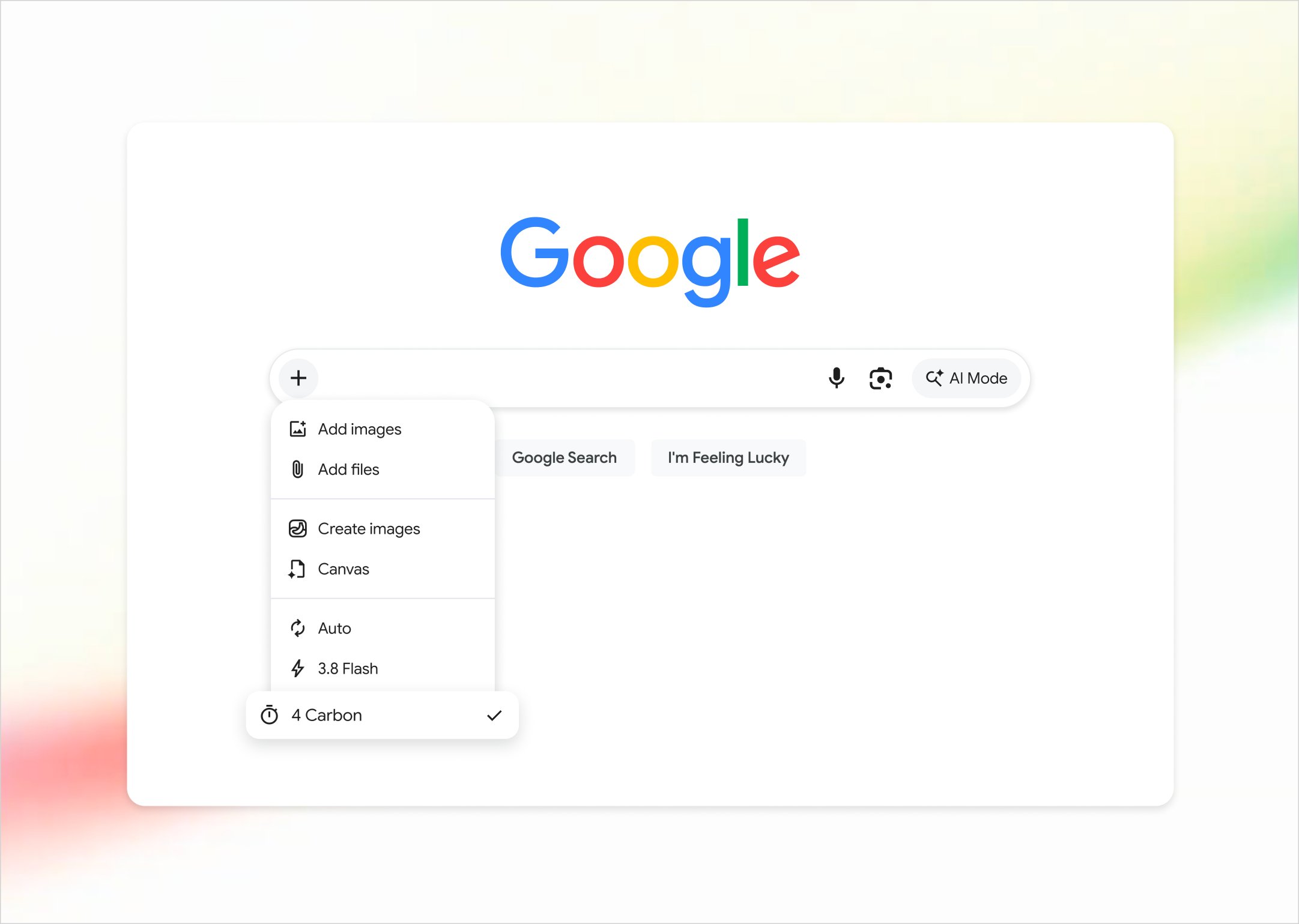
Google has made Gemini 4 Carbon, which it calls its strongest model, available in Search through AI Mode for Google AI Ultra subscribers. According to Google, the model is also rolling out to all Ultra subscribers in Google Antigravity and the Gemini app.
- Paying Ultra subscribers can now pick Gemini 4 Carbon in the Search AI Mode selector. It is also in the Gemini app and Antigravity.
- Carbon scored 59 on the Artificial Analysis Intelligence Index v5.0. That ranks it first, just ahead of Claude Opus 5.5 and GPT-6 Astra.
- Google reports strong results on SEC-bench Pro, ExploitGym and CWE-bench for vulnerability detection, exploitation and patching.
- Introductory API pricing is $2 per million input tokens and $10 per million output tokens, matching Argon. Cached input costs far less.
- The background page dated October 29 showed no public model ID and no context window for Carbon. Reports from November 10 say paying developers can now use it through the paid Gemini API.
Google puts Gemini 4 Carbon in AI Mode for AI Ultra subscribers
Google describes Carbon as its “strongest model with frontier performance in cybersecurity capabilities and long-horizon agentic workflows across complex knowledge work, software engineering, and scientific reasoning.” The company says the rollout covers all Google AI Ultra subscribers in Antigravity, the Gemini app and AI Mode in Search.
Paid subscribers see the Gemini 4 Carbon option in the AI Mode selector in Google Search. For teams that work on Search visibility, that means a new Google model is now part of the AI answer experience that sits next to the classic results.
Robby Stein of Google posted on X that Carbon ships in Search today for members of Google’s AI Ultra plan, with deeper reasoning and better instruction following. Rajan Patel, also of Google, posted that the model better understands user intent, which allows deeper back-and-forth conversations in AI Mode. He said it was rolling out now to Ultra subscribers.
The rollout came two weeks after Google released Carbon to cyber defenders. Google also previewed a swarm feature in Antigravity.
Glenn Gabe, who tested Carbon through the Gemini app early access program, said he used a single prompt to build a version of the Atari 2600 game Pitfall. That is one tester’s account, not a benchmark.
How to reach Carbon in Search, the Gemini app and Antigravity
AI Mode is Google Search’s AI-powered answer experience. For paid subscribers, the model selector inside it shows the Gemini 4 Carbon option.
Google AI Ultra is the paid Google subscription tier that gets Carbon in three places: Search, the Gemini app and Antigravity. Accessing Gemini on Google therefore means choosing Carbon in the AI Mode selector, or using the Gemini app on an Ultra plan.
The rollout also shows how Google uses AI in Search. Carbon is now one of the selectable options in AI Mode. Argon stays available to AI Pro and higher tiers, while Carbon is limited to AI Ultra in the app, and Google has not announced Carbon for AI Pro or free users. The facts available do not say whether people without a subscription will get Carbon in Search.
Early access outside the subscription runs through a separate channel. The Gemini 4 Carbon Fairwind Program is Google’s trusted-partner program for early Carbon access.
The facts available also say nothing about how Search treats AI-generated content, so that question is not answered here.
Here is where Carbon and Argon can be reached today, by surface and tier.
| Surface | Tier | Status |
|---|---|---|
| Gemini app (Carbon) | AI Ultra | Rolling out to all Ultra subscribers |
| AI Mode in Search (Carbon) | AI Ultra | Available in the model selector |
| Antigravity (Carbon) | AI Ultra | Rolling out to all Ultra subscribers |
| Paid Gemini API in AI Studio (Carbon) | Paying developers | Available, per November 10 reports |
| Gemini app (Argon) | AI Pro and higher | Available |
Carbon tops the Artificial Analysis index and leads on security benchmarks
Carbon’s published results fall into two groups, a general intelligence ranking and a set of cybersecurity and coding benchmarks. Most of the figures come from Google and its partners.
General intelligence ranking
The Artificial Analysis Intelligence Index v5.0 is a general AI benchmark that compares models across a broad set of tasks. Carbon scored 59 on it and ranked first, just ahead of Claude Opus 5.5 and GPT-6 Astra. More detail is in the coverage of the Gemini 4 Carbon benchmark results.
For comparison, Artificial Analysis listed Argon at 53 on October 15, before the v5.0 update. The two numbers come from different versions of the index, so the gap is not a like-for-like measure.
Cybersecurity and coding results
Carbon posted high scores on SEC-bench Pro for vulnerability detection, ExploitGym for exploitation and CWE-bench for patching. Google describes the SEC-bench Pro and ExploitGym results as state of the art. These are figures reported by Google and its partners, not independent measurements of everyday use.
| Benchmark | Task | Carbon result |
|---|---|---|
| SEC-bench Pro | Vulnerability detection | State of the art (per Google) |
| ExploitGym | Exploitation | State of the art (per Google) |
| CWE-bench | Patching | High score (per Google) |
| WebDev Arena | Web development | #4 at 1769 (up 89 Elo) |
On WebDev Arena, Carbon gained 89 Elo points to reach fourth place at 1769. Elo is a rating system that ranks competitors by head-to-head results. Fourth place means Carbon does not lead that particular board, even though it leads the general index.
Google says Carbon is safer, more honest and better at secure code
Google claims Carbon excels at finding and prioritizing vulnerabilities and at patching them at the root cause. It also says the model is twice as likely to generate secure code as Argon.
On behavior, Google says Carbon reduces shortcuts and loophole exploitation, boosts transparency and honesty, resists prompt injection and follows through without overstepping. Prompt injection is an attack in which hidden instructions in content try to steer an AI model off its task.
Two benchmark results back those claims. Carbon eliminated successful cheating on Terminal-Bench 4.0, and cheating attempts became rare. It also allowed no successful attacks on Gray Swan’s Indirect Prompt Injection Benchmark.
Outside voices add to the picture. Google’s Chrome team reported that Carbon performed far better than another lab’s large frontier model when generating high quality patches. Cloud security platform Wiz observed Carbon leading on benchmarks for web penetration testing.
Google links the Gemini 4 safety report, which covers Argon’s alignment results, and says Carbon uses the same multi-layer safety stack. The report therefore describes the shared safety design rather than separate Carbon-specific results.
Google is also participating in the U.S. government’s voluntary pre-release model testing process.
Carbon API pricing matches Argon’s introductory rate
Google announced Carbon pricing of $2 per million input tokens and $10 per million output tokens as introductory rates, around October 28, 2026. That matches the introductory price of Argon. Cached input tokens get a steep discount off the input token price.
A token is a small chunk of text, such as a word or part of one, and API pricing is counted per million of them in each direction.
Background pages give a post-introduction price of $4 per million input tokens and $20 per million output tokens. Google has not said how long the introductory period lasts, and one report gives only the $2/$10 figure without a later tier.
Argon’s schedule offers a reference point: $2/$10 through November 30, then $4/$20 from December 1. Whether Carbon follows the same dates is not known.
Developers pay these rates through the paid Gemini API in Google AI Studio. The same per-token price does not mean the same bill per task, though. Carbon reasons longer before it answers, so it can use more tokens on a given job, and its cost per task can rise even at Argon’s rate.
Carbon builds on Argon after a staged release
Koray Kavukcuoglu announced Gemini 4 Carbon on October 28, 2026, according to a background page. It was built on Gemini 4 Argon, which launched two weeks earlier.
Argon is a flagship reasoning model for developers. Its model ID is gemini-4-argon, it has been stable on the paid Gemini API since October 13, and it has roughly a 1M-token unified context.
Google said Carbon illustrates the pace at which it is pushing the frontier forward.
The release was staged. Carbon went first to select cybersecurity defense companies for pre-release testing, then to trusted partners through the Fairwind Program, ahead of wide release. The Search, Antigravity and Gemini app rollout for AI Ultra subscribers is the latest step in that sequence.
The two models differ in what is public. Argon has a model ID, a stable API listing and a stated context size. For Carbon, the background page dated October 29 shows none of these.
Google also separates the work each model should do. Argon remains the preferred choice for most coding and office work. Carbon targets tasks where extra reasoning pays off, such as hard debugging, open-ended scientific research, and legal and finance work that needs higher precision. For most teams that means Argon stays the default, and Carbon is the model to reach for when a problem resists the usual approach.
Developer access and wider release remain open questions
The sources differ on timing, so the dates matter. According to the background page dated October 29, there was no public API or Carbon model ID. The November 10 reports are newer. They describe the rollout in the Gemini app and Search and say paying developers can already use Carbon through the paid Gemini API in Google AI Studio. Where the two disagree, the November 10 reporting reflects the current state of availability.
As of October 29, no context window had been published for Carbon. No newer figure is available.
Two paid channels are open now. Developers reach Carbon through AI Studio, and businesses can use it through Gemini for business. Google will gradually expand availability to additional partners through the Fairwind Program and later to consumers. The reports do not say whether Carbon is available on Vertex AI or which countries the rollout covers.
The open questions are now narrower. Vertex AI availability, the country rollout and the context window are still unannounced, and the reports reviewed here name no Carbon model ID. The introductory price is known, but the length of the introductory period is not.
Sources
Photo: Search Engine Roundtable
Frequently asked questions
How do I access Gemini 4 Carbon in Google Search?
How do I access Gemini 4 Carbon in Google Search?
Paid Google AI Ultra subscribers can pick the Gemini 4 Carbon option in the AI Mode selector in Google Search.
Who can use Gemini 4 Carbon right now?
Who can use Gemini 4 Carbon right now?
Google AI Ultra subscribers, in Search AI Mode, Antigravity and the Gemini app. Trusted partners in the Fairwind Program also have early access.
How much does Gemini 4 Carbon cost?
How much does Gemini 4 Carbon cost?
Introductory API pricing announced by Google is $2 per million input tokens and $10 per million output tokens, with cached input at 95% off. Background pages give $4/$20 after the introductory period, but Google has not said how long it lasts.
What is AI Mode in Google Search?
What is AI Mode in Google Search?
AI Mode is Google Search’s AI-powered answer experience. Its model selector shows the Carbon option for paid subscribers.
Is Gemini 4 Carbon available to developers through the API?
Is Gemini 4 Carbon available to developers through the API?
Not with a confirmed date. As of October 29, the background page listed no public model ID. Google says developers will get access as soon as possible.
How does Gemini 4 Carbon compare with Gemini 4 Argon?
How does Gemini 4 Carbon compare with Gemini 4 Argon?
Carbon is built on Argon and scored 59 on the Artificial Analysis Intelligence Index v5.0, while Argon was listed at 53 before the v5.0 update. Google says Carbon is twice as likely to generate secure code. Introductory pricing is the same.