
Ziff Davis Google referrals fell about 37% year over year in the third quarter, CEO Vivek Shah told analysts on the company’s Nov. 6 earnings call. Shah said the company does not expect a Search recovery and is planning for the decline to continue.
- Organic Google referrals to Ziff Davis properties fell about 37% year over year in Q3, after a 23% drop a year earlier, a two-year decline of more than 50%, according to Search Engine Journal’s report of the earnings call.
- CEO Vivek Shah said the company is “not planning on a search recovery” and expects referrals to keep falling.
- Q3 revenue fell 5.6% to $289.3 million, a smaller drop than traffic because subscriptions and apps do not depend on Google.
- Shah cited about 2.7 billion AI Overviews and AI Mode impressions, nearly 10 times Google Search clicks, but the ratio is not an AI click-through rate.
- A UK regulator deadline of Dec. 3 could force Google to give publishers AI search impressions, clicks and click-through rate.
Ziff Davis Google referrals drop 37% in the third quarter
Organic referrals are visits that arrive from unpaid Google Search results. For Ziff Davis properties, those visits were down about 37% in the third quarter compared with the same quarter a year earlier, Shah told analysts on the call.
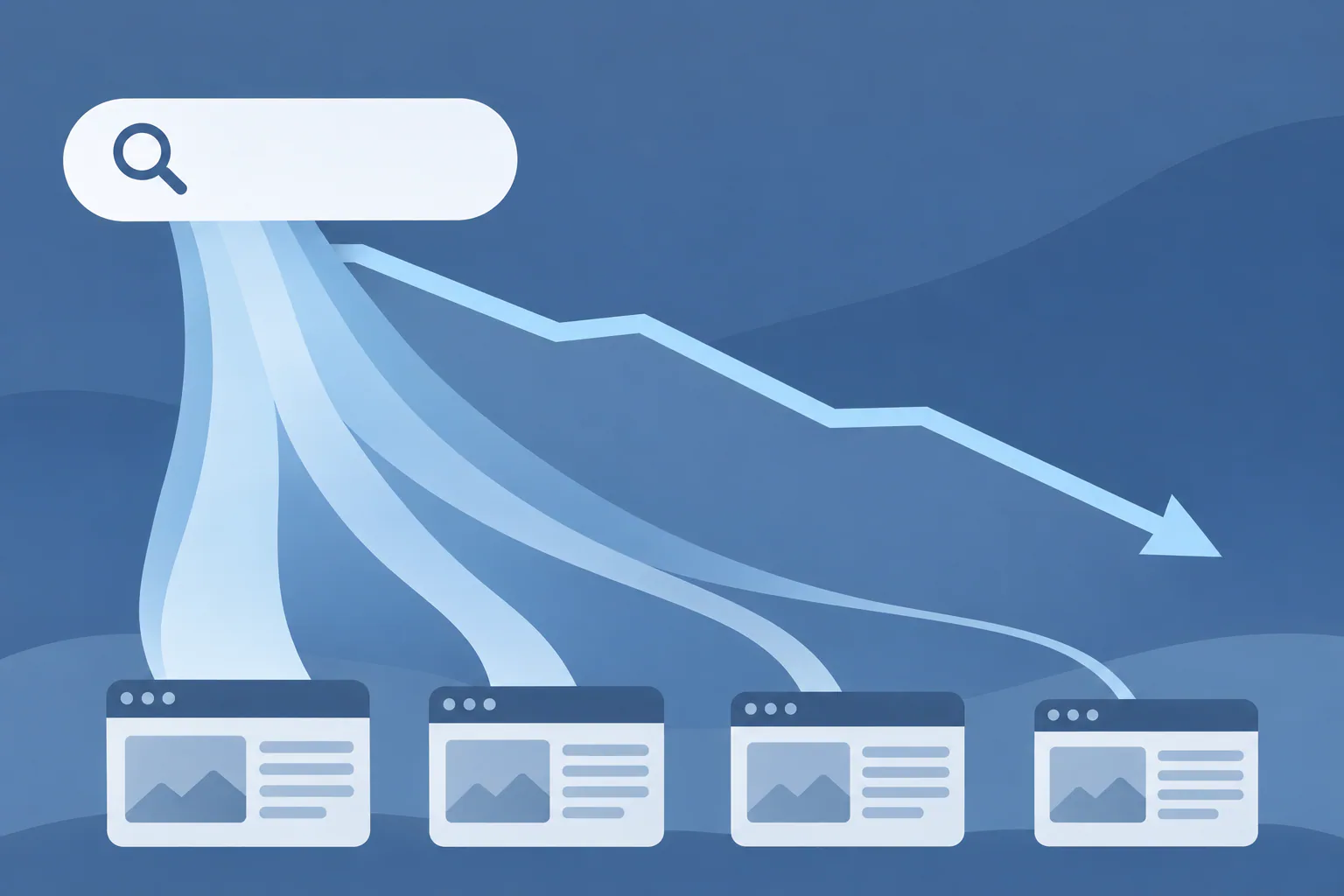
Search Engine Journal reported that the drop follows a fall of about 23% in the same quarter last year. The two declines compound, and together they put the two-year decline in organic Google referrals at more than 50%.
Shah did not describe the number as a temporary dip. He said Ziff Davis is “not planning on a search recovery” and expects referrals to continue declining. The company’s outlook is therefore built on the assumption that Google traffic keeps shrinking rather than returns.
Shah is the CEO of Ziff Davis, a digital media company whose properties depend in part on Search referrals. He made the remarks while speaking to analysts on the quarterly earnings call on Nov. 6.
For publishers and the agencies that work with them, the statement is notable for its source. A chief executive is not hedging about the timing of a rebound; the plan is to operate without one. The facts available do not say which specific changes at Google drove the 37% figure.
Shah did describe the cause in general terms. According to several reports of the call, he called the disruption of search traffic by Google and large language models a clear headwind for the business, and management attributed the shortfall to Google’s changes and to AI-driven content aggregation. He did not name specific Google updates, and his comments do not separate an AI Overviews traffic decline from other shifts in Google Search.
The AI impressions figure and why it is not a click-through rate
Shah also put a number on the company’s exposure to Google’s AI features. Ziff Davis’ digital media sites generated about 2.7 billion impressions across AI Overviews and AI Mode during the quarter. An impression, in this context, means a link to a site was shown, whether or not anyone clicked it.
By Shah’s estimates, that figure was nearly 10 times the clicks those sites received from Google Search. He did not say during the call where his total click figure came from, so the comparison cannot be checked against a published source.
There is also a limit on how the ratio can be read. It sets impressions in AI features against all Search clicks, so it cannot serve as an AI click-through rate. Click-through rate is clicks divided by impressions, and the clicks in this comparison are not AI clicks. The numerator and the denominator come from different pools.
What the figure does show is scale. Billions of appearances in AI answers sit next to a far smaller count of Search visits, which is the context for Shah’s summary of the situation: “there is a gap between usage and monetization.” In his telling, people are using AI answers that draw on publisher content, while the money from that use is not reaching the publishers.
The distinction matters for anyone quoting the number. Cited as “AI Overviews send one click for every 10 impressions,” it would be wrong. Cited as Shah’s own estimate of AI impressions relative to total Google Search clicks, it is accurate, if limited.
How Google’s AI features and reporting tools work
Two Google features sit at the center of the discussion. AI Overviews are Search results features that generate AI answers and can show links to sites. AI Mode is a Google Search feature that also generates AI answers, and in Google AI Mode publishers’ links can appear as well.
Site owners get their data from Google Search Console, Google’s tool for site owners. It includes a generative AI performance report, which counts how often a site’s links appear in Google’s two AI answer features.
What the AI report counts
The generative AI performance report counts the number of times links to a site appeared in either of those AI features. Those AI impressions are a subset of a website’s total Search impression figures, according to Google’s help page. They are not an extra number added on top of normal impressions.
Clicks work differently. Google’s help page says a click on a link within an AI Overview or in AI Mode counts toward a site’s total click count. The click lands in the same total as any other Search click.
What Google does not separate
None of the Search appearance types Google lists for the Performance report includes AI Overviews or AI Mode. As of Nov. 8, Google documents no separate AI click count.
The result is an asymmetry. A publisher can see how often its links showed up in AI features but cannot isolate how many visits those appearances produced. That is the same gap that makes Shah’s ratio impossible to turn into a click-through rate.
Google’s Gary Illyes said the company had nothing to announce yet on adding more data. Earlier coverage of Search Console’s AI report data covers what Illyes signaled about click and query data.
For teams reporting these numbers to clients, the line between what Google counts and what is inferred is practical, not academic. A guide to measured versus estimated SEO data explains how to label each figure, and Shah’s click total, whose origin he did not state, falls on the estimated side of that line.
Revenue fell 5.6% as non-Search businesses cushioned the blow
Third-quarter revenue fell 5.6% to $289.3 million. That is a far smaller decline than the 37% drop in organic Google referrals.
Shah attributed the smaller revenue drop to businesses that do not rely on Google traffic, such as subscriptions and apps. Revenue from those lines did not fall with Search visits, which is why the company’s top line moved far less than its traffic.
The segment figures the company gave show where the pressure is.
| Measure | Q3 change | Figure |
|---|---|---|
| Total revenue | Down 5.6% | $289.3 million |
| Tech and shopping revenue | Down 3.8% year over year | $82 million |
| Gaming and entertainment revenue | Down 2.1% | Not given |
Tech and shopping took the heaviest hit among the segments listed. Shah said those brands “continue to face the strongest search traffic headwinds in our portfolio.”
He pointed to some offsets, citing social commerce and the relaunched RetailMeNot app. He also said the tech and shopping decline has narrowed for three consecutive quarters, so the segment is still shrinking but at a slower rate than before.
The company’s response goes beyond the revenue mix. Management described cost actions that include a headcount reduction planned by the end of the year, and the company continues to fund share repurchases while referrals fall.
Ziff Davis is also putting more weight on video content, social commerce and direct audiences, channels where a visit does not depend on a Google results page. No figures were given for how much of the lost Search traffic these efforts are expected to replace.
IGN and gaming hold up better than other brands
IGN is Ziff Davis’ largest property by Search referrals, and it has continued to hold up relatively well. Shah explained why: its Search referrals are largely around game help, which is very map-heavy and hard to duplicate.
Gaming and entertainment revenue still declined 2.1%. Shah attributed that to a poor gaming advertising environment ahead of the release of Grand Theft Auto VI, which is set for later in November 2026. The decline is therefore tied to advertising conditions in the gaming market rather than to the Search traffic that IGN draws.
The contrast with tech and shopping shows that the Search damage is uneven across the portfolio. In Shah’s account, content that is hard to reproduce in a short AI answer has fared better than content that AI summaries can cover. A walkthrough built around detailed maps is a different product from a summary of a product category.
For publishers outside gaming, the comparison offers a practical lesson: the shape of the content, not only its topic, appears to determine how exposed it is. Ziff Davis did not provide traffic figures for IGN, so the extent of its resilience is not known.
Earlier AI Overview estimates from Shah
Shah has given AI Overview exposure figures before, and they show how the company tracked the feature’s reach.
| When | Share of queries with AI Overviews | Query set described |
|---|---|---|
| November 2025 | 29% | Queries that generate the majority of Ziff Davis’ traffic |
| August | About 50% | Queries relevant to Ziff Davis’ properties |
| Nov. 6 call | Not given | Not applicable |
The August figure was up from about 36% in the previous reading. The two main numbers are described in different terms, one as the queries behind most traffic and the other as queries relevant to the properties, so they are not necessarily a like-for-like series.
On the Nov. 6 call, Shah gave no AI Overview share. The trend therefore cannot be updated for the third quarter, and the 2.7 billion impressions figure is the only AI exposure number from this call.
Site owners reviewing their own data also have to account for reporting oddities, such as the Search Console click spikes some sites have seen, before reading any quarter-level change as a trend.
Licensing, litigation and the UK deadline come next
Shah said making money from Ziff Davis’ content in AI answers is “the priority.” The company is open to licensing agreements, which would pay it for the use of its content in AI products. No partner, price or timetable was given.
He also said the pending Ziff Davis litigation against OpenAI will help clarify the space. The facts available do not give details of the case or a date for a ruling.
Management presents licensing and the OpenAI case as two routes to the same goal, getting paid when AI products use Ziff Davis content. Alongside them, the company is reducing its exposure to Google by spreading distribution across more channels, so that fewer of its visits depend on a single search engine. Taken together, these are its answer to the decline in referrals rather than separate projects.
A regulatory deadline could change what publishers can measure. The UK Competition and Markets Authority set Dec. 3 as the date by which Google must give publishers impressions, clicks and click-through rate for AI search features in the UK.
The CMA’s interpretive notes name Search Console as one example of where that data could appear. Whether Google will use Search Console, and what the data will cover beyond the UK, is not known yet.
If the data arrives, it would address the gap behind Shah’s ratio: publishers would have AI-specific clicks and click-through rates rather than a comparison against all Search clicks. For agencies and content teams, that would turn an estimate into a number Google itself reports, at least for UK traffic.
Until then, the picture so far is referrals falling at Ziff Davis, a company that says it will plan around further declines, and a reporting system in which AI appearances are counted but their clicks are not broken out.
Sources
Photo via Search Engine Journal
Frequently asked questions
Who is the CEO of Ziff Davis?
Who is the CEO of Ziff Davis?
Vivek Shah is the CEO. He spoke to analysts on the company’s Nov. 6 earnings call. Ziff Davis is a digital media company.
How much did Google referrals to Ziff Davis fall?
How much did Google referrals to Ziff Davis fall?
Organic Google referrals fell about 37% year over year in the third quarter, after a roughly 23% drop in the same quarter last year. The two-year decline is more than 50%.
Does Ziff Davis expect search traffic to recover?
Does Ziff Davis expect search traffic to recover?
No. Shah said the company is “not planning on a search recovery” and expects referrals to continue declining.
Can Google AI Overviews clicks be seen in Search Console?
Can Google AI Overviews clicks be seen in Search Console?
Not separately. A click on a link in an AI Overview or AI Mode counts toward a site’s total click count, and as of Nov. 8 Google documents no separate AI click count. The generative AI performance report does count how often links appeared in those features.
What is the UK CMA’s Dec. 3 deadline for Google?
What is the UK CMA’s Dec. 3 deadline for Google?
The Competition and Markets Authority set Dec. 3 as the date for Google to give publishers impressions, clicks and click-through rate for AI search features in the UK.
How did Ziff Davis’ revenue change in the third quarter?
How did Ziff Davis’ revenue change in the third quarter?
Revenue fell 5.6% to $289.3 million. Tech and shopping revenue fell 3.8% to $82 million, and gaming and entertainment revenue fell 2.1%.
What about the stock price, buy advice, careers, subsidiaries and owner?
What about the stock price, buy advice, careers, subsidiaries and owner?
The facts available here do not cover Ziff Davis’ stock price, whether the stock is a good buy, careers, subsidiaries or ownership.