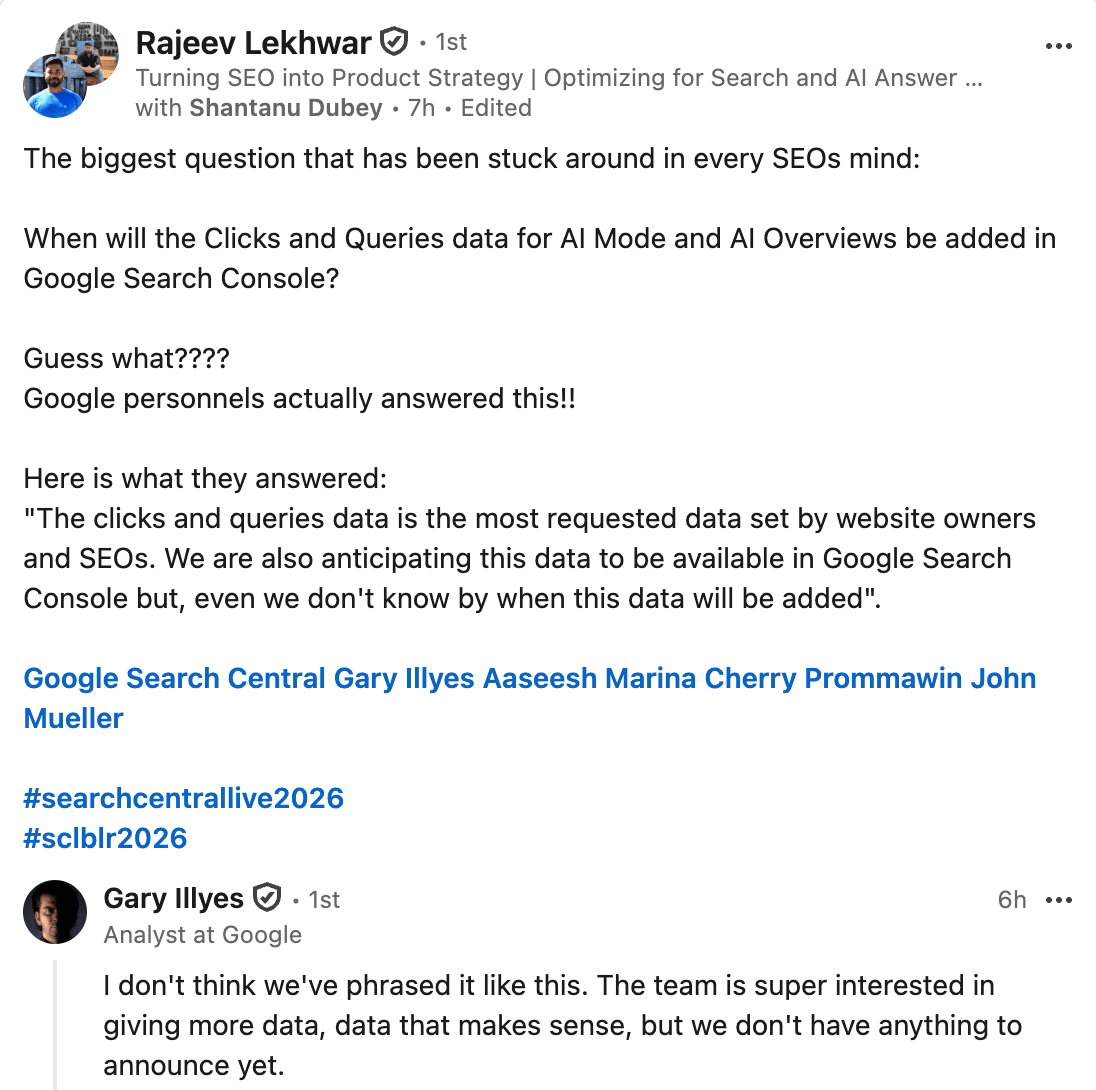
Google’s Gary Illyes has implied that click data and query data are likely not coming to the AI performance report in Google Search Console. He announced nothing, saying only that the team wants to provide more useful data. For site owners and SEOs who have asked for clicks and queries in the report, the remark points away from the metrics they want most.
- Gary Illyes implied that clicks and queries are likely not coming to the Search Console AI performance report, though he announced nothing.
- The Search Console team wants to add more meaningful data, but Illyes did not say that means clicks or queries.
- John Mueller read the comment differently, saying click data might be coming though he doubts it.
- The AI report has rolled out to all websites worldwide, though some properties may not yet have access. It shows impressions by page, country, device and date, but no clicks.
- The UK CMA expects click-through data. It has also set a March 2027 deadline for page-level controls.
Illyes implies click and query data are unlikely in the AI report
According to Search Engine Roundtable, Illyes implied that the AI performance report in Search Console is unlikely to get click or query data.
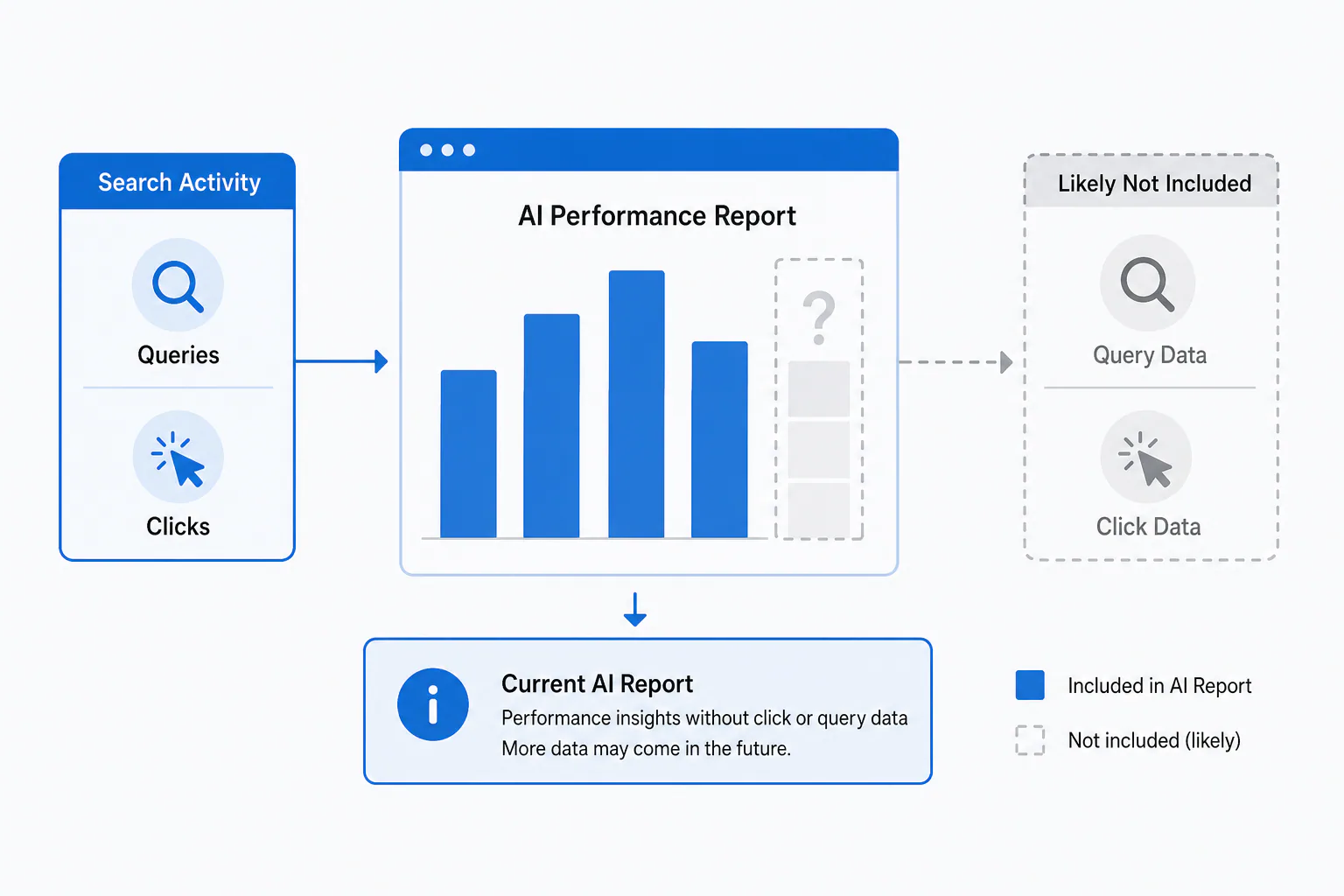
His exact words were: “The team is super interested in giving more data, data that makes sense, but we don’t have anything to announce yet.”
The statement leaves room for interpretation. Illyes wrote that the Search Console team is interested in bringing more sensible data to the report, but he did not say that clicks or query data fall into that category. The implication comes from what he left out and from how he framed the question.
He also questioned whether click data is useful in this context, noting that Google Ads charges most ads on a cost-per-click basis. The comment suggests the click metric carries a different weight in AI features than it does in standard Search results, though Illyes did not spell out the reasoning beyond that observation. How ads in AI Mode are personalized is handled separately, through an exception in Google’s privacy policy.
No commitment, timeline or list of planned metrics came with the remark. What it does establish is that the Search Console team is considering additional data for the report, and that Illyes did not name clicks or queries as part of it.
The LinkedIn post and Mueller’s reading of it
Illyes made the remark in reply to a LinkedIn post. That post quoted an unattributed Googler from a Google Search Central live event, who said click and query data may be coming soon.
The quoted Googler described clicks and queries as the most requested data set from website owners and SEOs. The person said Google anticipates adding it but does not know when.
John Mueller of Google then weighed in on Bluesky. He wrote that reading Illyes’s comment as a sign against click data was weird, so click data might be coming, though he doubts it. His wording is hedged, and it does not amount to a confirmation.
Where the signals diverge
The sources point in different directions. The unattributed quote from the live event and Mueller’s reply suggest click data may arrive eventually. Illyes’s reply points the other way, toward data that “makes sense” without naming clicks. Because the live-event speaker is not identified, the weight of that quote is hard to judge against a named Google engineer.
Taken together, the statements do not settle the question. Nothing in them is an official product decision.
What the Search Console AI report shows
Google announced the Search generative AI performance reports in Search Console on June 3, 2026, according to Google for Developers. They come with dedicated views for Search and for Discover.

The reports show impressions within AI Overviews and AI Mode, and within generative AI features in Discover. Impressions can be broken down by pages, countries, devices (Search only) and dates. Date data is available with hourly, daily, weekly and monthly granularity.
According to Google’s support documentation, the report includes two Search types: web text and web multimodal. The multimodal type covers Google Lens, Circle to Search and image uploads.
AI Overviews and AI Mode are counted together in the same figures. The report does not split them, so you cannot tell whether a page earned its impressions in an AI Overview or in an AI Mode conversation. The Search Console AI report also covers only Google’s own AI features. Answers from ChatGPT, Perplexity, Claude or Gemini that mention or link to your site are not included, so it measures visibility on Google, not AI visibility as a whole.
Rollout
Google said at launch that the reports would reach a subset of websites first, for testing and feedback. On August 31, 2026, Google stated that the insights had rolled out to all websites worldwide, though some properties may not yet have access, as Search Engine Journal reports.
The gap between “all websites” and “some properties may not yet have access” matters for anyone who opens Search Console and finds no report. Access can still lag behind the announcement.
| Item | In the AI report |
|---|---|
| Surfaces | AI Overviews, AI Mode, Discover generative features |
| Search types | Web text, web multimodal |
| Breakdowns | Pages, countries, devices (Search only), dates |
| Date granularity | Hourly, daily, weekly, monthly |
| Clicks | Not included |
| Queries | Not included |
| Average position | Not included |
How impressions and the AI control work
In the generative AI report, an impression counts how many times links to a site were shown to a user in a generative AI feature on Google Search. It is a count of exposure, not of visits.
Sites without enough AI impressions may not see the report at all. That is one reason a property can show nothing even after the worldwide rollout.
Clicks sit in a different report
Search Console’s standard performance report already shows clicks, impressions and position for Google Search, per Search Console’s own overview. The AI reports, by contrast, include no clicks and therefore no CTR or AI click-through figure, according to Search Engine Journal’s reporting.
That split means the two reports answer different questions. The AI report says how often a site’s links appeared in AI features, without clicks or average position. The standard report remains the place for both.
The Search generative AI control
Separately, Search Console offers the Search generative AI control. It is a property-level setting that excludes a site’s links and content from AI Overviews, AI Mode and generative AI features in Discover.
Google says the opt-out setting is not a ranking signal elsewhere in Search and does not affect AI training. Training is governed by a separate control, Google-Extended, according to Search Engine Journal. Opting out of the AI features therefore does not change how Google-Extended is handled, and the reverse also holds.
The control applies per property, so owners who run several sites set it for each one individually.
What the missing click data means for site owners and SEOs
Impressions alone cannot show what AI appearances are worth in traffic, and without clicks there is no way to calculate a true click-through rate. A site can be shown often in AI Overviews and still receive few or many visits, and the AI report cannot tell the two cases apart.
For now, owners who want to check visits must rely on the standard performance report for clicks. Comparing the two reports gives a rough picture of exposure and traffic, but they are separate datasets, and AI impressions cannot be matched to clicks one to one. Anyone reporting AI visibility to clients should label AI impressions as impressions and not imply a traffic figure.
Clicks from AI links do not disappear. They still show up in the standard web report, mixed in with clicks from regular results, and that report gives no way to separate them. The practical approach is to read the two reports side by side by page and date. If a page’s AI impressions climb in a given week, check whether its clicks in the standard report and its landing-page sessions in your analytics tool moved too. Pairing the AI impressions with separate analytics in this way gives an estimate of the traffic AI features send, not a measured figure, so the caution about one-to-one matching still applies.
For comparison, Microsoft’s Bing Webmaster Tools already offers an AI performance dashboard, which shows how far Google’s reporting trails on this point.
Google said at launch that it would keep working with website owners on additional metrics over time. That statement is general and names no metric. Teams tracking Search Console report changes will want to watch for any new fields in this report.
Regulatory pressure from the UK CMA
Regulation adds a second track. On June 3, the UK Competition and Markets Authority (CMA) issued a conduct requirement that requires Google to let websites opt out of AI Search features without penalty in standard results. The date matches the launch of the AI reports.
By March 2027, Google must introduce page-level controls for generative AI features, under the CMA’s deadline. The current opt-out works at the property level, so page-level controls would be a more granular option.
According to Search Engine Journal, the CMA also expects click-through data. That expectation stands in contrast to Illyes’s doubts about click data, and the two have not been reconciled publicly. Whether the CMA’s expectation translates into a Search Console metric is not clear from the available information.
Google must also report on compliance every six months during the first year, per Search Engine Journal. Those reports could offer further detail on what Google plans to provide, though their contents are not known.
What to watch next
Google has announced no date for click and query data in the AI report. Illyes said there is nothing to announce yet.
Two items are worth tracking. The first is the March 2027 CMA deadline for page-level controls, along with the six-monthly compliance reports. The second is any new metric Google adds to the AI report, since the company has said it will keep working with site owners on additional metrics over time.
Sources
- Search Engine Roundtable
- Google for Developers
- support.google.com
- Search Engine Journal
- search.google.com
Photo: Search Engine Roundtable
Frequently asked questions
Will click and query data come to the Search Console AI report?
Will click and query data come to the Search Console AI report?
Unclear. Illyes implied it is likely not coming but announced nothing. An unnamed Googler at a live event said it may come, and Mueller said it might, though he doubts it. No date has been given.
What does the Search generative AI performance report show?
What does the Search generative AI performance report show?
It shows impressions in AI Overviews, AI Mode and Discover generative features, broken down by pages, countries, devices (Search only) and dates, with hourly, daily, weekly and monthly granularity.
What is the Search generative AI control?
What is the Search generative AI control?
A property-level Search Console setting that excludes a site’s links and content from AI Overviews, AI Mode and generative AI features in Discover.
Does opting out affect rankings or AI training?
Does opting out affect rankings or AI training?
Google says the opt-out is not a ranking signal elsewhere in Search and does not affect AI training. Training is governed separately by Google-Extended.
Why can’t I see the AI report in Search Console?
Why can’t I see the AI report in Search Console?
Google said on August 31, 2026 that the report rolled out worldwide, but some properties may not yet have access. Sites without enough AI impressions may also not see it.
Where can I still see clicks for my site in Search Console?
Where can I still see clicks for my site in Search Console?
In the standard performance report, which shows clicks, impressions and position for Google Search.