
Secondary keywords in SEO are the supporting terms an article covers alongside its main target: subtopics, questions and close variants a reader expects on the same page. Pull candidates from the live results and a tool, keep those that share the primary intent, and give each one a section.
Most writers can name their main term and then guess at the rest. The guessing shows: one phrase repeats in every heading, or loose terms land in paragraphs that never address them. Well-chosen secondary keywords for SEO decide whether a page covers its topic.
What Are Secondary Keywords in SEO?
Secondary keywords are the supporting search terms a page targets alongside its main term. They are subtopics, questions and close variants with the same intent, so covering them makes the page a fuller answer. The primary term says what the page is about; the others say what a full answer includes.
A plain definition with one example
Take an article targeting "how to clean a cast iron skillet." People who search that also search "can you use soap on cast iron" and "how to remove rust from cast iron." Those phrases are secondary keywords: different words, same reader. Answering each in its own section can earn ranking for them too.
Primary vs secondary keywords: the roles on a page
The two types do different jobs on a page:
| Primary keyword | Secondary keywords | |
|---|---|---|
| How many | One | Usually five to eight |
| Where it goes | Title tag, H1, meta description, first 100 words | H2 or H3 headings, the opening of a section |
| What it defines | The intent and the results page you compete on | The subtopics a complete answer must cover |
Your ranking target is the primary term. The secondary terms widen the set of searches that the same page can answer.
Where long-tail and related terms fit
A long-tail keyword is a longer, more specific phrase with fewer searches. Many secondary terms are long-tail versions of the primary. On a well-built page, the head term and the long tail balance out on their own: the title carries the broad phrase and the sections carry the specific ones.
Related keywords form a wider pool that includes synonyms, entities and neighboring topics. Not all of these related keywords become secondary terms. A secondary term is a related phrase you deliberately assign a section to. The rest show up naturally in a thorough answer.
A Decision Rule: Is This Term Primary or Secondary?
A term is secondary when it shares your primary keyword's intent and fits inside one section. It is primary when it needs a page of its own to be answered properly. Three questions turn that into a test you can run on each candidate in about a minute.
Three questions to ask about any candidate term
- Would someone searching this term be happy landing on your planned article? If they want to buy, compare or troubleshoot and your article explains, the answer is no.
- Can you answer it fully in one section? A few paragraphs or a short list is a section. If the term needs its own steps, table and FAQ, it is too big.
- Do its top results overlap with your primary's? Search both terms. If several of the same pages appear for each, search engines treat them as one topic.
Three yeses make a term secondary. A no on the first or third question means it belongs on a different page or on none. A no on the second question alone means the term is strong enough for its own article, which you can link to from a short mention.
When a term deserves its own article instead
The third question gives the clearest signal. "Cast iron vs stainless steel" sounds close to a cleaning article, but its results are comparisons, so that searcher wants a verdict. Squeezing it in adds a half-answer and gives up a page that could compete for the comparison.
Splitting topics also prevents keyword cannibalization, which happens when several pages of your own target the same searches. They compete with each other, and often neither earns the ranking one focused page would. That is why this article exists on its own: choosing secondary terms is one step in writing an SEO article.
How to Find Secondary Keyword Candidates in 5 Steps
To find secondary keywords SEO articles need, pull candidates from the live results, add suggestions from a tool, filter them by intent, check the numbers lightly and keep only the terms that add something new. These steps take you from a raw list to a short one.
Step 1: Pull related terms and questions from the live results
Search your primary keyword in a private window so history doesn't color the results. Write down every People also ask question, the related searches, the "people also searched for" box and the H2s of the top pages, plus autocomplete suggestions and close synonyms. These related keywords come from real searches.
Step 2: Collect suggestions from a keyword tool, free or paid
Google Keyword Planner is free with a Google Ads account and shows volume as ranges. For an existing page, the Search Console queries report is free too. Paid tools such as Semrush and Ahrefs return longer lists of related keywords with difficulty scores. Paste everything into one spreadsheet column.
Step 3: Check search intent against your primary keyword
Run the three questions on every row and mark each term "same," "different" or "unsure." Delete the "different" rows now. For each "unsure," look at the term's first results. That settles most keyword research doubts in seconds.
Step 4: Compare volume and difficulty without chasing numbers
A secondary term doesn't need high volume, because it rides on a page that exists for the primary. A low-volume question in People also ask and on several top pages beats a popular term with mixed intent and a harder ranking fight. Use difficulty only to spot outliers among related keywords.
Step 5: Keep the five to eight terms that add a new angle
Start by merging variants: plurals, reordered words and synonyms count as one term. Then ask whether each remaining term adds a question the article wouldn't cover otherwise. Keep the five to eight that do, as good keyword research ends in a short list. If you can't picture a term as a heading, drop it.

How Many Secondary Keywords Per Page, and Where to Place Them
No fixed count or density earns a reward, but a usable rule answers how many secondary keywords should I use per page: one term for each section that genuinely needs one. For an article of 1,500 to 2,000 words with six or seven sections, that usually comes to five to eight terms, and your keyword research shows which sections qualify. Word count should come from the query too, so settle the right article length for its intent before you count sections.
A rule of thumb based on sections, not a density target
Count sections, not percentages. Density targets date from when engines matched exact strings and now push writers toward repetition readers notice. Plan the outline first, then see whether each H2 or H3 has a natural term. An introduction or short closing often won't, and that's fine. A SERP-based article outline template gives you headings that already match what the top results cover.
Placement: title, headings, intro and body
Each kind of term has its spot on the page:
- Title tag and H1: the primary keyword, near the start. Add a secondary term only if the title still reads well.
- Meta description: the primary term, plus one secondary term if it fits naturally.
- Introduction: the primary term within the first 100 words, in whatever form the sentence needs.
- H2 and H3 headings: each secondary term goes in the heading of the section that answers it, phrased the way readers say it.
- Body: the term goes in the first sentence or two of its section. After that, use pronouns and synonyms.
Keyword stuffing: signs you have gone too far
Watch for these signs in your draft:
- the same phrase in every heading;
- headings that read like search queries, such as "cast iron skillet clean soap";
- a term placed in a paragraph that doesn't answer it;
- FAQ questions nobody asks, written only to hold leftover terms;
- sentences that sound odd when you read them aloud.
The fix is always the same. Rewrite for the reader, then check that each term still appears once, where it belongs. Run that check as part of a full editing checklist before you publish, alongside readability and on-page basics.
A Worked Example: One Primary Term and Five Secondary Keywords Mapped to Headings
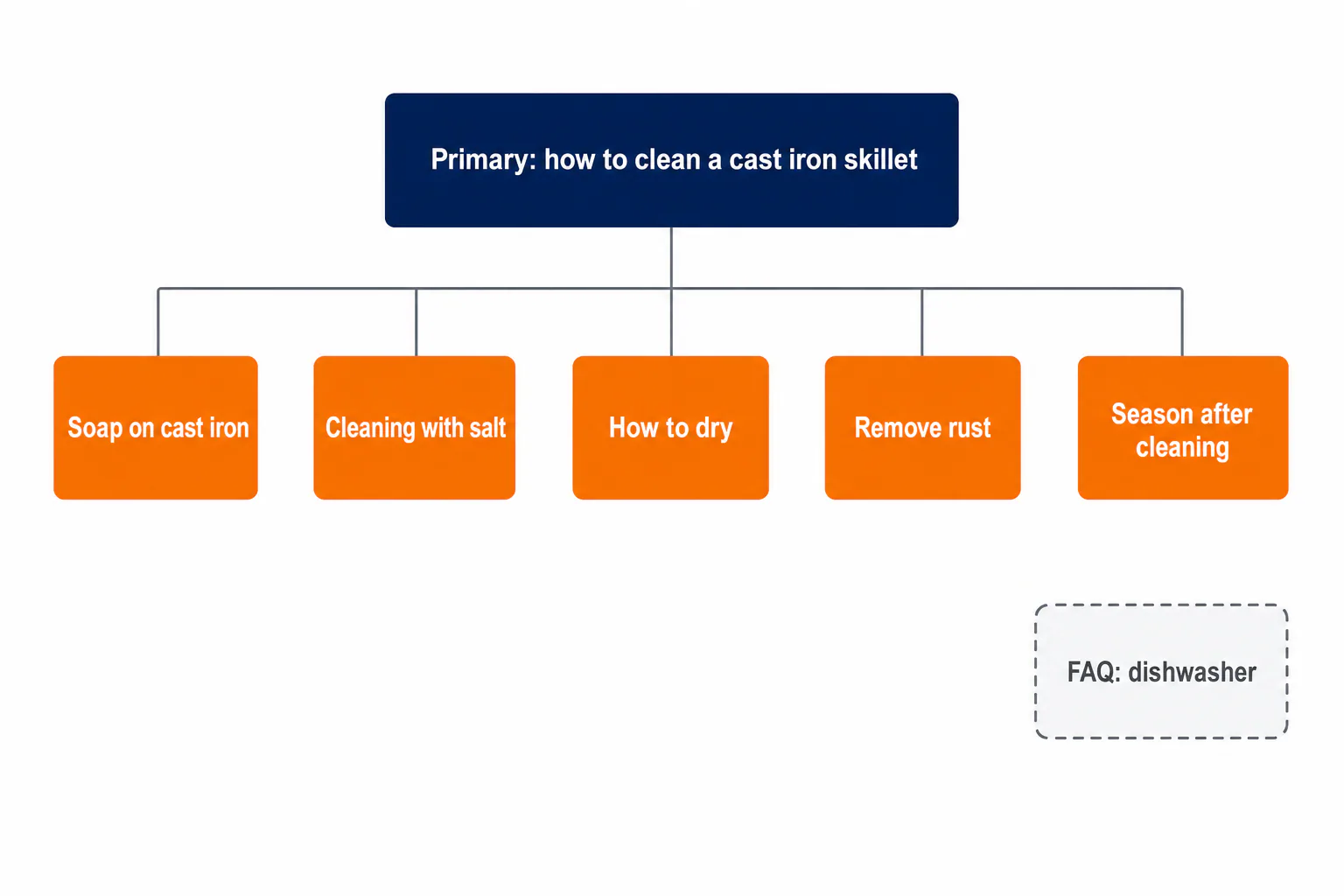
Here is the whole method applied to one illustrative article. The primary keyword is "how to clean a cast iron skillet," an informational how-to query, and the goal is five secondary terms, each tied to a heading.
The candidate list and what got cut
Steps 1 and 2 of the keyword research produced eleven candidates. Five passed every check: the soap question, "cleaning cast iron with salt," "how to dry cast iron," "how to remove rust from cast iron" and "how to season cast iron after cleaning." Six were cut, each for a reason:
- "cast iron skillet cleaning" and "clean cast iron pan": rewordings of the primary, so they were merged.
- "best cast iron skillet": commercial intent, which belongs on a buyer's page.
- "cast iron vs stainless steel": the results are comparisons, so it gets its own article.
- "how to season a new cast iron skillet": seasoning from scratch is a separate task with different top results, so it gets a short mention and its own page.
- "can you put cast iron in the dishwasher": it passed all three questions, but the answer is one line, so it moved to the FAQ.
The final outline with each term mapped to a section
The table maps each heading to the term it carries and the job it does:
| Heading | Term it carries | What the section answers |
|---|---|---|
| H1: How to Clean a Cast Iron Skillet Without Ruining It | Primary keyword | The short routine, in two sentences |
| H2: Can You Use Soap on Cast Iron? | can you use soap on cast iron | When soap is fine and what really harms the surface |
| H2: Scrubbing Stuck-On Food With Coarse Salt | cleaning cast iron with salt | The salt scrub, step by step |
| H2: How to Dry Cast Iron So It Stays Rust-Free | how to dry cast iron | Towel drying and heat drying |
| H2: How to Remove Rust From Cast Iron | how to remove rust from cast iron | Fixes for light and heavy rust |
| H2: Oiling and Seasoning After Each Cleaning | how to season cast iron after cleaning | A thin oil coat, plus a pointer to the full seasoning guide |
| H2: FAQ | can you put cast iron in the dishwasher | A short, direct answer |
The order follows the reader's task, not the keyword list. Rust removal comes after drying, because a reader who dries the pan properly may never need it.
When Secondary Keywords Are Unnecessary or Hurt Readability
Secondary keywords in SEO help when a topic has real subtopics. They are unnecessary when it has none, and they hurt when they pull the text away from what the reader asked.
Cases where one topic needs no extra terms
Some pages answer one narrow question: a short definition, opening hours, a product spec sheet or a brief news update. If every candidate is just the primary reworded, there are no related keywords with extra angles. Forcing terms into a 400-word answer only makes it longer.
Why LSI keywords are the wrong mental model
LSI stands for latent semantic indexing, an old document-retrieval technique. "LSI keywords" became shorthand for scattering synonyms through a page. Modern search doesn't read text that way, and no page needs a hidden word list. Synonyms and related terms are worth using because they help readers. "Semantic terms" is a better label.
How search engines judge topical depth and intent today
Search engines match meaning, not strings. So do secondary keywords SEO writers choose help rankings? Yes, indirectly: they remind you to cover what searchers expect. The Search Console queries report often lists searches missing from your outline, useful for the next round of keyword research and for finding more related keywords.
For your next draft, run the three questions on your candidates before outlining and give each survivor a heading. RankFlow is a single workspace for SEO content covering keyword research, content plans and Search Console reporting, with numbers labeled as measured, calculated or estimated.
Frequently Asked Questions
What is the difference between primary and secondary keywords?
What is the difference between primary and secondary keywords?
The primary keyword is the one search a page is built to win. It sets the intent and goes in the title, the H1 and the introduction. Secondary keywords are the supporting searches the same page also answers, each in its own section. A page has one primary keyword and several secondary terms, and every secondary term must share the primary's intent.
What are the SEO keywords?
What are the SEO keywords?
SEO keywords are the words and phrases people type into search engines that a page is written to match. They range from short head terms like "cast iron" to long, specific questions. In practice, the phrase usually means the list that keyword research produces: one primary target for each page and the terms that support it.
What are three keywords?
What are three keywords?
The phrase usually refers to three types grouped by length: short-tail (one or two broad words), mid-tail (two or three words with a clearer topic) and long-tail (longer, specific phrases with fewer searches). Some writers use it for the three roles in an article plan instead: primary, secondary and long-tail. Most pages mix all three.
Can a beginner do SEO?
Can a beginner do SEO?
Yes. The basics don't require a technical background. Pick one primary keyword per page, check what already holds a top ranking for it, answer the search better than those pages and keep the text easy to read. Choosing secondary terms with the three-question test is a good first skill because it improves every article you write.
What is the 80/20 rule for SEO?
What is the 80/20 rule for SEO?
It's the Pareto principle applied to search: a small share of your pages, terms and tasks usually brings most of the results. For content, that means updating the articles that already earn impressions before writing many new ones. It also means planning a few secondary terms that add real angles instead of long lists. Treat it as a habit for setting priorities, not a measured law.