
Knowing how to explain SEO results to clients comes down to one habit: translate every number into the outcome the client cares about (calls, orders, leads) and treat rank figures as supporting evidence in client reports. Clients ask "where do we rank?" because a list spot is a number they already understand.
Below you'll find the timeline conversation to have before the first report, a plain-English script, a five-step method for how to explain SEO results to clients in each report, the metrics to pick for each type of client, a worked example and the wording for a bad month.
Why clients ask for rankings and what they really want to know
Clients ask for a rank because a spot in the list is easy to check and compare, not because it's what they need. Underneath is almost always a question about money, competitors or proof to pass on. Every client SEO conversation starts there.
Rankings feel like a scoreboard
A ranking looks like a sports score: one number, lower is better, and anyone can check it. Many clients also inherited the habit from a previous agency whose monthly SEO report opened with a table of positions, so they assume that table is what SEO performance means.
The question behind the question: is this bringing business?
When a business owner asks where they rank, the real question is usually one of three. Is the money working? Are competitors getting my customers? Can I tell my partner this is going well? A position answers none of them; booked jobs, orders or demo requests show real performance.
Say it out loud on your next call: "I think what you're really asking is whether this brings in work. Let me show you that first, then where you rank." Any agency account manager can use it with an SEO client, and the conversation usually shifts within a minute.
Why a single rank misleads (personalization, location, volatility)
A rank isn't one fixed number. Google adjusts what it shows by the searcher's location, device and history, and by maps, ads, product grids and AI overviews around the organic links. A client checking from their office sees something different from a customer across town.
So when the client searches their own keyword, finds the website at spot 6 while your report said 3, both can be true. Unexplained, it looks like a mistake. Use keyword rankings to show direction across a group of terms, and let business performance judge your efforts.
Set expectations on timeline before the first report
The timeline talk belongs in the kickoff, not in the third monthly report when the client is already nervous. Agree on what "progress" looks like in each phase of the SEO strategy, tie it to the client's goals and business goals, write it down, and refer back to it every month.
What to tell clients about how long SEO takes to pay off
When you explain SEO progress to clients, start with the fact that SEO compounds: early months mostly show completed work and leading signals, while conversions arrive later. Tell them: "First Google shows your pages more often, then more people click, then more get in touch." Never promise a date for a keyword.
A simple milestone map: first month, third month, sixth month
Here is a milestone map you can agree on at kickoff and paste into your SEO report template, so all client reports show where the project stands. Any report template works if it keeps this map on top, and it makes performance easy to read:
- First month: audit finished, priority technical fixes started, tracking checked so calls, forms and sales are recorded as conversions, and a baseline written down. Good looks like: everything that matters is measured.
- Third month: target pages appear more often in search, new ones are indexed and showing for longer keyword variations, first clicks arrive. Good looks like: Google shows the site more.
- Sixth month: clicks and enquiries from organic traffic trend up against the baseline, and it's clear which ones earn and which need work. Good looks like: business numbers are moving.
Each milestone names what "good" means, which is the part clients remember. Write the goals in the client's own numbers (their call volume, their order count), not in generic benchmarks, so performance insights mean something to them.
What to say when the client expects fast change
Don't argue, and don't overpromise. Fixing a broken contact form, adding a missing location URL or unblocking an unindexed service can show an effect soon on your website; competitive terms take longer. Say plainly: "SEO builds, ads rent. If you need calls this week, paid Google search ads are the right tool."

A plain-English script for explaining SEO to non-technical clients
When you explain SEO to clients who are non-technical, they don't need to understand how search engines work; they need one picture that connects your work to their customers. An analogy, a short list of swapped words and a rehearsed script do most of the job.
An analogy that makes organic traffic and rankings easy to grasp
The shop analogy works for almost everyone. The website is a shop. Google is the city's map and signposts. Rankings are where the shop appears on those signposts. Organic traffic is people who walk in without a paid flyer, and conversions are people who buy or book.
A keyword is the search phrase a customer types into Google, such as "emergency roof repair near me". In the shop picture, it is the street the customer asks about before choosing which signpost to follow.
Search engine optimization, in this picture, is making the shop easier to find, easier to recommend and worth walking into. The analogy also shows why a signpost position alone isn't the goal: a shop on a busy street that nobody enters makes no money.
Words to avoid and the plain version to use instead
The table below swaps the terms that most often lose a client for the version they'll understand on first hearing:
| Avoid | Say instead |
|---|---|
| Impressions | How many times Google showed your pages to people searching |
| CTR | How many of those people clicked |
| Backlinks | Other sites recommending yours with a link |
| Crawl budget, indexation | Whether Google has found and filed your pages |
| Domain authority | A third-party estimate of how trusted the site looks (not a Google number) |
| SERP | The Google results page |
| Bounce rate | People who left after seeing one page |
A 30-second script you can adapt
Keep the order and change the brackets. It works on a call, at the top of an email and as the opening of a report:
"This month more people found you on Google without ads: [clicks] visits compared with [last year's figure]. More importantly, [number] of them called or filled in the form. Most of that came from [the pages we worked on]. Next month we're doing the same for [next service]. What we need from you is [one thing]."
What changed, what it brought, why, what's next, what you need. An agency team can turn that into a fixed rule for every account manager, so a client hears the same structure in all client reports, whoever writes up the data and the SEO metrics. A good agency treats this structure as part of its service.
How to explain SEO results in 5 steps
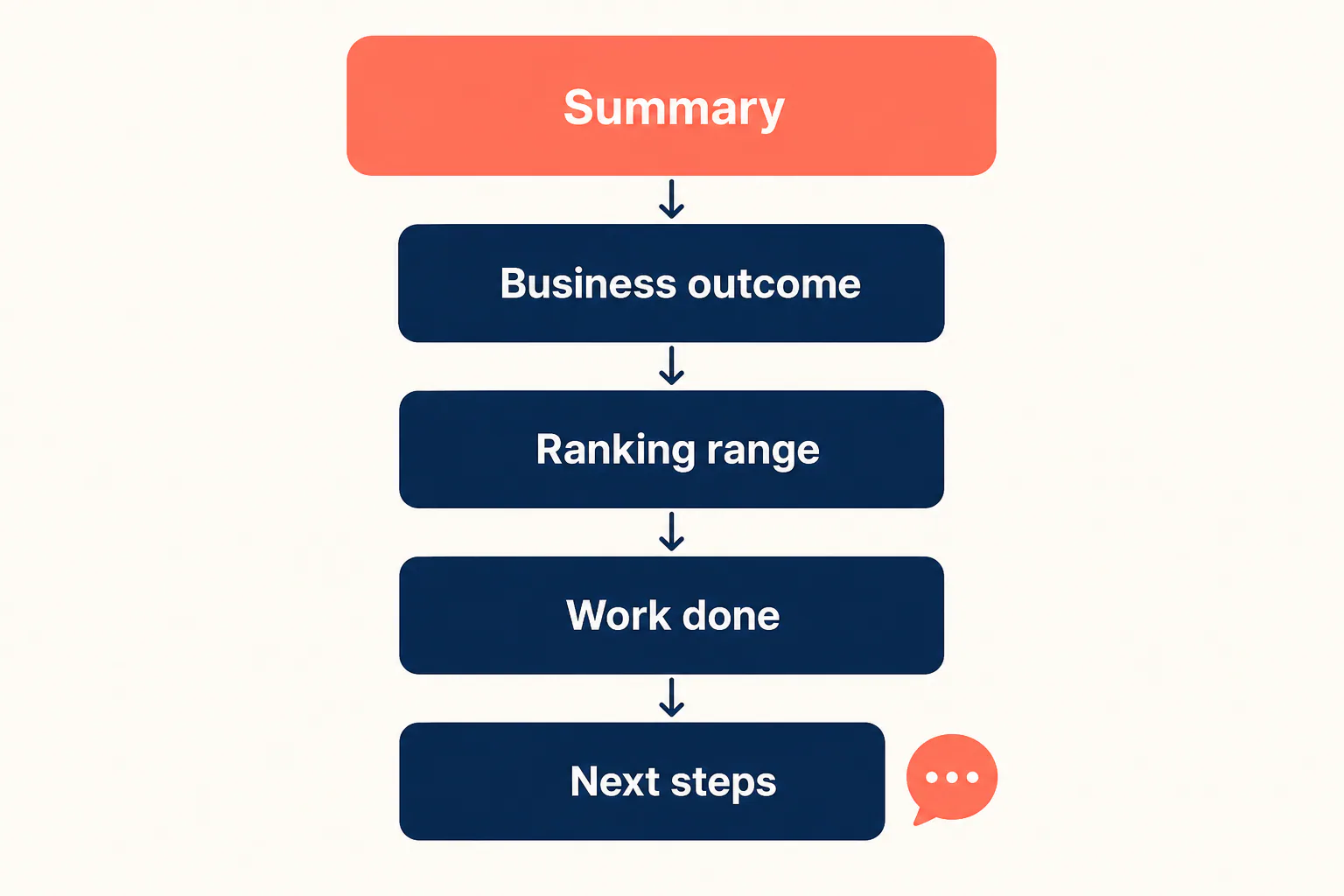
A strong report reads like a short memo with evidence attached, not a dashboard export. These five steps show how to explain SEO results to clients by turning the data you already have into insights they can act on, whether you run an agency or work in-house, and whether the client sees your efforts as clearly as the outcomes.
Step 1: Open with a one-paragraph summary of what changed
Write three sentences before any chart: the headline outcome, the main reason, the next move. For example: "Quote requests from Google rose this month, mostly through the kitchen renovation service. Brand searches also grew. In November we'll publish the bathroom content."
Mark milestones directly on the trend chart: a content launch, a technical fix or a confirmed algorithm update, each with its date. Move the full raw data into an appendix so the summary layer stays short.
Step 2: Tie each metric to a business outcome
Every number gets a "so what". Clicks from organic search went up: more potential customers saw the service pages, and conversions followed. If you can't write a "so what" for a metric, drop it. Link each line to the goals agreed at kickoff, so progress is measured against the client's targets.
Step 3: Show rankings as a range, not a single position
Group tracked terms into buckets (positions 1-3, 4-10, 11-20) and show movement in keyword rankings. Search Console impressions and analytics sessions can diverge, so a URL can hold a top spot and still send fewer visits. An AI answer above the listings can be the reason; name the affected queries.
Step 4: Explain the work you did and why it matters
List the work done this period, each item with its reason. "Rewrote the emergency repair copy because it appeared often but few people clicked." "Fixed the mobile menu because phone visitors couldn't reach contact details." Reasons show judgment and tie the work to performance.
Step 5: Close with next steps and what you need from the client
End with two or three planned actions and anything blocked on the client: draft approval, product photos, call-tracking access, a push for reviews. A report that ends with a request gets replies; one that ends with a chart gets filed. A reusable template keeps this closing consistent for each client SEO account.
Which metrics to show each type of client
Pick metrics by how the client makes money: the outcome first, then the two or three SEO metrics that lead to it. That also answers how to explain SEO results to clients: present the outcome they track and use search data to explain why it moved. Each SEO client needs a different strategy.
The table shows a starting set for four common client types:
| Client type | Lead with | Supporting signals |
|---|---|---|
| Local service | Calls, direction requests, local leads | Map pack visibility, profile views, location page clicks |
| E-commerce | Organic revenue and orders | Clicks to product and category pages |
| Lead generation and B2B | Form fills, qualified leads | Traffic to service and comparison pages |
| Brand-focused | Branded search growth | Impressions, non-branded reach |
Local service business: calls, direction requests and local leads
A plumber or dental clinic cares about the phone ringing. Report calls and direction requests from the Google Business Profile, form fills from location pages and how often the business appears in the map results for its core services. A client like this rarely needs a keyword table at all.
E-commerce: organic revenue and product page visibility
Lead with revenue and orders from organic search, taken from analytics with e-commerce tracking turned on. Then show which categories and product pages gained or lost clicks and traffic, and flag out-of-stock items that still attract visits, because that's lost money the client can fix with simple optimization.
Lead generation and B2B: form fills and qualified leads
Form fills are the floor; qualified leads are the point. Ask the sales team or CRM owner which organic leads became real opportunities, and report those as conversions. Sales cycles are long, so show a rolling quarter next to the monthly number to keep a slow month in perspective.
Brand-focused clients: branded search and impressions
For clients who invest in awareness, show how many people look for the brand name (queries containing it in Google Search Console) and how often the website appears for non-branded topics. Rising branded queries suggest the wider marketing is working, and SEO visibility is catching that demand.
What to leave out of the report
Cut anything that invites the wrong question:
- Daily ranking changes and screenshots of a single search
- Lists of hundreds of tracked terms; keep the ten to twenty that map to revenue
- Third-party authority scores presented as if Google uses them
- Bounce rate or time on page without a reason it matters
- Speculation about algorithm updates you can't support with evidence
Technical health can stay, but as one line ("speed and indexing checked, two issues fixed") in your SEO report template rather than a long audit output, which is how a good agency keeps reports readable. Any agency can reuse the same template across accounts.
Compare the client's results with two or three named competitors for the same terms. A rival's gain or loss often explains a rank move: if the client held steady while a competitor jumped three spots, the story is a rival's new content, not a failure. Those insights turn a rank change into a plan.

A worked example: turning one metric into a sentence the client understands
The quickest way to get better at how to explain SEO results to clients is to rewrite one metric at a time until it reads like a sentence a business owner would repeat to their partner. The numbers below belong to an invented roofing company; they're illustrative, not real data.
From raw Search Console numbers to a plain-language line
Start with the raw figures for one page, compared with the same month last year so seasonality doesn't distort the picture. Search Console shows this for the roof repair page:
- Impressions: 9,800 last October, 14,200 this October
- Clicks: 310 last October, 480 this October
- Average position: 9.1, now 6.4
Call tracking adds the business side: 22 calls from organic visitors last October, 35 this October. Now ask three questions. What did customers do differently? (More found the roof repair URL and called.) What caused it? (The July rewrite.) What next? (The same approach for gutters.)
What a similar client sees at month 2, month 5 and month 12
Take a comparable roofing client. By month 2, tracking is fixed and a baseline exists. Month 5 brings rising calls from organic visitors. After a year, a steady monthly lead trend shows against the baseline, so client reports can present business growth, not position moves.
The same data told badly and told well
Here is the version many reports send, technically accurate and useless to the client:
"Roof repair page: impressions 14.2k, clicks 480, avg. position 6.4, CTR up slightly."
And the version that answers the question behind "where do we rank?":
"Your roof repair page now shows up near the top of Google for more of the searches people make about leaks. That brought 170 more visits than last October and 13 more calls. The July rewrite is the main reason, so next month we'll give the gutter page the same treatment."
Same metrics, same console export. The second version names the outcome, the cause and the next move, and it only mentions the ranking indirectly. Keep the raw data in an appendix, and mark the July rewrite on the trend chart so the SEO report shows when the change happened.
How to explain a bad month or a ranking drop without losing trust
In a bad month, explain it early, plainly and with a plan. Say what happened, why, and what you're doing about it, before the client finds out alone. Trust in an agency breaks over surprises, rarely over a dip in performance itself, and an agency that reports early keeps that trust.
Check whether it is noise, a seasonal dip or a real problem
Before you write a word, run these checks:
- Compare with the same month last year. A roofer's traffic falling in a dry month may simply be the season.
- Check whether the drop is sitewide or on one page. A single URL points to a narrow cause; everything at once points to tracking, a site change or an update.
- Confirm tracking still works: a removed analytics tag or a broken form looks exactly like lost traffic.
- Check the Google Search Status Dashboard for confirmed algorithm updates around the date.
- Look at who now ranks above the client for their main keyword, and what changed on those sites.

How to word it: what happened, why, what you are doing
Use three short parts in order. "Visits from organic search fell this month, mainly on emergency electrician queries. An algorithm update on the 9th moved competitors with detailed pricing up. We're adding a pricing section this week." If the cause is unclear, say so and say when you'll know more.
When the client panics and asks for a call
Take the call quickly; waiting two days makes it worse. Bring one summary, not a dashboard: business impact, findings, then the dated plan. Email the plan afterwards. RankFlow pulls Search Console data into one place and labels every number as measured, calculated or estimated.
Frequently asked questions
How do I know my SEO is working?
How do I know my SEO is working?
Look for these signs, roughly in this order:
- Google shows your pages more often (impressions rising in Search Console)
- More people click through from search results
- Target pages move into higher ranking buckets
- Calls, forms or orders from organic visitors grow against your baseline
- Branded searches increase over several months
Can you provide an example of a SEO report?
Can you provide an example of a SEO report?
A useful SEO report fits on one or two pages: a three-sentence summary, the business outcome with last month and last year for comparison, three or four supporting metrics with a "so what" for each, rankings shown as buckets, the work done with reasons and the next steps. The worked roofing example above shows how to write each line. Detailed exports belong in an appendix.
How often should I send SEO results to a client?
How often should I send SEO results to a client?
Monthly suits most clients, because SEO moves too slowly for weekly numbers to mean much and weekly reports invite questions about noise. Add a quarterly review where you compare the quarter with the same period last year and adjust the plan. During a migration, a relaunch or a sharp drop, a short weekly update is reasonable until things settle.
What is the 80/20 rule for SEO?
What is the 80/20 rule for SEO?
It's the Pareto principle applied to search: a small share of your pages and topics tends to bring most of the visits and leads. In practice, find the pages that already earn conversions and improve those first, and put them at the top of the report too. Clients care far more about the pages that make money than about a long tail of minor terms.
Can ChatGPT help me write the summary of an SEO report?
Can ChatGPT help me write the summary of an SEO report?
Yes, as a drafting aid. Give it your real numbers, the client's goals and the work done, and ask for a three-sentence plain-English summary. Then check every figure against the source, because language models can misstate numbers or invent causes. Keep the distinction between measured data and estimates clear, and rewrite the result in your own voice before it goes to the client.