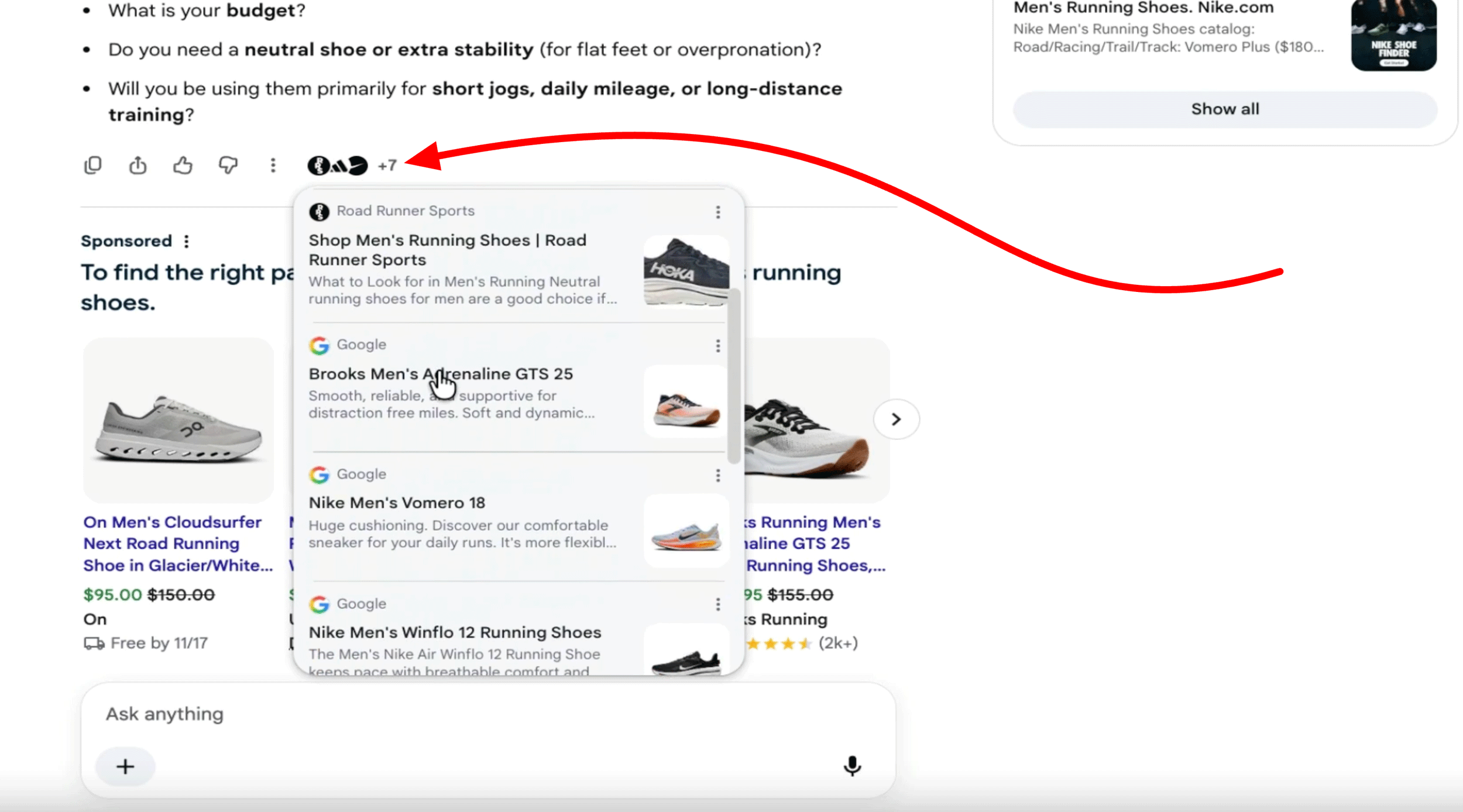
Google is testing a layout in which the AI Overviews source icons move from the top of the response to the very bottom, and hovering over the icon displays the full list of citations. The test was reported on 2026-11-12.
- Google is testing placing the sources icons at the very bottom of AI Overviews instead of the top.
- In the test, every citation appears only when a user moves the cursor onto the icon.
- Brodie Clark spotted the test; Search Engine Roundtable reported it on 2026-11-12.
- Search Engine Roundtable says the move could make sources harder to find and cut clicks to websites further.
- Preferred Sources, which Google says earn twice the clicks, is one of Google's other source-visibility features.
Google is moving the sources icons to the bottom of AI Overviews in a test
Google is trying a new position for the citation, or sources, icons in AI Overviews. In the test version, they sit at the very bottom of the AI-generated response.
Until now, the sources icons appeared at the top of the AI Overview, directly above the citations. The test reverses that order: the answer comes first and the icons come last.
The second change is how the citations are displayed. In the new version, hovering over the icon reveals every citation at once. The list is not shown until the user takes that action.
Brodie Clark spotted Google's test and posted about it on X and on SERP Alert. Search Engine Roundtable reported the change on 2026-11-12.
The two layouts side by side
| Element | Earlier layout | Layout in the test |
|---|---|---|
| Position of the sources icons | At the top of the AI Overview, directly above the citations | At the very bottom of the response |
| How the full citation list appears | Shown with the citations | Displayed when the user hovers over the icon |
The facts available describe only these two differences. They do not say whether the wording of the answer, the number of citations or the label has changed in the test.
This is not the first time Google has tried placing citations below the answer. Search Engine Roundtable reported earlier tests in 2025 that moved citation cards or a citation block underneath the AI Overview. A desktop test reported in September 2026 added a "show all" button that opened the full list of sources. The current test follows the same pattern, with a hover taking the place of the button. In Google's citation lists, each cited source is usually identified by its site name and favicon, so a reader who does hover still sees which sites the answer drew on.
How AI Overviews and their citations work
AI Overviews are AI-generated summaries placed above search results. They synthesize an answer from multiple sources, so a searcher gets a condensed response before looking at any single result.
They are built on Google's standard crawling, indexing and ranking systems. Crawling is the process by which a search engine discovers pages, indexing is the storage of what it found, and ranking decides which pages come up for a query. The pages behind an overview therefore come from the same infrastructure that powers regular search, not from a separate system.
The technology behind the answers
AI Overviews are powered by Google's Gemini models. They use Retrieval-Augmented Generation, usually shortened to RAG. In this technique, the AI fetches fresh web content at search time and grounds its answer in it.
That design explains why citations exist. The answer is tied to material retrieved from the web at the moment of the query, and the citations credit where that material came from. Without them, a reader would have no visible link between the summary and the pages behind it.
The standard layout
Before May 2026, the standard layout showed a clear "AI Overview" label, followed by a paragraph or a bulleted answer. Alongside it sat 3-6 expandable reference links on the right that credited the sources.
From May 2026, Google moved Google AI Overviews citations next to the text. These inline citations sit beside the specific sentence they support, and the link icons became more prominent on desktop and mobile. On desktop, Google added hover previews that show a page's title, a short description and sometimes images, as part of what it describes as redesigned link previews. That inline design is the baseline the current test is set against. Instead of keeping the AI Overviews source icons close to the text they support, the test gathers them at the bottom of the response.
Users can also expand an overview to see source links and follow-up questions without starting a new search. In that flow, the sources icons are where a reader goes to check an answer's origin. Moving them from the top to the bottom changes what the reader sees first when looking for those references.
Where the feature sits in search
The overview appears first on the Google Search results page, above the individual results. Anyone looking for it on a results page finds it there, as the summary that comes before the usual list of results.
The feature is also newer than some searchers assume. It was introduced under a different name in May 2023, as described further below.
Google has adjusted the layout of AI Overviews before. An earlier AI Overviews layout change for brand searches moved the overview to the right column. Together with the icon test, it shows that placement within the format keeps being revised.
What the new placement means for readers and publishers
Search Engine Roundtable writes that the placement may make it even harder to find sources and could reduce clicks to websites further. That is an assessment of the test, not a measured result, and the facts available contain no click data from the experiment.
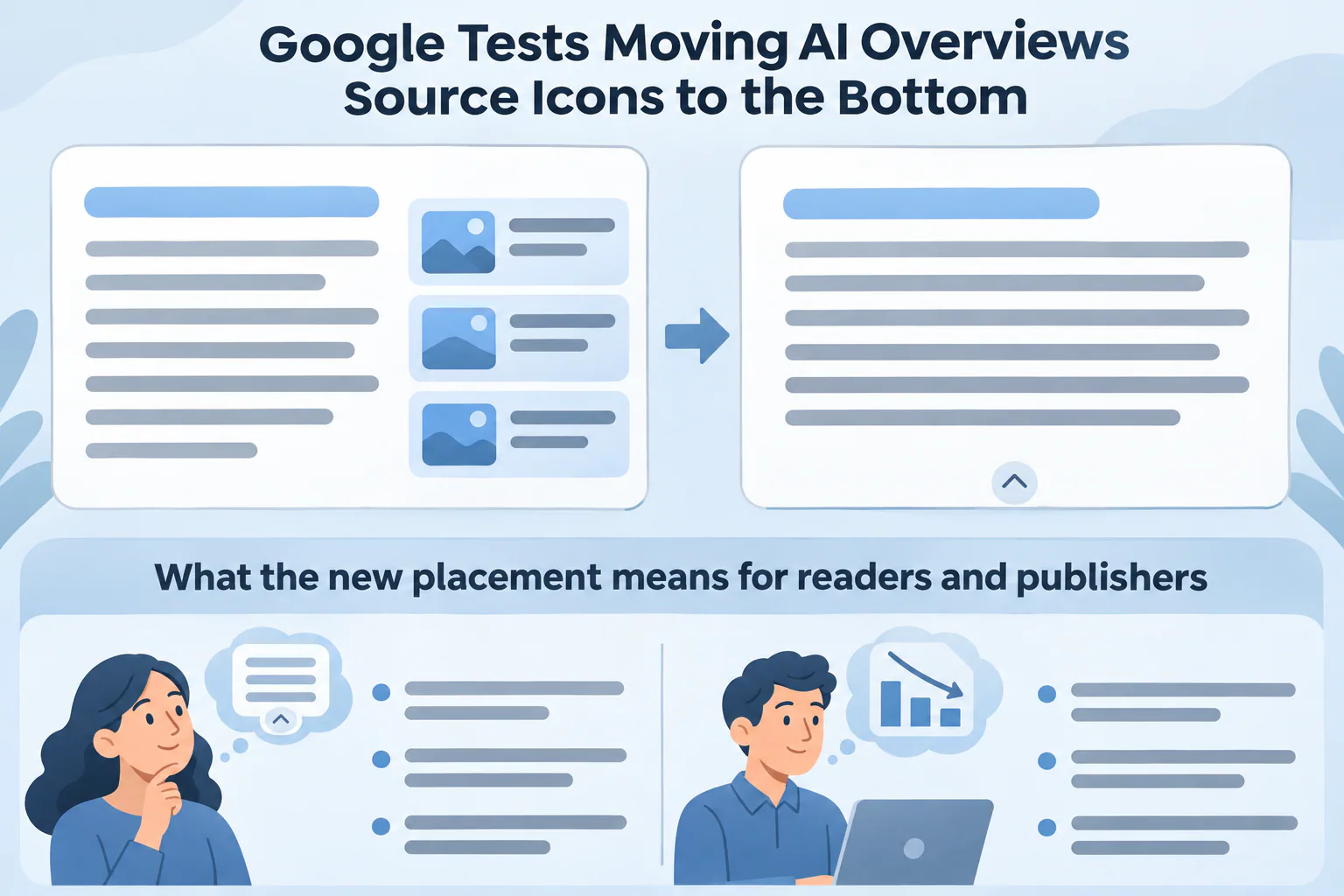
The concern builds on an existing trend. AI Overviews have been linked to a significant decline in search traffic for many publisher and brand websites since launch.
Searcher behavior points the same way. A Bain & Co. survey found that most consumers resolve a large share of their searches on the results page without clicking through. When the answer is complete on the page, a link that only appears after a hover is less likely to be used.
Who is affected
Publishers and brands whose pages are cited in AI Overviews are the most directly affected, because the citation is the visible path from the answer to their site. If AI Overviews source icons hide that path until a hover, the same citation may be seen less often, though the test has produced no figures on that.
Content teams and agencies that report on visibility in AI answers have a practical question to track. A page can still be cited, and still be counted as cited, while the list that shows it is one step further from the reader. Reports that treat a citation as equal to a visible link may need a note about the layout in use.
Readers are affected as well. Anyone who wants to verify where an answer came from has to find the icon and hover over it, instead of seeing the references next to the answer from the start.
What can be checked now
Because the change is a test, it is not visible to every searcher. Teams that audit how their pages appear in AI Overviews can compare what they see with the layouts described above and record the result for each search. The facts do not say how the test is distributed, so not seeing the change on one screen says nothing about the rest.
- Note whether the search was run on desktop or on mobile.
- Record where the source icons appear: next to the text as inline citations, in a side panel, or in a block at the bottom of the response.
- Check whether the full citation list opens on hover or behind a "show all" control, or whether no such control is present.
- Note which of your pages are cited and whether they are visible without a hover.
- Save a screenshot with the date of the search, so later layouts can be compared.
Other Google features that surface sources in AI answers
The icon test is one piece of a wider set of features that decide which sources users see in AI responses.
Preferred Sources
Preferred Sources is a feature where users choose sites they trust, which are then labeled in AI responses. The labels appear in AI Overviews and AI Mode. As of May 2026, over 345,000 unique websites had been selected.
Google says links from Preferred Sources are twice as likely to be clicked. That is Google's own claim. The facts do not say how it was measured.
For a publisher, the feature works differently from the icon placement. It depends on a reader's own choice of a site, not on where Google puts the citation list. A site that readers select can be labeled regardless of the layout the overview uses.
Highly Cited labels
Highly Cited labels flag news stories and articles that other publishers reference heavily. They mark content that other publishers rely on, which gives a reader a quick signal about a piece before opening it.
Perspectives carousels
Perspectives carousels pull in articles, forum threads and social posts to show multiple viewpoints. They widen the kinds of sources shown beyond traditional publishers, so a forum thread or a social post can appear next to an article.
How the features differ
| Feature | What it does |
|---|---|
| Preferred Sources | Labels sites that users chose as trusted, in AI Overviews and AI Mode |
| Highly Cited labels | Flags news stories and articles that other publishers reference heavily |
| Perspectives carousels | Shows articles, forum threads and social posts to present multiple viewpoints |
Taken together, these features give sites several routes to being seen in AI answers, each separate from where AI Overviews source icons sit. Whether any of them offsets a hidden citation list in the test layout is not something the available facts address.
How AI Overviews got here from the 2023 test
AI Overviews were introduced as Search Generative Experience in May 2023, as a test in Google's Labs in the United States. At that stage, the format carried a different name and was still an experiment.
The feature was rebranded and officially launched in the United States in May 2024. Its layout is still being tried in different forms, and the current icon test is the latest example.
That history also gives the test some context. The format started as a Labs experiment, and changes to it, including this one, have continued after the launch.
What is still unknown about the test
The change is a test. Nothing in the available facts confirms a wider rollout, so whether the bottom placement of the AI Overviews source icons becomes permanent remains unconfirmed. The facts also do not say how many users see it. All that is known comes from Brodie Clark's posts on X and SERP Alert and from the 2026-11-12 report.
The open question is whether the hover list changes the number of AI Overviews clicks that reach cited sites. That is the concern Search Engine Roundtable raised, and it can only be settled by click data that has not been published.
Sources
Photo: Search Engine Roundtable
Frequently asked questions
What are AI Overviews in Google Search?
What are AI Overviews in Google Search?
They are AI-generated summaries placed above search results that synthesize answers from multiple sources. They are built on Google's standard crawling, indexing and ranking systems.
Where are the sources in an AI Overview now?
Where are the sources in an AI Overview now?
In the standard layout, the answer carries 3-6 expandable reference links crediting sources, and the source icons appear at the top, directly above the citations. Users can expand an overview to see source links and follow-up questions without a new search.
What is changing in Google's test?
What is changing in Google's test?
Google is testing moving the source icons to the very bottom of the response. Hovering over the icon displays the full list of citations.
When did AI Overviews launch?
When did AI Overviews launch?
They were introduced as Search Generative Experience in May 2023, as a US Labs test. They were rebranded and officially launched in the United States in May 2024.
What is Retrieval-Augmented Generation?
What is Retrieval-Augmented Generation?
It is a technique where the AI fetches fresh web content at search time and grounds its answer in it. AI Overviews, powered by Google's Gemini models, use it.
What is Preferred Sources in Google?
What is Preferred Sources in Google?
It is a feature where users choose sites they trust, which are then labeled in AI Overviews and AI Mode. Google says links from Preferred Sources are twice as likely to be clicked.