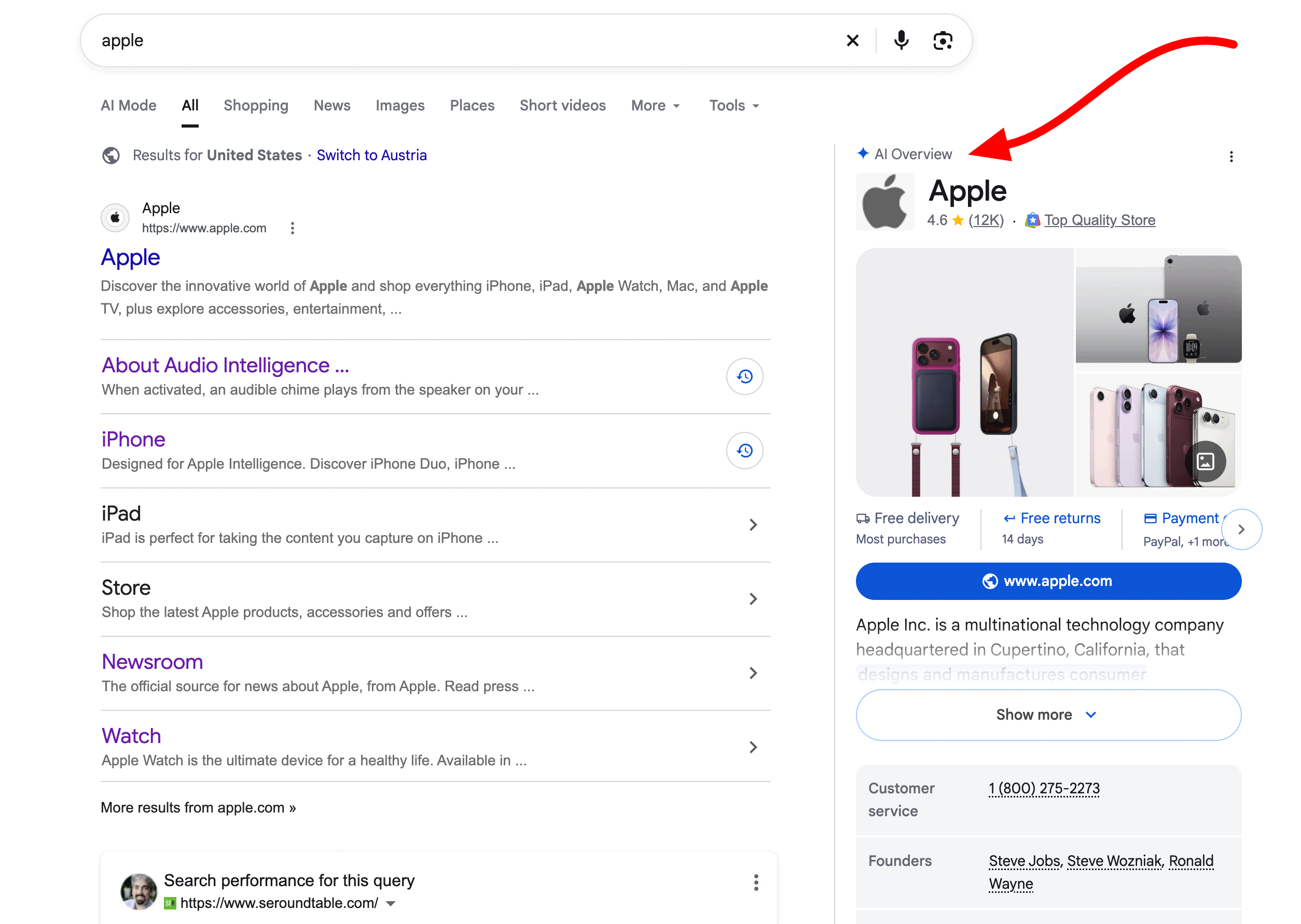
Google has moved AI Overviews for many brand-related searches into the right-hand column of the results page, according to a report from Search Engine Roundtable. The summaries previously sat at the top or middle of the main results. That changes how a brand is presented to people who search for it by name.
- Google now shows AI Overviews for many brand searches in the right-hand column, not at the top or middle of the main results.
- The change effectively replaces brand Knowledge Panels with AI Overviews, as seen in a search for [Apple].
- SEO professionals Chris Long and David McSweeney spotted the change on X, and Sachin Patel had earlier noticed an AI-generated label on Knowledge Panels.
- Search Engine Roundtable’s author calls the placement better than the main results but doubts AI should describe a brand better than the brand’s own site.
- The move departs from earlier descriptions of AI Overviews as sitting at the very top of results.
Google has moved brand AI Overviews into the right column
For many brand-related keywords, Google now places the AI Overview in a column to the right of the main search results, Search Engine Roundtable reports. The report refers to many brand-related keywords, not all of them.
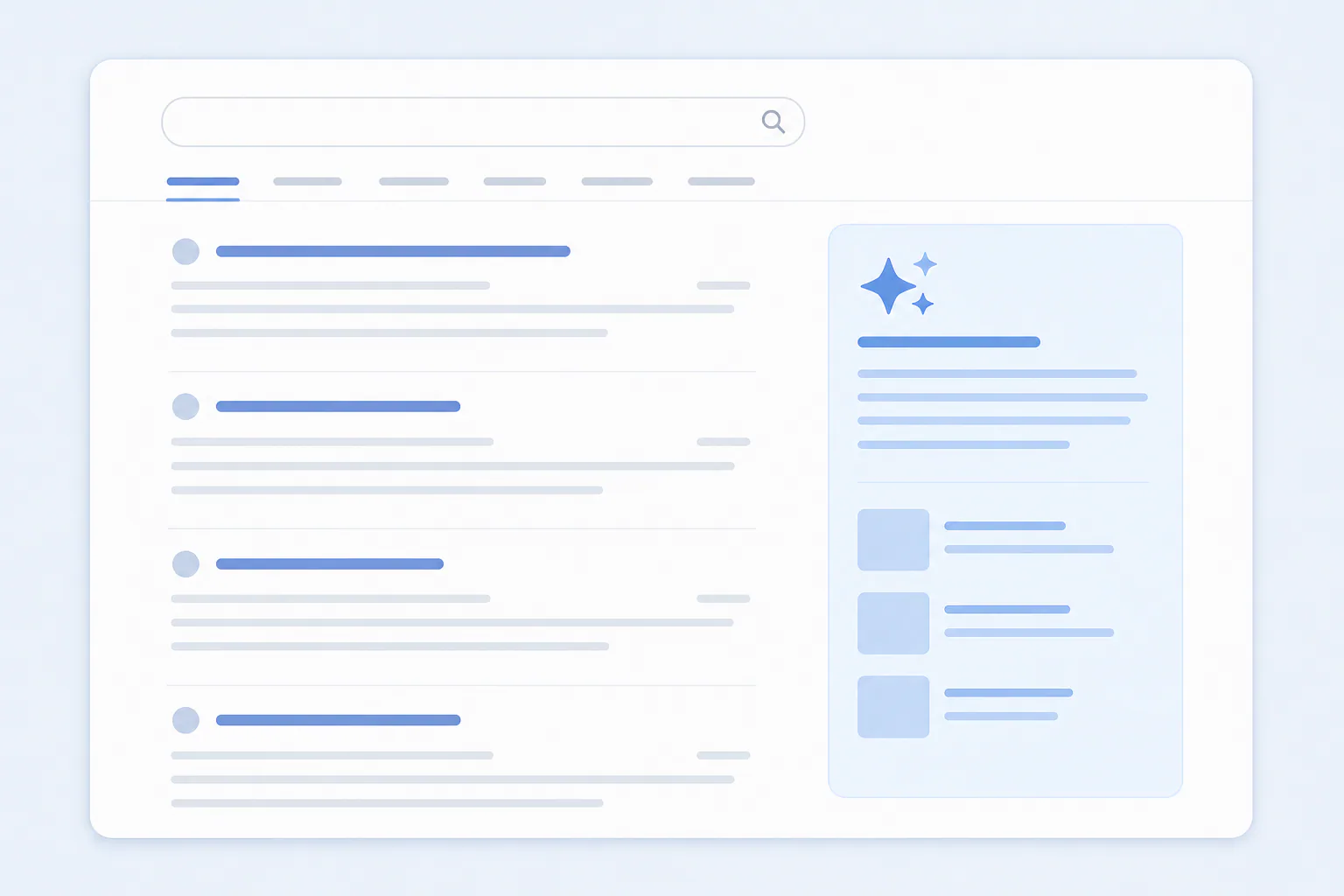
Until now, AI Overviews for brand searches appeared in the main results section, at the top or in the middle. That placement put the generated summary in the same stream of content as the ranked links. The new position moves it out of that stream and into a side column.
The report uses a search for [Apple] as its example of the new layout. Square brackets are the convention SEO professionals use to mark a search query, so [Apple] means a search for the brand name itself rather than a topic around it.
Search Engine Roundtable describes the result as essentially replacing brand Knowledge Panels with AI Overviews. A Knowledge Panel is the information box Google shows for brands and entities in search results. If the report’s description holds across more brands, the box that used to present a company in a fixed, structured form is now an AI-generated summary.
Several things are not stated in the material available. The sources do not give a list of affected brands, do not say what share of brand queries show the new layout, and do not include a statement from Google about the change. The report rests on observations by SEO professionals and on the Search Engine Roundtable author’s own comments.
SEO specialists spotted the shift over several days
The change surfaced through posts on X rather than through an announcement. Three SEO professionals are named in the report, each describing a slightly different part of the same picture.
Sachin Patel, October 27, 2026
Patel posted on X on October 27, 2026 that the Google Knowledge Panel now shows an AI-generated label, often referred to as the AI Overview label. That is the earliest dated observation in the report. It indicates that, before the right-column AI Overview was widely noticed, the Knowledge Panel itself had begun to carry a label identifying AI-generated content.
David McSweeney, October 31, 2026
McSweeney posted on October 31, 2026, noting that AI Overviews on desktop now generally appear in a right panel, or in some cases further down the page. Two details stand out. He refers specifically to desktop, and he allows for cases where the overview lands lower on the page instead of in the side panel. The layout therefore does not appear to be uniform in every instance he saw.
According to the report, McSweeney spotted the layout change a couple of days before he posted about it on October 31, 2026. The report does not give a date for Chris Long’s post, so no comparison between the two is possible.
Chris Long
Long also posted about the change on X. He wrote that Google is showing AI Overviews for brand terms in the right column instead of a Knowledge Panel. Of the three posts, his wording is the most direct statement of a swap between the two features. The date of his post is not given in the material available.
Taken together, the posts cover a span from October 27 to the days after October 31, 2026. They describe a label on the Knowledge Panel, a move of the overview to the side, and a replacement of one feature by the other. Whether these are separate steps of one rollout or different views of the same layout is not clarified in the sources.
Search Engine Roundtable report, November 2, 2026
The observations became public on November 2, 2026, when Barry Schwartz reported the change on Search Engine Roundtable. His examples include searches for [Apple], [Zillow], [Coke] and [Google], each showing an AI Overview on the right side of the page where a Knowledge Panel used to sit. These are examples, not a complete list of affected brands.
What a Knowledge Panel and an AI Overview each do
The two features serve different purposes, which is why the swap draws attention. A Knowledge Panel is the information box Google shows for brands and entities in search results. An AI Overview is an AI-generated answer summary, typically shown with source links, according to Semai.
| Feature | What it is | Where the sources place it |
|---|---|---|
| Knowledge Panel | Information box for brands and entities | Being replaced for many brand searches, per Search Engine Roundtable |
| AI Overview | AI-generated answer summary, typically with source links | Right-hand column for many brand searches; earlier described at the top of results |
A Knowledge Panel draws on Google’s Knowledge Graph, a database of entities and the facts that connect them. Several explainers point out that the two features can appear together, with the AI Overview drawing on the panel’s structured facts while the panel itself offers more detail. On that reading, the summary builds on the panel instead of replacing it. The Search Engine Roundtable report describes a swap for many brand searches, so both views may hold for different queries.
How AI Overviews are built
Semai states that AI Overviews are powered by Google’s Gemini models, using two techniques named Retrieval-Augmented Generation and Query Fan-Out. Both are worth defining, because they explain why an overview can differ from a stored, fixed panel.
- Retrieval-Augmented Generation (RAG) is a technique where the AI fetches live web content at search time and grounds its answer in it. The text is assembled from pages retrieved at the moment of the query.
- Query Fan-Out splits a question into several sub-queries that are searched simultaneously before the answer is merged. One brand search can therefore trigger several lookups behind the scenes.
For a brand, the practical consequence follows directly from the first definition. An answer grounded in live web content draws on what is published on the web at that time, which includes, but is not limited to, the brand’s own site. Which pages Google uses for a brand overview is not stated.
Links and sources
Google AI Overviews show 3-6 expandable reference links, usually on the right side, crediting sources, Semai says. The right side is therefore already where those reference links tend to appear, so a brand overview on that side follows a familiar pattern.
No report describes what a brand AI Overview in the side column contains, how many links it shows or which sources it credits for a brand. Those details are not known from the material available.
What it means for brands and searchers
Search Engine Roundtable’s author says the right-column placement works better than showing the overview in the main results. According to the same author, it is not a good idea to trust AI to describe a brand better than the brand’s own website. The two remarks together make up the only editorial assessment in the report: the position is an improvement, the premise is questionable.
The change also stands out against background reporting. Semai says AI Overviews usually do not trigger for simple brand-name searches, which makes their appearance for many brand terms a notable shift. A query that a brand could treat as safely served by its own panel and site may now carry a generated description beside the results.
Who is affected
Brand owners are the most directly affected group, since the box that describes them when people search their name is now generated differently. Local businesses may form a second group, since local knowledge panels that draw on Google Business Profile data are also being turned into AI Overviews, according to Marwick Marketing. Agencies and in-house content teams that monitor brand queries for clients would see a different right-hand column than before, and the report suggests that column can differ between desktop and other cases. Searchers encounter the change as a summary beside the results instead of a Knowledge Panel.
Nothing in the reporting says whether a brand can influence the text of its AI Overview, or whether the Knowledge Panel’s earlier content is still used. No claim is made about either point here.
Clicks and visibility
Brands care about how summaries affect visits. A study cited by Semai found that the click-through rate for the #1 organic result drops sharply when an AI Overview is present. That finding concerns AI Overviews in general, not the new right-column placement for brand searches, and the sources contain no click data for the new layout.
A Bain & Co. survey, cited by EBQ, found that most consumers resolve a large share of their searches on the results page without clicking through. For a brand search, that increases the importance of whatever the results page itself says about the brand. A summary beside the results may be the only description some searchers read.
Both figures describe searching broadly. They are context for the change and not measurements of its effect.
How to check your brand’s AI Overviews
We suggest a simple routine if you want to see what Google says about your brand. Start in Search Console, where the branded queries filter shows which search queries include your brand name. Then run those queries yourself, alone and together with words such as reviews, pricing or complaints, and record:
- whether an AI Overview appears, and where on the page
- whether what it says about your brand is accurate
- which competitors it names
- which sources it cites, and whether those pages actually support its claims
Repeating the check on desktop and on mobile shows whether the right-column layout applies to your brand.
How AI Overviews evolved from SGE to a global feature
AI Overviews started as an experiment. They were introduced in May 2023 as Search Generative Experience (SGE), available in US Labs only, according to Semai.
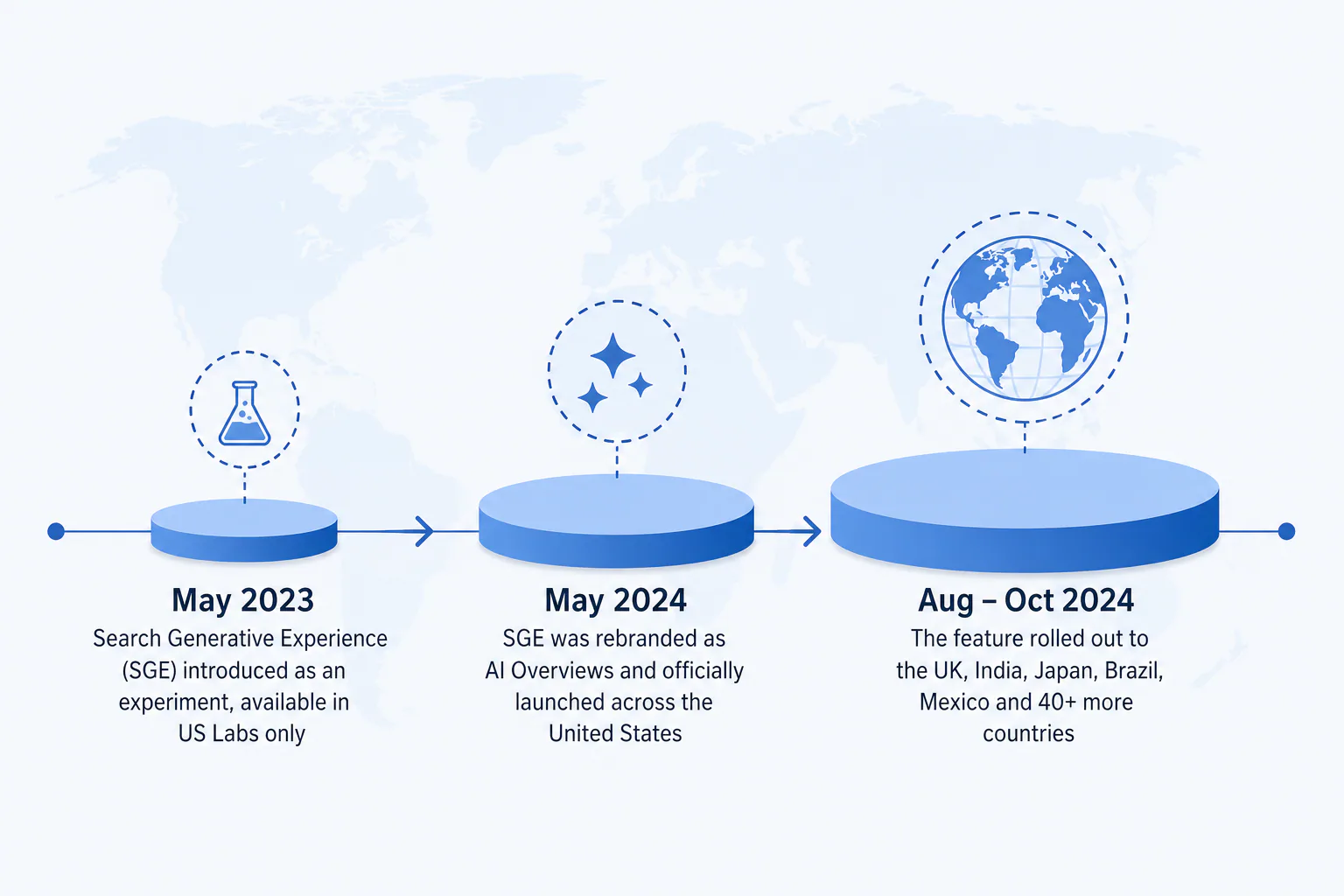
In May 2024, SGE was rebranded as AI Overviews and officially launched across the United States. From August to October 2024, the feature rolled out to the UK, India, Japan, Brazil, Mexico and 40+ more countries.
| Date | Step |
|---|---|
| May 2023 | Introduced as Search Generative Experience in US Labs only |
| May 2024 | Rebranded as AI Overviews, launched across the United States |
| August to October 2024 | Rolled out to the UK, India, Japan, Brazil, Mexico and 40+ more countries |
| October 27 to 31, 2026 | SEO professionals report an AI-generated label on Knowledge Panels and AI Overviews in the side column for brand searches |
| November 2, 2026 | Barry Schwartz reports the right-column move on Search Engine Roundtable |
A change from earlier descriptions
The sources differ on placement. Search Engine Roundtable says AI Overviews for brands now appear in the side column. Semai, in background material from 2025, describes AI Overviews as sitting at the very top of results, the spot SEO professionals often call Position Zero. The right-column position for brand searches is therefore a change from those earlier descriptions.
The feature itself first appeared in May 2023 as Search Generative Experience, so the brand-column move comes about three and a half years after that original experiment.
Coverage and citations
Semrush, in November 2025, put AI Overview coverage at a noticeably lower level than its mid-2025 peak, according to Semai. The share of searches that show an overview changes quickly, and this article has no current figure for it, for brand searches or in general.
Separately, an Ahrefs analysis of 730,000 AI responses, cited by ekamoira.com, found little citation overlap between AI Mode and AI Overviews. The two Google AI features cite largely different sources. AI Mode is not explained further in the material, and the overlap finding does not address brand searches specifically.
Open questions around ads, publishers and Google’s intent
It is not stated whether the right-column layout is a test or permanent, or how widely it has rolled out. Google has not been quoted on the change in the material available. Practical questions, such as whether the summaries cost anything to see or how a user turns them off, also go unanswered.
Money and legal pressure form the backdrop. In May 2025, Google broadened the rollout of Search and Shopping ads within AI Overviews, according to EBQ. EBQ also states that paid search, mainly Google Ads, accounts for the large majority of Google’s total income. Ads inside AI Overviews and the importance of paid search are both documented, but neither source ties them to the brand-search layout.
Publishers have sued Google, arguing that AI Overviews reproduce copyrighted content without fair compensation, Semai reports. Brand owners are in a different position from publishers, since the summaries describe them rather than reuse their articles, though the sources do not draw that comparison.
None of the sources links ads, income or lawsuits directly to the move of brand AI Overviews into the right column, so any connection remains unconfirmed. Further observations from SEO professionals, or a statement from Google, would be needed to establish how long the layout stays and how many brands it covers.
Sources
Photo: Search Engine Roundtable
Frequently asked questions
Where do AI Overviews appear for brand searches now?
Where do AI Overviews appear for brand searches now?
For many brand-related keywords, they appear in the right-hand column of the results page. David McSweeney noted they are generally in a right panel on desktop, or in some cases further down the page.
What are Google AI Overviews?
What are Google AI Overviews?
They are AI-generated answer summaries in Google Search, typically shown with source links. They usually show 3-6 expandable reference links crediting sources.
When did AI Overviews launch and where are they available?
When did AI Overviews launch and where are they available?
They began in May 2023 as Search Generative Experience in US Labs only. In May 2024 they were rebranded and launched across the United States. From August to October 2024 they rolled out to the UK, India, Japan, Brazil, Mexico and 40+ more countries.
Do AI Overviews replace Knowledge Panels?
Do AI Overviews replace Knowledge Panels?
For many brand searches, Search Engine Roundtable describes the change as essentially replacing brand Knowledge Panels with AI Overviews. The sources do not say this applies to every search.
How do AI Overviews work?
How do AI Overviews work?
They are powered by Google’s Gemini models, using Retrieval-Augmented Generation, which grounds answers in live web content fetched at search time, and Query Fan-Out, which splits a question into sub-queries searched in parallel before combining the results into one answer.
How do AI Overviews affect clicks to websites?
How do AI Overviews affect clicks to websites?
A study cited by Semai found the click-through rate for the #1 organic result drops about 34.5% when an AI Overview is present. No click data for the new brand-search layout is available in the sources.