Google has started rolling out Gemini 4 Carbon in AI Mode to Google AI Pro subscribers, and the AI Mode header no longer names the Gemini model in use. Rajan Patel, Google's VP of Engineering for Search, confirmed on X that both changes are intended.
- Google's AI Mode header now says only "AI Mode" and no longer names the Gemini model in use.
- Rajan Patel confirmed the label removal is intended, not a bug, and said Google is weighing how to bring back a model indicator.
- Gemini 4 Carbon is rolling out in AI Mode to Google AI Pro subscribers, less than a week after Ultra subscribers got it.
- Carbon's introductory API price is $2 per million input tokens and $10 per million output tokens, and it is expected to double in late November.
- Google's early benchmarks put Carbon among the strongest models, closely trailing Fable 5.2.
Google removes the model name from AI Mode and widens Carbon access
The AI Mode bar now shows only the words "AI Mode". Until this change, the header also carried a Gemini model label that told the user which model was handling the query, and that information is gone from the interface.

The second change concerns access. Gemini 4 Carbon is now rolling out in AI Mode to Google AI Pro subscribers, according to a November 16, 2026, report. The model had reached Google AI Ultra subscribers less than a week earlier, so the step from the top tier to the Pro tier took only days.
Google also rolled out Gemini 4 Hydrogen in AI Mode to all users. That makes three groups with different levels of access to Gemini 4 models inside the same Search interface: all users, Pro subscribers and Ultra subscribers.
Gagan Ghotra spotted both changes and posted screenshots on X. Google had not announced the label removal in advance, and the screenshots were the first visible sign of it. Patel's reply followed on the same platform.
The two changes arrived together, which is why they are reported together. A wider group of people can now reach a newer model in AI Mode, and at the same moment the interface stopped saying which model that is.
Rajan Patel says both changes are intended and an indicator may return
Patel confirmed the label change on X and described it as "Intended, but we're thinking through the right way to bring back an indicator for your selected model." The sentence contains two statements: the removal was a decision, and Google sees a need for some kind of indicator.
He also said the label removal is not a bug. A blank header could have been read as a display fault or a failed update, and the statement rules that reading out.
The Pro rollout drew the same answer. Patel confirmed it on X with the words "Not a bug", which means Carbon's appearance for Pro subscribers is not an access error.
His wording points to an unsettled design. The phrase "your selected model" suggests that the indicator is meant to reflect a choice made by the user, though the facts do not say how that choice would work or which models would be on offer.
The header may therefore change or return in some form. Google has not said what the indicator would look like, where it would appear, or when it would come back.
What AI Mode, Antigravity and token pricing mean
Three terms recur in the Carbon coverage, and each has a narrow meaning.
AI Mode
AI Mode is Google Search's AI-powered search interface. Before this change, the Gemini model in use was shown in its header, which is the element that now reads only "AI Mode".
Antigravity and the swarm feature
Antigravity is Google's agentic development platform. An agentic platform is one where AI systems carry out tasks as agents instead of only answering a single question. Google announced a "swarm" feature there that turns one prompt into a coordinated team of AI agents.
Ultra subscribers can reach Carbon in Antigravity, so the swarm feature sits within the set of products where the model is offered. The facts do not say whether the feature requires Carbon.
Input and output tokens
Input and output tokens are the units an AI API charges by, and prices are quoted per million tokens. Input tokens cover what a developer sends to the model, such as a prompt and any supporting material. Output tokens cover what the model sends back. Each side has its own rate, which is why Carbon has two prices. Google's launch pricing also covers cached input tokens, meaning input the model can reuse, billed far below the standard input rate.
Gemini 4 Carbon price, access and release timeline
Google officially introduced Gemini 4 Carbon to the general public as its most advanced model to date, designed to compete with systems from Anthropic and OpenAI. That positioning places it against the largest rival models, not only against earlier Gemini releases.
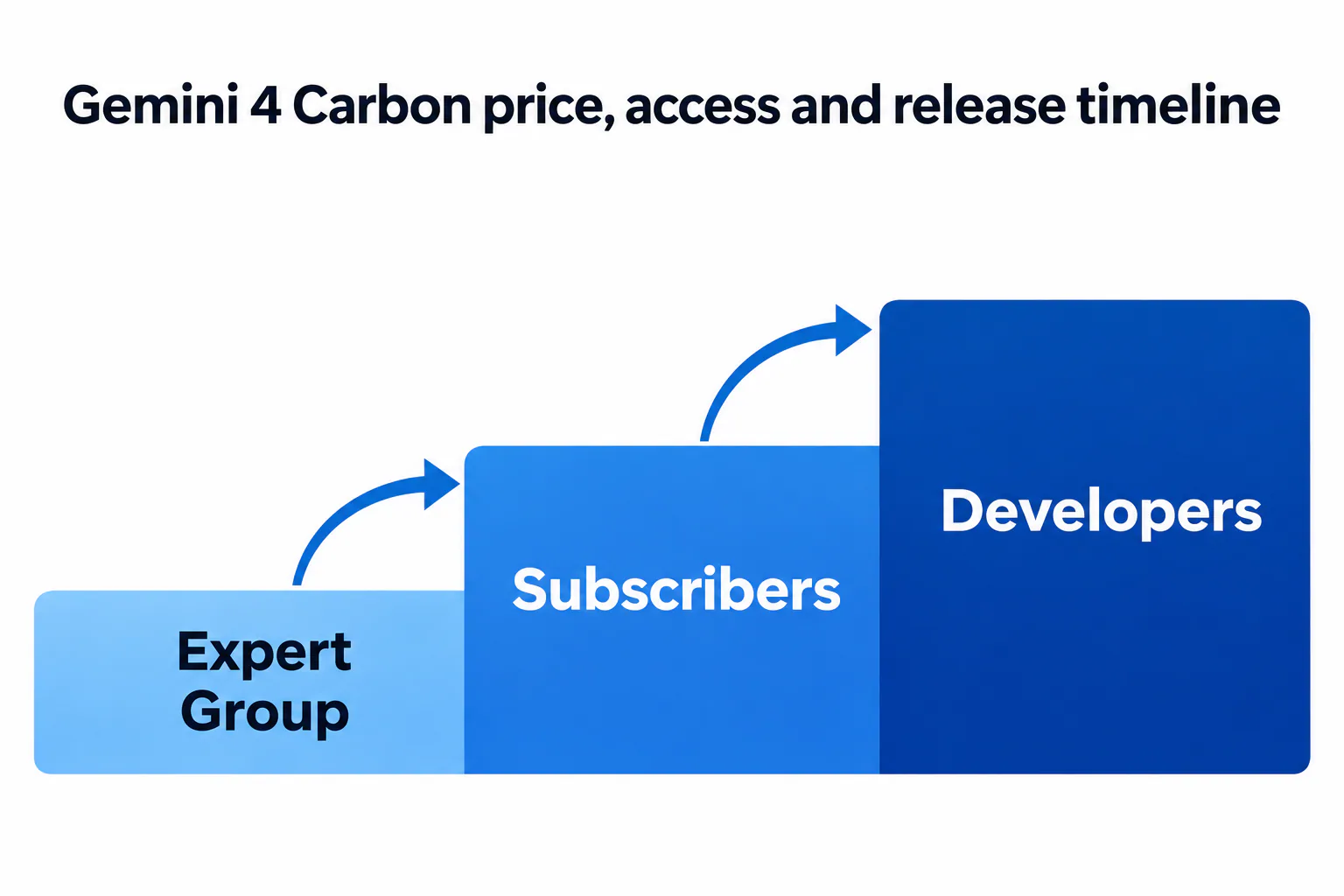
The public introduction followed an initial rollout to a select group of cybersecurity experts two weeks earlier. A restricted first release to specialists, then a public launch, then a widening of subscriber access is the sequence the facts describe. Earlier coverage of Gemini 4 Carbon in AI Mode dealt with the Ultra stage of that sequence.
That first release ran through the Fairwind Program, Google's trusted-partner channel for cyber defenders. Carbon went to a subset of defenders first, and trusted partners were added gradually before the public launch. Google also offers a separate cyber-specific variant of Carbon for approved projects, which sits outside the subscriber and API access described below.
Where Carbon is available
Google AI Ultra subscribers can reach Carbon through the Gemini app, through AI Mode in Search and through Antigravity. With the latest rollout, Google AI Pro subscribers can use it in AI Mode as well.
For developers, Carbon is available through the Gemini API within Google AI Studio and Gemini for business. Access extends to all paying developers and enterprises. A separate analysis covers Gemini 4 Carbon's limited access at an earlier point, before the subscriber and API availability described here.
Introductory API pricing
| Item | Detail |
|---|---|
| Introductory input price | $2 per million input tokens |
| Introductory output price | $10 per million output tokens |
| Introductory period ends | Late November, when prices are expected to double |
These are introductory API prices, so they concern developers and enterprises paying per token. They are separate from what subscribers pay for the Google AI Pro and Google AI Ultra tiers, for which the facts give no figures.
The words "expected to double" matter. Google has set a date range for the end of the introductory period, but the facts describe the later price as an expectation, not as a published rate.
Where the reports differ on timing
The sources do not fully agree on when Carbon first appeared in AI Mode. One report places the Ultra stage less than a week before November 15-16. Another, published on November 10, already mentions Ultra access in AI Mode as part of Carbon's public introduction. The exact date of the first AI Mode rollout is therefore unclear.
Who gains from Carbon and what the label change means for users
Carbon is aimed at complex challenges such as intricate multi-step coding projects and expansive scientific research. Those are long, layered tasks, which is the kind of work where a more capable model is meant to make the difference.
Pro subscribers are the newest group to get the model in AI Mode. Because the header no longer states the model, a Pro subscriber cannot easily confirm from the interface which Gemini model produced a given answer. Access is real, but the visible proof of it is not. Model choice is narrowing as well, since a November 13 change limits Pro-model selection in the Gemini app and AI Mode to Google AI Pro and above, which leaves Google AI Plus subscribers without that option.
The same applies to anyone who watches AI Mode as a search surface, including content and SEO teams that review how AI answers appear. With the model name gone from the screen, a result seen in AI Mode cannot be tied to a specific model on the strength of the header alone. The subscription tier used and the date of the observation become the only context a viewer has.
Developers and enterprises
Developers and enterprises are in a different position. Through the Gemini API they use Carbon in Google AI Studio and Gemini for business, and the introductory pricing applies to their usage. The label change does not affect the API, where the model is specified in each call.
The rollout order also shows who gets new models first. A select group of cybersecurity experts came first, Ultra subscribers followed, and Pro subscribers came less than a week later, while Hydrogen went to all users in AI Mode.
How Carbon compares with Argon, Fable 5.2 and GPT-6 Astra
Carbon can be measured against its own predecessor, against Anthropic's newest model on benchmarks, and against OpenAI's and Anthropic's models on price.
Argon, the earlier model
Argon, Carbon's predecessor, launched about two weeks before Carbon. It is described as suitable for most software engineering and knowledge tasks, while Carbon is pitched at the harder end of the range. In the Gemini app model picker the two sit side by side, each labeled for a different kind of work, and Argon stays available for AI Pro and above. Gemini 3.1 Pro was removed from the app at the same launch. Carbon's pricing is similar in approach to Argon's.
Benchmarks against Fable 5.2
Google's initial benchmarks indicate Carbon ranks among the most powerful AI models available, closely trailing Fable 5.2. Fable 5.2 is Anthropic's newly launched model. The wording places Carbon just behind it and not ahead, and the facts give no scores.
Google's own launch post also cites the Artificial Analysis Intelligence Index, an independent ranking, for Carbon's placement near the top of the field. Independent evaluations do not always match a vendor's framing. The Vals AI index, for example, lists different prices for the models it tracks, so it pays to compare several sources before relying on any single ranking or price claim.
Price against GPT-6 Astra and Fable 5.2
According to Google-related reporting, Carbon's introductory per-token price is lower than that of OpenAI's GPT-6 Astra and Anthropic's Fable 5.2. The facts do not give the rivals' prices, so the size of the gap is not known.
| Model | Position in Google's initial benchmarks | Per-token price against Carbon's introductory rate |
|---|---|---|
| Gemini 4 Carbon | Among the most powerful, closely trailing Fable 5.2 | $2 per million input tokens, $10 per million output tokens |
| Fable 5.2 | Ahead of Carbon | Higher than Carbon |
| GPT-6 Astra | Not stated | Higher than Carbon |
| Gemini 4 Argon | Not stated | Similar pricing approach |
Two cautions on the comparison
Token usage varies by task, so a lower per-token price does not necessarily mean a lower overall project cost. A model that needs more tokens to finish a job can cost more in total despite a cheaper rate, which makes a test on real workloads more telling than a price list.
Benchmarks are also presented selectively by companies to highlight their products' strengths. Because the ranking above comes from Google's initial benchmarks, it reflects the company's own choice of tests and its own early results.
The comparison is also time-limited. The per-token advantage rests on the introductory rate, and that rate is expected to double in late November.
Open questions and what comes next
Google has not said how or when a model indicator will return to the AI Mode header. Patel's statement says only that the company is thinking through the right way to do it.
Whether Hydrogen, Carbon and other models will be selectable or labeled in AI Mode is also unresolved. His reference to "your selected model" hints at a selection, but the facts do not confirm what can be selected or how.
The exact date of the first Carbon rollout in AI Mode remains unclear, because the reports place it differently.
The next dated event is the end of the introductory Carbon API pricing in late November, after which prices are expected to double. Developers and enterprises using the Gemini API have until then to run work at the lower rates, and the late-November change will show whether the doubling expectation holds.
Sources
Photo: Search Engine Roundtable
Frequently asked questions
When is the Gemini 4 Carbon release date?
When is the Gemini 4 Carbon release date?
Carbon first went to a select group of cybersecurity experts, and the public launch came two weeks later. It reached Ultra subscribers in AI Mode less than a week before the Pro rollout reported on November 16, 2026. The reports differ on the exact first AI Mode date.
How much does Gemini 4 Carbon cost?
How much does Gemini 4 Carbon cost?
Introductory API pricing is $2 per million input tokens and $10 per million output tokens. That period ends in late November, when prices are expected to double.
How does Gemini 4 Carbon perform on benchmarks?
How does Gemini 4 Carbon perform on benchmarks?
Google's initial benchmarks place it among the most powerful models available, closely trailing Fable 5.2. Companies present benchmarks selectively, so these are Google's own early results.
Who can use Gemini 4 Carbon in AI Mode?
Who can use Gemini 4 Carbon in AI Mode?
Google AI Ultra subscribers and, with the new rollout, Google AI Pro subscribers. Ultra subscribers can also use it in the Gemini app and Antigravity.
Is the missing model label in AI Mode a bug?
Is the missing model label in AI Mode a bug?
No. Rajan Patel said the change is intended and that Google is thinking through how to bring back an indicator for the selected model.
Does lower per-token pricing mean Carbon is cheaper overall?
Does lower per-token pricing mean Carbon is cheaper overall?
Not necessarily. Token usage varies by task, so a lower per-token price does not guarantee a lower total project cost.