
The best Surfer SEO alternatives depend on which part of your workflow stopped fitting:
- Page scoring: NeuronWriter or Clearscope.
- Briefs for writers: Frase or Content Harmony.
- Planning across a large domain: MarketMuse.
- Automated changes on live pages: SEOJuice.
Most teams don’t leave Surfer because it’s a bad tool. They leave because one bottleneck stops matching how they work: credits, cost, briefs, planning or publishing.
Below you’ll find nine tools grouped by use case, a summary table with dated pricing notes, a decision path, a same-page comparison test and an honest look at when staying put is smarter. We also cover our own platform, RankFlow, and label it clearly as ours.
Why teams look for Surfer SEO alternatives
Teams usually start looking for three reasons:
- Credits run out before the month does.
- The content score starts driving edits more than the reader does.
- Surfer sits apart from the rest of the work.
Surfer SEO pricing is the complaint people name first. Cost is usually a symptom of one of these three, and knowing which one tells you what to replace.
Credit limits and shared AI Draft caps on higher plans
Surfer’s plans are built around credits. On the Scale plan at $219/month, you get 100 article credits and 100 audit credits. For one site publishing a few guides and smaller articles a week, that’s plenty.
The math changes for an agency running several client sites. Refreshing old pages draws on the audit pool, and a big content refresh can drain it in one sprint.
AI writing adds a second limit. One Business plan quoted on pages ranking for this search caps AI Drafts at 20 per month, shared across all users. Split between five writers, that’s four drafts each (calculated). Check whether a draft cap applies per seat or per account, and what usage data the vendor shows.
Score volatility and optimizing to a number
A content score is calculated from the pages currently ranking in Google, so it moves when they move. Re-run the editor a few weeks after publishing and the same text can land lower without a word changed, because the competitor set shifted.
The bigger risk is behavioral. Writers chase the score by adding NLP terms until the gauge turns green, even when a term doesn’t belong. The result reads stuffed, and a high score never guaranteed a ranking. Treat the score as a coverage checklist, not a strategy or a forecast.
A scoring tool that sits apart from planning and publishing
Surfer handles on-page optimization very well, but that’s one step of several. Keyword research often lives in another tool, the content plan in a spreadsheet and the brief in a doc. Publishing happens in WordPress, and performance tracking sits in Search Console.
Every handoff between those places is a spot where data gets copied by hand or goes stale. When that friction costs more hours than the scoring saves, a different kind of platform starts to make sense. If you’re weighing that move, our guide to choosing the right SEO content software walks through the criteria that matter before you commit.
How we picked and grouped the options
We picked tools that replace a specific job Surfer does, or a job teams wish it did, then grouped them by that job instead of ranking them in one list. A single “number one” would mislead you, because a freelancer optimizing pages and an agency running twelve client sites need different things.
Criteria: scoring quality, briefs, planning, automation, price clarity
Each tool was judged on five points:
- Scoring quality: how the tool builds its term list from the top Google results, and whether its NLP suggestions fit the topic or only pad the word count.
- Briefs: whether a writer can act on the brief without a call: intent, outline, questions to answer, sources.
- Planning: keyword clustering, content inventory and topical coverage across a whole domain, not just one page.
- Automation: whether the tool can publish or change pages, or only advises.
- Price clarity: published pricing, credits explained in plain terms, and seats and client sites that fit how agencies actually bill.
These five map to the three groups below: direct optimizers, brief tools, and planning or automation platforms. A tool can score well on one criterion and poorly on the others, which is exactly why the groups exist.
What we did not test hands-on, and how to read the notes
We didn’t run a controlled benchmark of these nine tools on the same pages. No ranking results, scores or test numbers appear here.
The notes describe what each vendor says its product does, matched against the criteria above. Prices appear only where we could cite them, each with a “checked on” date. Everything else is marked for you to verify. Prices in this category change often.
We apply the same rule we use in our own product: say which numbers are measured and which are not. If a tool sounds right, run the same-page test further down before you commit.
Popular tools we left out
Some well-known names did not make the nine. WriterZen overlaps with Scalenut and Frase on keyword clustering and drafting, so it added no new use case. Dashword is a close scorer like NeuronWriter, and we found too little citable pricing or SERP method detail to compare it fairly. Page Optimizer Pro focuses on technical, page-level tuning against SERP averages, which suits specialists more than the teams this guide targets. Each of these may still fit you; run the same-page test below before deciding.
The best Surfer SEO alternatives at a glance
The shortlist of Surfer SEO alternatives below gives one “best for” label per tool, and the table adds each tool’s main limit and a pricing note. Start with the label that matches your bottleneck and skip the rest.
Quick shortlist with a “best for” label per tool
The best Surfer SEO alternatives, by use case:
- NeuronWriter: best for budget-friendly scoring and SERP analysis.
- Clearscope: best for editorial teams that want clean guidance for writers.
- Semrush SEO Writing Assistant: best for teams already paying for Semrush.
- Rankability: best for scoring plus AI search visibility tracking.
- Frase: best for fast research, outline and draft.
- Content Harmony: best for detailed briefs handed to writers and editors.
- Scalenut: best for planning and writing in one tool.
- MarketMuse: best for content inventory and topical authority strategy.
- SEOJuice: best for automated on-page changes on live sites.
Our own platform, RankFlow, fits teams that want keyword research, plans, writing, WordPress publishing and Search Console reporting in one workspace. We list it separately because it’s ours.
Summary table: tool, best for, main limit, pricing note with a “checked on” date
The table compares the nine Surfer SEO alternatives on fit, their main limit and what we could confirm about pricing. “Unverified” means we had no source to cite, so check the vendor’s pricing page before you budget.
| Tool | Best for | Main limit | Pricing note (checked on Oct 14, 2026) |
|---|---|---|---|
| NeuronWriter | Budget scoring, SERP and NLP term lists | Lighter on planning and team workflow | Unverified; check vendor page |
| Clearscope | Editorial guidance for writers | Higher entry price; little keyword strategy | Essentials $129/month, Business $399/month |
| Semrush SEO Writing Assistant | Semrush users writing in Docs or WordPress | Needs a Semrush subscription | Unverified; tied to Semrush plan |
| Rankability | Scoring plus AI visibility tracking | Newer; smaller user base | Unverified; check vendor page |
| Frase | Research to outline to draft | Scoring less central than in Surfer | Unverified; check vendor page |
| Content Harmony | Briefs for writers and editors | No built-in publishing | Unverified; check vendor page |
| Scalenut | Keyword planning plus writing | Does many things, fewer in depth | Unverified; check vendor page |
| MarketMuse | Inventory and topical strategy | Learning curve; heavier setup | Unverified; check vendor page |
| SEOJuice | Automated on-page fixes | Changes live pages; needs review rules | Unverified; check vendor page |
Direct content optimizers: NeuronWriter, Clearscope, Semrush SEO Writing Assistant and Rankability
These four do what Surfer does best. They read the top search results, build a term list and grade your draft in an editor. Pick from this group if scoring works for you and only the price or a missing feature doesn’t.
Before trusting any term list, know how the scorer builds it. Most tools read the top 10 to 30 pages of the SERP, extract shared terms and weight them by how often and how prominently they appear. Check which country and language the data comes from, whether outliers such as forums or giant brands are included, and whether the suggested terms fit your topic and intent.

NeuronWriter: the closest budget-friendly match for scoring and SERP analysis
NeuronWriter is the option most often named as a cheaper alternative to Surfer SEO. It works the same basic way: competitor analysis of the top Google results, NLP term suggestions, and a content score in a writing editor.
It fits freelancers and small teams who mainly optimize pages and don’t need much collaboration. Collaboration features and planning are thinner than in Surfer. If several writers and an editor review the same pages, test that workflow during a trial.
Clearscope: editorial-grade guidance, with Essentials at $129/month and Business at $399/month
Clearscope lists Essentials at $129/month and Business at $399/month on its official pricing page (checked Oct 14, 2026). Its strength is a clean, readable report: term suggestions with grades that writers understand without SEO training.
Editorial teams like it for that reason. The guidance supports writing instead of turning it into a term hunt.
The trade-off is cost and scope. You pay a premium for content optimization guidance, not for keyword research or publishing.
Semrush SEO Writing Assistant: for teams already inside Semrush
The SEO Writing Assistant is a Semrush add-on that checks drafts against SEO, readability and tone targets inside Google Docs or WordPress. If your agency already pays for Semrush, it adds content optimization without a new vendor or login.
Its term analysis is less detailed than a dedicated scorer’s. Buying Semrush only to get it rarely makes sense.
Rankability: scoring plus AI search visibility
Rankability pairs a content optimizer with tracking of how your brand appears in AI-generated answers. That second part matters because several 2026 pages in this search now cover visibility in AI search, and plain page scoring doesn’t measure it.
It’s a fit when a client asks whether they show up in AI answers as well as in classic results. Treat AI visibility numbers as estimated rather than measured. They come from sampled prompts, not from a Google report.
Brief and research-to-draft tools: Frase, Content Harmony and Scalenut
These tools are built around the step before scoring: turning research into a brief and a first draft. If your writers stall on blank pages or misread intent, a better brief will help more than a better score. For a wider view beyond briefs, compare SEO writing tools sorted by workflow stage, from research through drafting to final edits.
Frase: fast research, outline and draft
Frase pulls the top results for a keyword, shows their headings and the questions people ask, and lets you build an outline and an AI draft from that research in one editor. It’s fast. A freelancer can go from keyword to working draft in one sitting.
Scoring exists, but it’s less central than in Surfer. If the team grades every page against strict targets, check whether Frase’s optimization view is detailed enough for your editors.
Content Harmony: briefs for writers and editors
Content Harmony focuses on the brief itself. It covers search intent, competitor outlines, questions, and notes a writer can follow without a kickoff call.
It suits agencies that hand work to outside writers, where a vague brief means a second round of edits. The trade-off: it stops at the brief and grading, so drafting and publishing happen elsewhere.
Scalenut: planning and writing in one place
Scalenut combines keyword clustering, briefs and AI writing in one tool. It’s aimed at small teams that want topic planning and draft production without stitching three products together.
The breadth is the selling point and the limit. Each part is lighter than a specialist tool. That’s fine for a small blog, but thin for a team that needs deep scoring or detailed briefs.
Who should pick a brief tool instead of a scorer
A simple rule: if editors mostly fix structure and intent, buy a brief tool. If they mostly fix missing terms and depth, buy a scorer. Pull your last ten edited drafts and sort the editor’s comments into those two piles.
If most comments say “wrong angle”, “missing section” or “this isn’t what the searcher wants”, the problem starts before writing. A strong brief prevents those rewrites; a score only flags them afterward.
Planning, topical authority and site-wide automation: MarketMuse, SEOJuice and RankFlow
This group answers a different question: not “is this page good?” but “what should the whole domain publish and fix next?” Teams with large inventories or many clients tend to land here, because their bottleneck is coordination and tracking, not a single page.
MarketMuse: content inventory and topical authority planning
MarketMuse audits your existing content inventory, maps topics and gaps, and suggests what to write or update to build authority on a subject. It works as a strategy layer above the page, turning inventory data into a publishing plan.
That’s useful for sites with hundreds of articles where nobody remembers what already exists. Expect a learning curve, and plan for writers to need briefs from it, not just topic lists.
SEOJuice: automated on-page changes on live sites
SEOJuice makes changes on live pages automatically, such as internal links and on-page elements. You don’t wait for a human to work through an audit list.
It suits teams with more fixes than hours. Set review rules first: automated changes on a client’s domain need someone accountable for what goes live, plus tracking of what changed.
RankFlow: keyword research, plans, AI-assisted articles, WordPress publishing and Search Console reporting in one workspace
RankFlow is our platform, so read this part with that in mind. It’s one workspace for SEO content: keyword research, competitor gaps, content plans, AI-assisted writing, WordPress publishing and Search Console reporting, covering the workflow from research to measurement.
Articles are written from your content profile, your authors and what currently ranks. Each draft starts from facts about your business, not generic advice.
Numbers in RankFlow are labeled as measured, calculated or estimated, so AI-researched keyword volume never poses as Google data. The quality score is computed from eleven checks. Site Health runs about 115 checks per scan across security, privacy, SEO, performance, accessibility and DNS.
What RankFlow isn’t: a clone of Surfer’s term-by-term editor. If minute-level scoring is your whole job, a direct optimizer fits better.
When one workspace beats a stack of separate tools
One workspace wins when coordination costs more than any single feature. Count your handoffs per article: keyword tool to spreadsheet, spreadsheet to brief, brief to writing tool, writing tool to WordPress, then WordPress to a reporting sheet.
Five copy-paste steps per article, across several client accounts, is where multi-site SEO content management breaks down. Status gets lost and nobody sees which review is late. If that sounds familiar, consolidating saves more time than a better score. If you run one blog and publish twice a month, a focused scorer is probably enough.

Which Surfer SEO alternative fits your bottleneck and budget
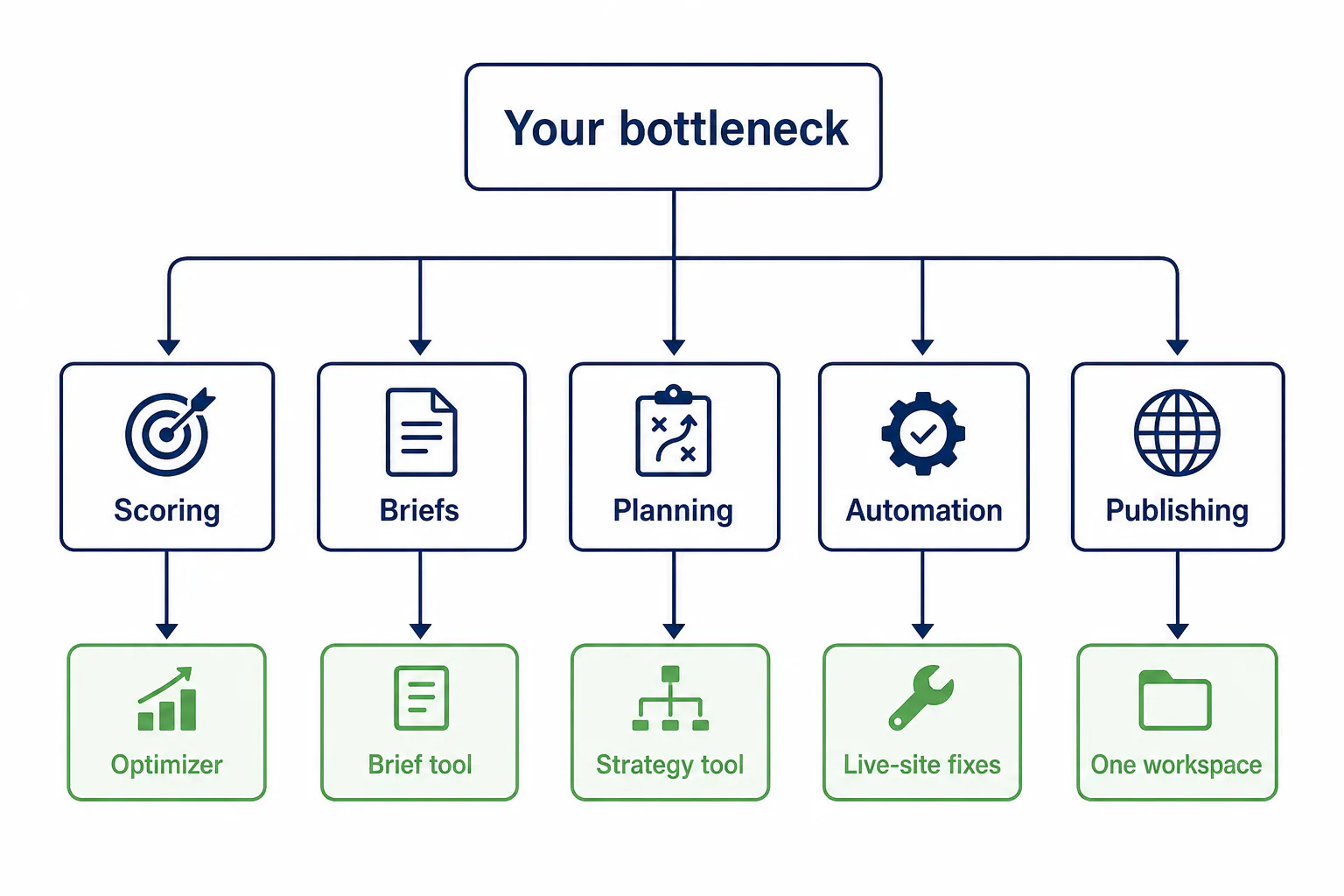
Name your bottleneck first, then filter by budget. The steps below turn that into a decision among Surfer SEO alternatives, then help you test a tool and judge whether switching is worth it at all.
Decision path: scoring, briefs, planning, automation or publishing
Follow the first line that matches your situation:
- Scoring is fine, but credits or cost hurt: NeuronWriter for a tight budget; Clearscope if writer-friendly guidance is worth the higher price.
- You want scoring plus AI answer tracking: Rankability.
- You already pay for Semrush: try the SEO Writing Assistant before buying anything new.
- Writers miss intent and structure: Content Harmony for detailed briefs, Frase for faster drafts.
- You don’t know what to publish next across a large domain: MarketMuse.
- Audit lists never get done: SEOJuice, with review rules.
- Publishing and reporting across several sites eat your week: a single workspace such as RankFlow.
Free versions and trials: what to check in limits and trial length
Searches for Surfer SEO alternatives free usually end at a trial, not a free plan. A trial only helps if it lets you run real work. Before you sign up, check:
- How many reports, briefs or drafts the trial allows, and whether they renew.
- Trial length, and whether a card is charged automatically at the end.
- Whether exports work during the trial, so your test data isn’t trapped.
- Whether team seats and client sites are included or locked to paid plans.
Note each limit on the day you check it. Vendors change trial terms often.
The free route: free tiers and extensions
A few tools offer something free. Semrush has a free tier with a small daily allowance of reports, but it does not include the SEO Writing Assistant, so it won’t score drafts. Surfer’s own free Keyword Surfer extension shows search volume and related keywords in the SERP, yet it gives no content score, brief or audit data. Treat free options as a way to check fit, not as a replacement for a scorer.
Same-page test: how to run one article through two tools and compare
Testing on your own content beats any review, ours included. To compare two tools on the same page:
- Pick one published article that ranks on page two for its keyword.
- Run that keyword through both tools on the same day, with the same country and language.
- Record each tool’s content score for the current text, plus its top recommended terms.
- Compare the term lists. Mark the NLP terms that make sense in your article and the ones that would be filler.
- Give both briefs or reports to the same writer, and ask which one they would rather work from.
- Note the time each tool took from keyword to usable guidance.
Record the results in a simple sheet:
| What to record | Tool A | Tool B |
|---|---|---|
| Content score of current text | ||
| Recommended terms that fit the topic | ||
| Recommended terms that are filler | ||
| Writer’s preference and reason | ||
| Minutes from keyword to guidance |
The tool with more useful terms and fewer filler ones wins, whatever its headline score says. Also note what input data each tool needs, such as a seed keyword, a URL or a competitor list.
Switching cost: moving projects, scores and team habits
Switching costs more than the subscription. Each tool calculates content scores its own way, so old Surfer scores can’t be carried over or compared. Before you switch, export existing reports and audits, and record current rankings as a baseline.
Habits are the slower cost. Writers trained to hit one gauge will chase the new one the same way. Budget a few weeks of slower production, and update the brief template and editor checklist before the first article in the new tool.
When staying with Surfer is the better call (a plan with 100 article credits and 100 audit credits at $219/month may already fit)
Stay if your volume fits the plan and your bottleneck is somewhere else. The Scale plan gives 100 article credits and 100 audit credits at $219/month. For one domain, or a small agency with steady output, that may already cover the month.
If credits aren’t running out, a new scorer won’t fix late client reviews or a missing plan. Don’t replace Surfer in that case. Add a brief or planning tool next to it instead.
If your real problem is the number of tools around Surfer rather than Surfer itself, that’s the gap we built RankFlow to close.
Frequently asked questions
Is there a free version of Surfer SEO?
Is there a free version of Surfer SEO?
Surfer is a paid product. Its content editor and credits come with paid plans, and offers such as trials or free tools change over time, so check Surfer’s own pricing page on the day you decide. If budget is the issue, compare trial limits across alternatives side by side, using the checklist above, rather than looking for a permanent free tier.
What is the main competitor to Surfer SEO?
What is the main competitor to Surfer SEO?
For page scoring, NeuronWriter and Clearscope are the competitors named most often. NeuronWriter competes on price, and Clearscope competes on editorial quality. Which one counts as the “main” competitor depends on your bottleneck. A team that needs briefs compares Surfer with Frase or Content Harmony instead, and a team with a large content library compares it with MarketMuse.
Is NeuronWriter a good alternative to Surfer SEO?
Is NeuronWriter a good alternative to Surfer SEO?
Yes, if your main job is optimizing individual pages and you want a lower bill. NeuronWriter covers SERP analysis, NLP terms and a content score in a similar editor. It’s a weaker fit when several writers and editors collaborate on the same pages. Run the same-page test on one article before moving your whole team over.
Which Surfer SEO alternative is best for agencies?
Which Surfer SEO alternative is best for agencies?
It depends on where agency time goes. If writers need better instructions, Content Harmony’s briefs help most. If you run many client sites and lose time between tools, a single workspace with client review links and a cross-site overview, such as RankFlow, reduces handoffs. For pure scoring across clients, Clearscope or NeuronWriter, depending on budget.
Is Surfer SEO the best?
Is Surfer SEO the best?
Surfer is one of the strongest page scorers, but no tool is best for every team. It fits when on-page optimization is your bottleneck and its credits cover your volume. It fits less well when planning, briefs, publishing or reporting take most of your week. Pick based on that bottleneck, and test on your own pages before you decide.