Mistral released the weights of Mistral Large 4, nicknamed Le Chonk, on 29 October 2026. The model has roughly one trillion parameters, and it follows about three weeks of additional reinforcement learning after a public preview. For teams that run coding agents or want a model on their own servers, it is an open-weight release they can host themselves.
- Mistral published the weights of Large 4 (Le Chonk), a roughly 1T-parameter multimodal model with 52B active, on Hugging Face on 29 October.
- A modified MIT license allows free use and modification. Cloud resellers need a separate license.
- Terminal-Bench 4.0 scores rose sharply after three weeks of extra reinforcement learning, with noticeably fewer output tokens.
- On Mistral’s own cyber chart Large 4 is third among open models, behind DeepSeek V4.1 Flash and MiMo-V2.6-Pro.
- API pricing is $0.70 input and $2.10 output per million tokens, about half the preview list price.
Mistral publishes Large 4 weights on Hugging Face
Mistral made the weights of Mistral Large 4 public on 29 October, according to The Decoder. The model carries the nickname Le Chonk.
Large 4 has about one trillion parameters in total, with only a small fraction active per step. It accepts text and images as input and produces text and code as output. The weights are hosted on Hugging Face.
The release closes a loop opened earlier in the month. Large 4 launched as a public preview in early October 2026; eesel.ai gives the date as 6 October. At that point it was reported as a 1.05T-parameter model with 52B active, a 1M-token context window and image input. i10X News reports that raw weights were promised for public release by the end of October, and the 29 October publication falls inside that window.
Mistral describes Large 4 as the base for specialized models of its own. The company would not yet comment on smaller versions, so nothing is known about the size or timing of any compact variant.
How the model works and what it takes to run it
Open weights means a model’s trained parameters are published for anyone to download and run. Anyone with enough hardware can host Large 4 without going through Mistral’s API.
Large 4 is a mixture-of-experts model. That is an architecture in which a router activates only a small slice of the network for each token. It explains the gap between the trillion total parameters and the much smaller share that is active on any given step.
Hybrid design and reasoning modes
The model is hybrid: it can run as a plain instruct model or with reasoning switched on through a reasoning_effort parameter, according to eesel.ai. The final release supports three reasoning modes, per Mistral and Progressive Robot:
- Low covers simple tasks and replaces the earlier None setting.
- Medium is meant for everyday tasks.
- High is the default and targets the hardest use cases.
Progressive Robot, reading Artificial Analysis cost curves, says Mistral positions Medium as offering near-frontier performance with lower token use.
Hardware requirements
SGLang is an inference framework for serving large language models. According to its documentation, as cited by The Decoder, the standard version of Large 4 runs on eight Nvidia B300 GPUs. A quantized version runs on four GB300 GPUs. These are data-center configurations, so self-hosting is realistic for organizations with that class of hardware rather than for individual developers.
The weights come in two Hugging Face repositories. The main checkpoint stores the weights in FP8. A second repository holds a quantized build in NVFP4, a 4-bit format for NVIDIA Blackwell GPUs, which stores each weight in fewer bits so the model fits in less GPU memory and runs on a smaller Blackwell cluster, at some cost in precision. How many GPUs that build needs is not settled. The four GB300 figure comes from the SGLang documentation, while other sources report a different number of GPUs for the quantized build, so check the model card before you size a deployment.
On the training side, eesel.ai, citing the launch post, reports that Large 4 was trained on 3,800 NVIDIA Grace Blackwell GPUs in Mistral’s European data centers.
License terms allow free use but restrict cloud resellers
The Mistral Large 4 license is the Mistral Ecosystem Open-Weight License, a modified MIT license, and the model can run on your own hardware. Mistral says use, modification and commercial deployment are free.
The exception is a commercial cloud service. Companies that offer Large 4 that way need a separate license from Mistral. In practice, a business can build Large 4 into its own products or run it internally, but a provider that wants to resell hosted access to the model must negotiate terms.
Open weights, not open source
The release is open-weight rather than open source. You can download the trained weights, run them and change them, but the license attaches a commercial condition, so it is not an unrestricted open-source grant, and the release covers the weights themselves rather than everything used to build them.
That condition is about Model-as-a-Service. If your company sells hosted access to Large 4 as a commercial cloud service, for example through a paid API that other businesses call, you need a separate license from Mistral. If you run the model internally, fine-tune it for your own team or build it into a product you sell, you do not. Using the model through Mistral’s own API and products is also unaffected, since Mistral is the one serving it.
The model is trained entirely in Europe, and Mistral and The Decoder both describe it as sovereign AI that can run on an organization’s own servers. For European companies with data-residency or procurement concerns, that is the core of the pitch.
Coding benchmarks show a large gain over the preview
Terminal-Bench measures how well AI agents complete tasks in a terminal environment. On version 4.0, Large 4 scores well above the preview while using noticeably fewer output tokens. The sources differ slightly on the exact baseline, and Progressive Robot also puts Large 4 well ahead of Kimi K3.
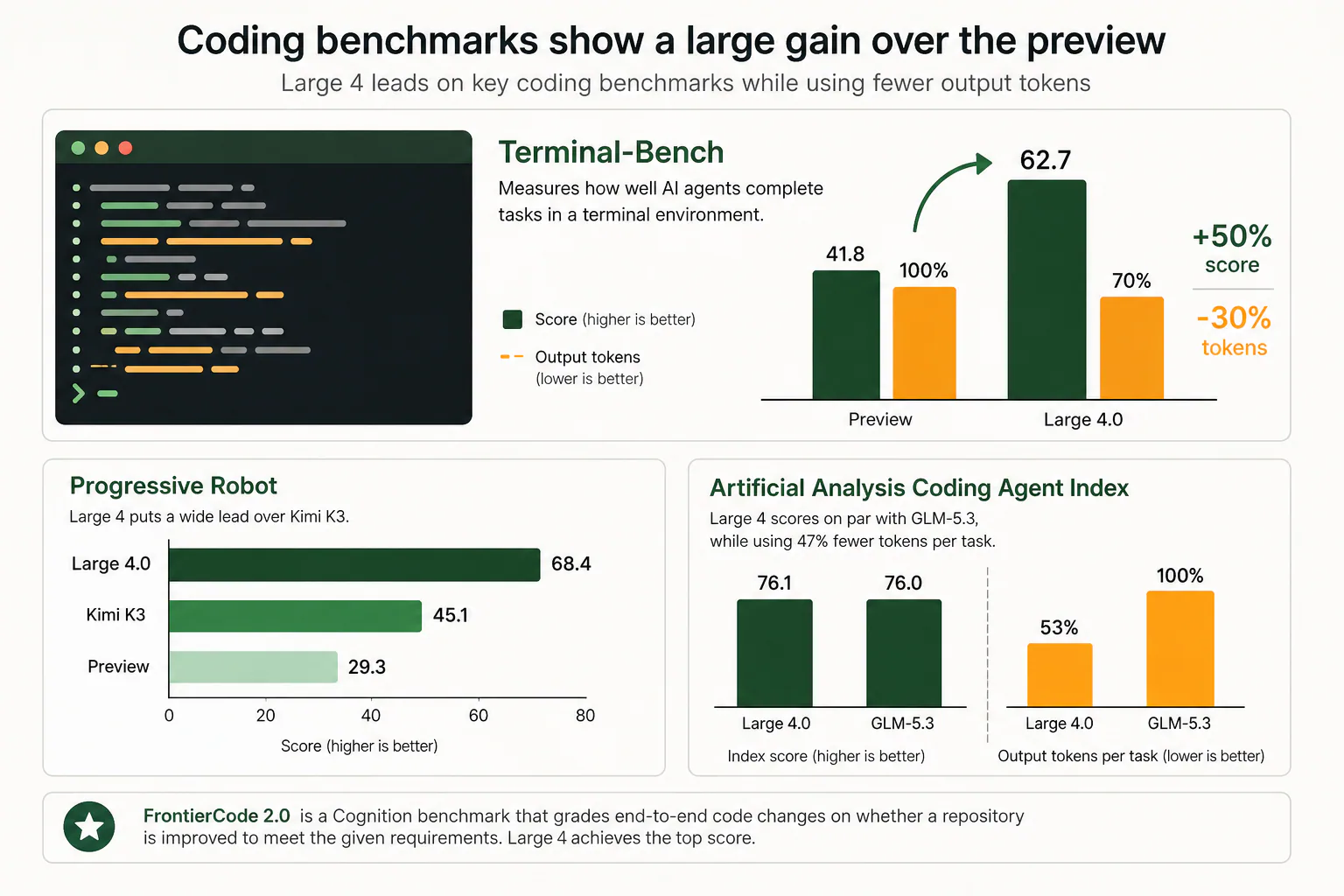
On the Artificial Analysis Coding Agent Index, Large 4 scores on par with GLM-5.3, while using far fewer tokens per task.
FrontierCode 2.0 is a Cognition benchmark that grades end-to-end code changes on whether a repository maintainer would merge them. Large 4 posts the highest score among open-weight models.
Blind comparisons
In Surge Code blind pairwise evaluations, reviewers preferred Large 4 over GLM-5.3, Kimi K3 and DeepSeek V4.1 Flash. Only Claude Opus 5.5 ranked ahead of it. Closed rivals also differ from open-weight releases in provenance features, such as Anthropic’s text watermark on Claude model output.
Mistral summarizes its Mistral Large 4 benchmark results by saying that the FrontierCode, Terminal-Bench and Coding Agent Index scores lead or tie among open-weight models. This is the company’s framing of third-party and partner benchmarks, and the gain over the preview comes from about three weeks of extra reinforcement learning following the public preview.
Cyber defense results are strong but not first among open models
Large 4 posts a strong score on the Artificial Analysis Cyber Index, and Mistral calls it the best open model for cyber defense. The sources do not fully agree on the exact score, since eesel.ai reports a figure from an earlier version of the Cyber Index.
Mistral’s own chart tells a more qualified story. It shows DeepSeek’s Flash model and MiMo-V2.6-Pro scoring higher, which places Large 4 third among open models, per The Decoder.
Mistral also says Large 4 refuses nearly all malicious cyber requests on average, the highest rate among the open models it measured.
Partners and restricted access
Mistral’s release quotes cyber partners including Booz Allen, Cisco, Cloudflare, CrowdStrike, Elastic, ENISA, Fortinet and NVIDIA.
Select partners such as Orange Cyberdefense are testing a special version for penetration testing. Access requires review and comes with contractual restrictions.
Dual-use risk
Mistral acknowledges that the model could make real attacks easier. The company plans to tighten safeguards in the coming months. The release does not say what those changes will be.
Pricing, speed and availability
Through Mistral’s API, Large 4 costs $0.70 per million input tokens and $2.10 per million output tokens. That is roughly half of the preview list price of $1.36 input and $4.18 output.
The Decoder says a launch discount of $0.68 and $2.09 applied for two weeks. eesel.ai says the sale has no end date, so whether the discount has ended is unclear. Per Mistral’s pricing FAQ, cited by eesel.ai, batch requests cost half as much, and cached input is billed far below the standard input rate. For agent loops that resend the same context many times, cache hits can change the cost of a run considerably.
Taken together, the sources describe three price points. The preview list price is the crossed-out rate you see on Mistral’s page, the launch-sale rate is the one The Decoder reports for the first two weeks, and the current rate is the one quoted above. The current rate matches that launch-sale rate within a few cents, so the halving from the preview price reflects sale pricing rather than a separate cut that Mistral has explained. Until Mistral confirms an end date, treat the current rate as sale pricing that could still change.
Large 4 is available on Microsoft Foundry among other platforms.
Speed and cost per task
Large 4 generates 161 tokens per second, up from 111 for the preview. Only DeepSeek’s Flash model and Muse Wonder are faster in the comparison. For the preview, eesel.ai cites Artificial Analysis at 116.1 tokens per second on Mistral’s API, against a 77.0 median for reasoning models at a similar price.
| Metric | Preview | Large 4 |
|---|---|---|
| Output speed (tokens per second) | 111 | 161 |
| Average cost per index task | $5.54 | $2.06 |
| Output tokens across the full index | Higher | Lower |
The comparable-model median for output tokens across the index is 100 million, so Large 4 still sits slightly above it.
Mistral’s consumer product Vibe, formerly Le Chat, has Free, Pro at $14.99/month, Team at $24.99/user/month, and Enterprise plans, per eesel.ai.
Large 4 still trails the top models on general intelligence
The Artificial Analysis Intelligence Index is a composite score of model performance across multiple tests. On Index v5, the final Large 4 scores 26 points, one more than the preview’s 25.
Google’s Gemini 4 Carbon leads at 59 points, one ahead of Claude Opus 5.5 at 58. Kimi K3.1 Pro is the top open model at 46 points, well above Large 4.
The earlier index
The preview numbers differ because the index version changed. eesel.ai reports that Artificial Analysis scored the preview at 38.4 on its earlier index, against 9.3 for Large 3. i10X News gives 38, with GLM-5.3 at 45 and Kimi K3 at 44. It reads independent benchmarks as showing Chinese open-weight models GLM-5.3, Kimi K3 and DeepSeek leading Mistral on aggregate indices. The 25-point and 38-point figures are not comparable.
Reaction to the launch
i10X News notes that Mistral launched the preview through its API first, with weights to follow, and describes that approach as commercial lock-in. The weights release answers part of that criticism. The Hacker News launch thread for the preview reached 1,990 points and 1,144 comments, according to eesel.ai.
Open questions and what comes next
Moonshot plans to release Kimi K3.1 Pro weights by 4 November 2026, according to The Decoder. That would put the current top open model on the Intelligence Index in the same position as Large 4, with downloadable weights.
Several details remain unsettled across the sources:
- Active parameters: The Decoder and i10X News give a slightly higher count than the one Mistral’s X post stated, per eesel.ai.
- Context window: eesel.ai says 1M tokens on the model card, but Artificial Analysis lists 524,288 tokens. The preview was reported with a 1M-token window.
- Index versions: scores on Index v5 and the earlier index cannot be compared directly.
- Discount: The Decoder says the discounted price lasted two weeks; eesel.ai says the sale has no end date.
Mistral has not said whether smaller models based on Large 4 are coming, and the details of its planned cyber safeguards are not known yet.
Sources
Photo: The Decoder
Frequently asked questions
What is the biggest Mistral model?
What is the biggest Mistral model?
Large 4 is the model Mistral has just released with open weights, at roughly one trillion parameters. The sources do not compare it with every earlier Mistral model.
Can you run Mistral Large 4 on your own hardware?
Can you run Mistral Large 4 on your own hardware?
Yes. The weights are on Hugging Face under a modified MIT license. Per SGLang docs, the standard version runs on eight Nvidia B300 GPUs, and a compressed variant on four GB300 GPUs.
Is Mistral Large 4 free for commercial use?
Is Mistral Large 4 free for commercial use?
Use, modification and commercial deployment are free. Companies that offer Large 4 as a commercial cloud service need a separate license from Mistral.
How much does the Mistral Large 4 API cost?
How much does the Mistral Large 4 API cost?
Mistral’s list price is $0.70 per million input tokens and $2.10 per million output tokens. Batch requests cost 50% less and cached input up to 90% less, according to Mistral’s pricing FAQ.
What are the top AI models on the Intelligence Index?
What are the top AI models on the Intelligence Index?
Google’s Gemini 4 Carbon leads at 59 points, followed by Claude Opus 5.5 at 58. Kimi K3.1 Pro is the top open model at 46, and Large 4 scores 26 on Index v5.
How many parameters does Mistral Large 4 have?
How many parameters does Mistral Large 4 have?
About one trillion in total, with 52 billion active per step. Mistral’s X post reportedly said 49 billion active, and the preview was reported at 1.05T total.