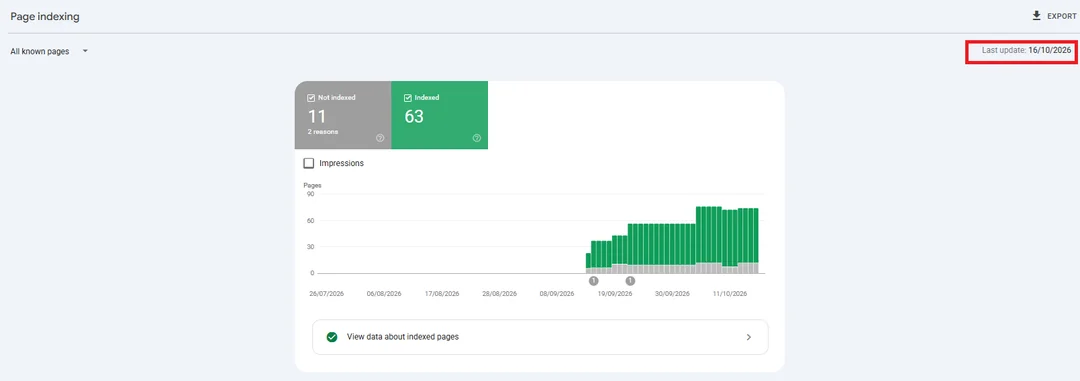
John Mueller of Google has downplayed concerns that the Page Indexing report in Search Console stopped updating, after a Reddit user said it had not changed since October 16. Mueller said indexing moves slowly and that changes show up in performance reports first.
The exchange matters for teams that include indexing data in SEO reporting, because it shows how Google treats the freshness of that report and which other data to consult when it pauses.
- A Reddit user said the Page Indexing report had not updated since October 16 and the graph had flatlined.
- John Mueller said indexing changes slowly and shows up in performance reports first.
- He said Google will not comment on data freshness for every report, which is why dates appear in the reports.
- A similar delay in December 2025 affected reporting only, not crawling, indexing or ranking.
- No resolution date is given for the October freeze.
Mueller tells a Reddit user the stalled indexing graph is not worth worrying about
The discussion began on Reddit, where a site owner raised concerns about the stalled report. Mueller answered there, and both Search Engine Roundtable and Search Engine Journal covered his reply.
What the user reported
The Reddit user said the Page Indexing report in Google Search Console had not updated since October 16. According to the post, the graph had flatlined, meaning it showed no movement since that date.
The report was the user’s concern, not a drop in visibility. The post, as covered by both outlets, describes a chart that stopped moving, not pages that disappeared from search.
What Mueller said
Mueller replied that the site in question is relatively new and that its numbers have been relatively stable. He then made the central point of his answer: “Indexing doesn’t change quickly, and when it does, you see that reflected in the performance reports first.”
On whether Google should say more about the state of each report, he said: “I don’t think it makes sense for me / us to comment on the data freshness for all reports all the time, this is why we put dates in there.”
He also addressed Search Engine Roundtable’s Barry Schwartz and others who write about everything in Search Console. Mueller said “it can feel like it’s important to focus on it, but honestly, save your energy.”
Mueller added a general explanation, saying “Complex systems are complex, and we prioritize faster updates there where we think it’s actually useful for folks.” In his framing, Google chooses where faster updates are worth the effort, and this report is not necessarily one of those places.
Search Engine Journal characterized the response as a suggestion that SEOs should relax about Search Console data freshness.
What the Page Indexing report shows and how to open it
Search Console is a free tool from Google that helps website owners understand how their sites perform on Google Search. Within it, the Page Indexing report shows which pages of a site are indexed and which are excluded, along with the reasons.
The report is reached through the Index menu, then Pages, according to Victorious.
Opening it takes four steps:
- Sign in to Google Search Console.
- Choose the property you want to check.
- Open the Indexing (Index) section in the left-hand menu.
- Click Pages.
A new site may show no data at first. Setup guides note that the report only fills in once a sitemap has been submitted and Google has crawled the site, so an empty chart on a fresh property is normal rather than a sign of a problem.
It replaced an older report. The Index Coverage report was divided into sections for error, valid with warnings, valid and excluded pages, as described by Supple Digital. Its successor covers the same ground, listing pages by status and the reason behind it.
Because the report is built around reasons, it is often the first place owners look when a page does not appear in search. That is also why a graph that stops moving draws attention, even when the site itself has not changed.
The reports carry dates showing when their data was last refreshed. Mueller pointed to those dates as Google’s way of signaling freshness, instead of commenting on each report separately.
How to read the chart
The chart at the top of the report shows two series over time, indexed pages and not indexed pages. Checking the impressions option overlays search impressions on the same timeline, which helps tell whether a change in indexed pages actually affected visibility. When the lines go flat, as in the Reddit post, the date on the chart shows how old the data is.
Below the chart, a table groups not indexed pages by reason, and clicking a reason opens a list of example URLs. The “View data about indexed pages” link opens a similar list for indexed URLs, with the last crawl date for each one. Those crawl dates are useful on their own, because they show Googlebot is still visiting the site even when the totals have stopped moving.
Common indexing statuses and the terms behind them
The report sorts every URL into a status, and each status comes with a reason. Some statuses call for a fix, while others simply reflect choices the site made, so knowing what each one means saves time when reviewing the list.
Not indexed statuses
Victorious lists several statuses that commonly appear in the report:
- Duplicate without user-selected canonical
- Alternate page with proper canonical tag
- URL blocked by robots.txt
- URL marked noindex
- Server error (5xx)
- Redirect error
- Blocked due to unauthorized request (401)
In practice, these statuses split into those that need action and those that do not. “Alternate page with proper canonical tag” is usually fine, because Google is respecting the canonical the site set. “Duplicate without user-selected canonical” means Google picked a canonical itself, which is worth reviewing only if it chose the wrong URL. “URL blocked by robots.txt” and “URL marked noindex” are instructions from the site, so they need a fix only when the page should appear in search. “Server error (5xx)”, “Redirect error” and “Blocked due to unauthorized request (401)” usually point to real problems, such as an unstable server, a broken redirect chain or a login wall in front of a public page.
Once the cause is corrected, the Validate Fix button on the status’s detail page asks Google to recheck the affected URLs, and the report tracks that validation as it runs.
Two further statuses are easy to confuse. According to Cedarwood Digital, “Crawled – currently not indexed” means Google crawled the page but has not indexed it, and the page may be indexed in the future after a recrawl. “Discovered – currently not indexed” means Google found the page but had not yet crawled it.
Terms to know
Two terms in the list need a short definition. A canonical tag tells Google which URL is the preferred version when pages are duplicates. The robots.txt file tells Googlebot which URLs it can crawl and index. A blocked URL that other pages link to can still get the warning status “Indexed, though blocked by robots.txt”, meaning Google indexed the address without reading its content.
Statuses like these describe individual pages, so they help diagnose specific problems. A frozen graph says nothing about any single URL, only that the report’s totals have not refreshed.
What a frozen report means for site owners and what to check instead
Mueller’s guidance points to a practical order of checks. Since changes in indexing appear first in the performance reports, those are the place to look for any real shift in how a site is doing in Google Search.
For a single page, the URL Inspection Tool shows real-time indexing information for a given URL. It does not depend on the Page Indexing report’s refresh schedule, which makes it the direct way to confirm whether a page is indexed.
For availability problems, the Crawl Stats Report shows issues with site availability, according to Victorious and w3era.com. That helps rule out server trouble when a report looks off.
A quick check and a fix workflow
For a first test, a site: search with the exact URL (for example, site:example.com/page) shows whether Google has the page in its index. It is not exhaustive, but on a smaller site with a few dozen pages, a handful of these queries can answer the question faster than waiting for a stalled report to refresh.
When a real problem shows up, the order of work stays the same whatever the cause. First, fix the underlying problem, whether that means removing a stray noindex tag, correcting a robots.txt rule, repairing a redirect or stabilizing the server. Second, open the status in the report and click Validate Fix, which asks Google to recheck the affected URLs. Third, run the most important URLs through URL Inspection, since that tool shows live results even while the chart is frozen. Validation can take days or weeks, so the live check is the faster confirmation.
Agencies that report indexing figures to clients can note the report’s last-updated date next to the numbers, since Mueller named those dates as the place Google signals freshness. Related material on building client reports is in SEO Reporting for Agencies.
The December 2025 delay offers a precedent, and Cutts’s old video adds context
A comparable episode occurred in December 2025. Google confirmed via LinkedIn a longer-than-usual delay in the Index Coverage report and said it affected only reporting, not crawling, indexing or ranking, according to w3era.com.
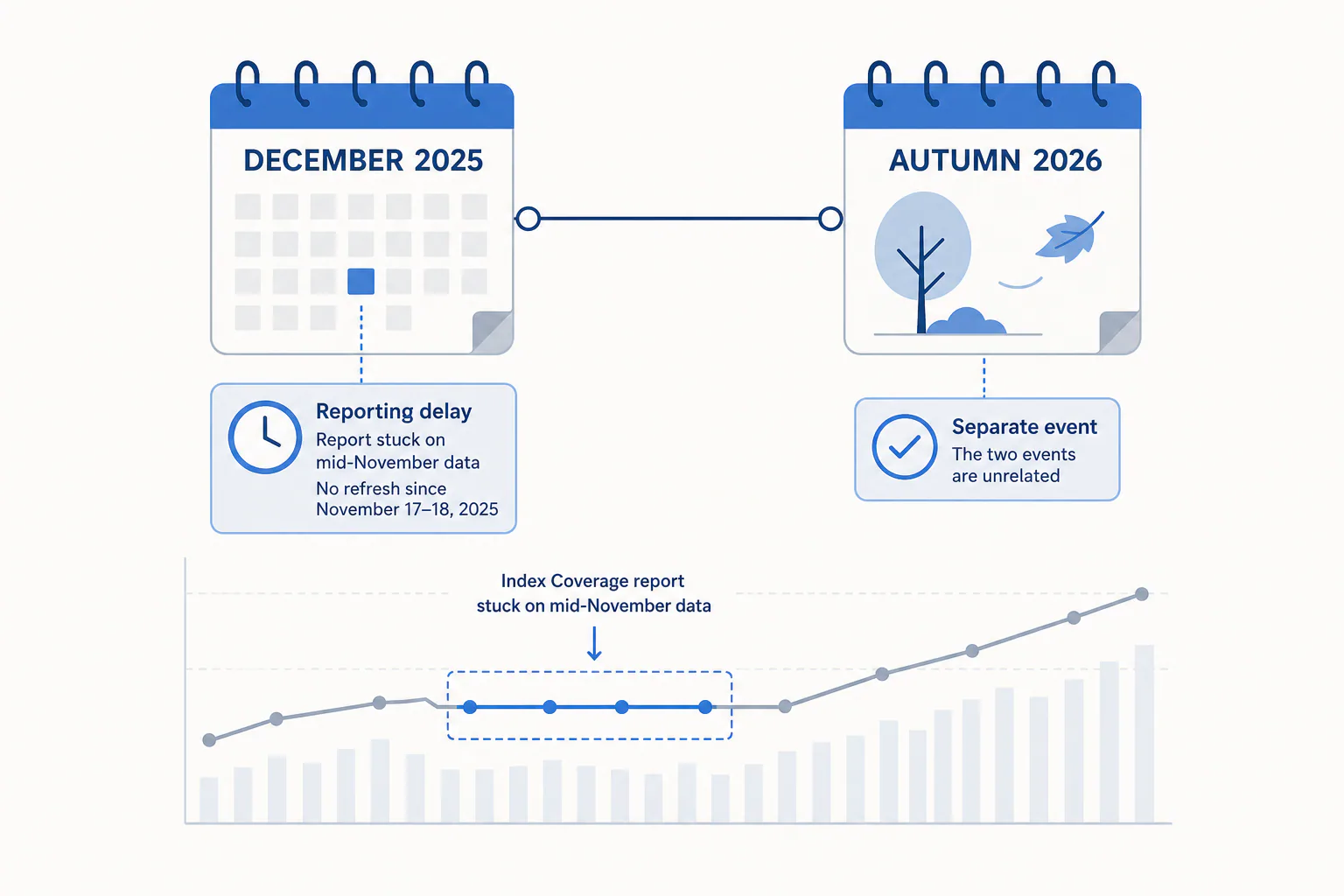
That delay left the report stuck on mid-November data, with no refresh since November 17-18, 2025. During it, Google recommended the URL Inspection Tool for real-time indexing status.
The two events are separate. The Reddit user’s report concerns a stall since October 16, and Search Engine Journal describes the stall the same way, while the December 2025 delay involved a stall from November 17-18, 2025. Nothing in the sources links them.
Mueller also pointed to an older video by former Google engineer Matt Cutts about Search Console, then called Webmaster Tools, and its error monitoring. He did so by searching for the video ID “qHt8WP_euoY”.
In that video, Cutts said Google’s Webmaster Tools team has extensive monitoring for the front end and the pipelines, and that errors are tracked and fixed internally. The reference fits Mueller’s message that Google watches these systems itself, without needing site owners to flag every pause.
Open questions and what comes next
Google committed to sharing an update when the December 2025 reporting delay was resolved. For the October freeze, no date for resolution appears in the sources.
Mueller did not say whether the report is broken or simply delayed. His reply addressed whether the freeze deserves attention, not its cause, so the reason for the stall remains unstated.
Until Google says more, the report’s last-updated date and the performance reports are the available indicators.
Sources
- Search Engine Roundtable
- Search Engine Journal
- Victorious
- Supple Digital
- w3era.com
- Cedarwood Digital
Photo courtesy of Search Engine Roundtable
Frequently asked questions
Has the Search Console Page Indexing report stopped updating?
Has the Search Console Page Indexing report stopped updating?
A Reddit user reported that it had not updated since October 16 and that the graph had flatlined. Mueller did not confirm whether the report is broken or delayed.
What did John Mueller say about the report’s freshness?
What did John Mueller say about the report’s freshness?
He said indexing does not change quickly and that changes appear in performance reports first. He added that Google will not comment on freshness for every report, which is why dates are shown.
Where do I find the Page Indexing report?
Where do I find the Page Indexing report?
It is in Google Search Console under the Index menu, then Pages.
Does a delayed indexing report mean my pages are not being indexed?
Does a delayed indexing report mean my pages are not being indexed?
Not according to the sources. In the December 2025 delay, Google said the problem affected only reporting, not crawling, indexing or ranking. No such statement has been reported for the October freeze.
How can I check a page’s indexing status in real time?
How can I check a page’s indexing status in real time?
The URL Inspection Tool shows real-time indexing information for a given URL.
Has Google had a reporting delay like this before?
Has Google had a reporting delay like this before?
Yes. In December 2025 the report was stuck on mid-November data, not updated since November 17-18, 2025, and Google confirmed the delay via LinkedIn.