
Google rank data collected by tracking tools has been distorted since September 2026 by unrelated one-word listings and unresolved goto redirect URLs, according to SE Ranking and several tool providers. In the same week, PageSpeed Insights moved to Lighthouse 13.6.0, a version that can shift lab scores without any page change.
- SE Ranking found unrelated results, mostly built around one word of the query, starting at position 9 or lower in the vast majority of affected blocks.
- Google now limits how many goto redirect links from one results page can be resolved, so DataForSEO says it will resolve only about half.
- PageSpeed Insights has switched to the new Lighthouse release, and lab scores can change without any change to a page.
- Google, Microsoft and OpenAI plan to honor a shared robots.txt AI training control, but none supports it yet.
- Google has not publicly explained the misleading results.
Rank trackers are collecting one-word results and unresolved redirects
Unrelated listings built around a single word, plus goto URLs that are never resolved to a real destination, can both distort the Google rank data behind ranking reports. PageSpeed Insights changed in the same week, so teams reviewing their numbers are dealing with several shifts at once.

Since September 2026, SEO teams and rank-tracking providers have noticed websites disappearing from Google results and unrelated pages appearing in their place, without an obvious error.
On Nov. 3, SE Ranking published a review of 10,000 Google US desktop keywords that found unrelated listings in its flagged cases. In that study, most of the cases with unrelated results were about just one word from the search query.
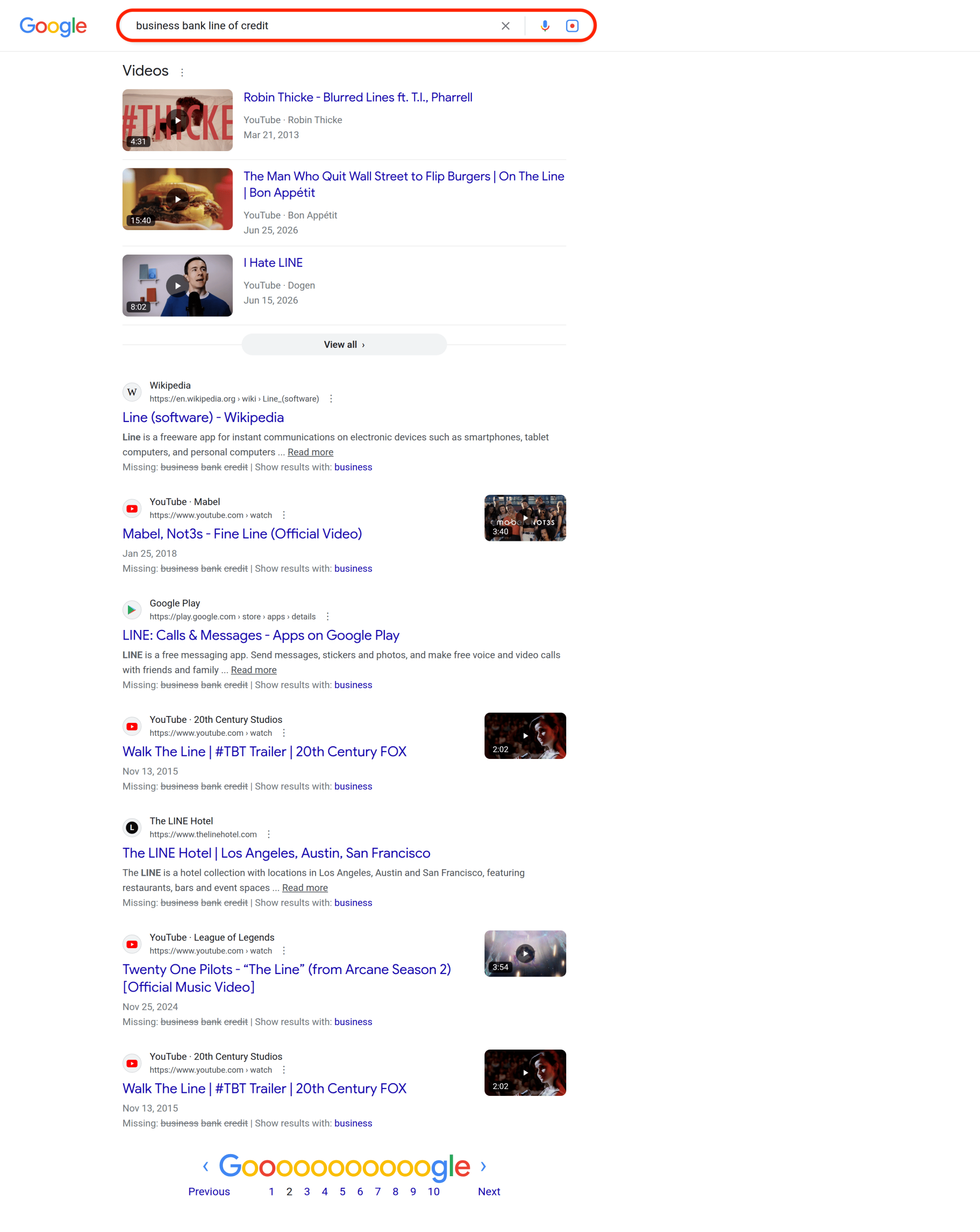
One example shows how this looks in practice. The query “business bank line of credit” returned results about the word “line”, such as the Line messenger app, The Line Hotel and Florida Georgia Line, instead of business financing.
Where in the results the unrelated listings appear
The unrelated blocks sit low on the page. In SE Ranking’s study, nearly all blocks with unrelated results began at position 9 or lower, a small share began at positions 6-8, and none appeared in the top five.
That placement means a site ranking in the top five is unlikely to be pushed out by these blocks, but listings lower down can be replaced or shifted in the Google rank data a tool records.
SE Ranking describes an unrelated SERP, sometimes called a “poisoned SERP”, as a results page returned to an automated check that looks valid but contains misleading results. The definition matters because the page looks normal to the tool collecting it, so nothing flags an error.
How widespread the problem is depends on who measures it
The scale differs by provider, and each uses its own methodology, so the figures are not directly comparable.
| Provider | What it reported |
|---|---|
| SE Ranking | Affected keywords jumped from almost none on Sept. 16 to more than half on Sept. 17; the peak came on Sept. 24 |
| Nozzle (Oct. 21) | A sizable share of assessed SERPs since Sept. 13 classified as poisoned, with the daily peak on Sept. 30 |
| Keyword.com (Nov. 1) | A notable share of SERPs from Sept. 13 to Oct. 14, compared with almost none in August |
| Nozzle (weekly share) | A small share in mid-October, rising noticeably during the week of Oct. 26 |
The two Nozzle figures look far apart because they measure different things: one is a share of all assessed SERPs since Sept. 13, the other a weekly share of impacted SERPs, and the company uses different methodologies for them.
What the numbers share is the timing. All of them place the break in Google rank data in mid-September, followed by a high stretch through late September and a lower but persistent level in October.
Goto redirect links and the new resolution limit
Goto links are Google redirect URLs that point to the ranked page. Rank trackers must resolve them to find the actual destination, and without that step a tool cannot tell which site holds a given position.
In reports, these links usually appear in a wrapper form such as google.com/goto?url=…, with the real destination encoded in the parameter rather than shown as a plain address. The wrapper cannot be read directly, so a tool has to request each link and follow the redirect to learn where it leads. That means at least one extra request per result on top of the request for the results page itself, which is why a limit on resolution leaves gaps.
DataForSEO states that Google has implemented a mechanism limiting how many goto links from a single results page can be resolved over a given timeframe. As a result, its High Priority and Live modes will now only resolve approximately half of goto URLs.
Other providers show the same pattern on their status pages. Serper lists the limitation of goto URLs as starting on Oct. 30. SerpApi opened its second incident of goto links replacing direct links on Nov. 3, and it still showed as Identified when last reviewed on Nov. 4.
Why collecting complete rank data costs more
Collection costs had already gone up before the goto limit. Google removed the num=100 parameter in September 2025, so a tracker that once fetched 100 results in a single request now needs ten requests of ten results each. Resolving goto links adds further requests for every result on those pages, which raises the cost of complete ranking data again.
For anyone reading rank reports, the practical effect is gaps or unresolved entries in Google rank data that used to be complete. Related changes to how results are collected have been discussed before, including the possible return of the num=100 results parameter.
What SEO teams should do with their Google rank data
SE Ranking recommends checking Search Console impression and click reports for the same query to determine which factor caused a ranking issue. Search Console data comes from Google itself rather than from an automated check, so it shows whether a drop reached real searchers.
A tracker showing a site missing from its Google rank data while Search Console impressions and clicks hold steady points to a data-collection problem. A fall in both points to a genuine change in visibility.
Analytics deserve a check too. If goto redirects strip the referrer, some organic visits could be recorded as direct traffic in GA4, so a drop in organic sessions alongside a rise in direct sessions may point to the redirects rather than to lost rankings.
Tool vendors are also adjusting. SE Ranking says that in October it rolled out a mechanism that detects unreliable Google results pages and filters them out before they reach users’ reports. It also says it re-checked and corrected affected September and early October ranking data.
Teams that kept reports from that period can compare them with corrected data from their provider, and ask other vendors whether similar filtering or corrections exist.
It also helps to treat the period from mid-September onward as a break in the historical series rather than a normal trend. Annotating ranking charts at the date the distortion began keeps later comparisons honest. Each vendor’s own statement about which of its tools were affected shows how far its corrected figures can be trusted, and providers have described their situation differently, so the statement from your own provider is the one to check.
Why Google is returning these results is unconfirmed
Google has not publicly explained the misleading results. Any explanation of the cause is speculation.
Nozzle’s Derek Perkins theorized that Google is disrupting AI scraping by returning misleading results instead of blocking automated requests. That is unconfirmed.
Cloro’s Ricardo Batista argues that Google appears to direct some automated traffic to a lower-quality set of results. That is also unconfirmed.
Both explanations tie the behavior to automated requests rather than to ordinary searchers, which would fit the pattern of blocks showing up in Google rank data collected by trackers.
Lighthouse 13.6.0 can change PageSpeed Insights lab scores
PageSpeed Insights now runs the new Lighthouse release, and it updates the loading simulation used for its lab scores. Details are also covered in the PageSpeed Insights Lighthouse 13.6.0 update article.
Lighthouse is Google’s tool for lab-based page performance scores, and Lantern is the simulation it uses to estimate loading metrics. Lantern now uses Chrome’s render-blocking label for every request and defaults to fetch priority when the label is missing.
Google’s Barry Pollard said on Bluesky that the updated simulated FCP and LCP will be more accurate and generally give better results. He added that JavaScript-intensive websites are more likely to be affected by the new version.
A score change after the update therefore does not necessarily mean a page changed. Teams that track lab scores over time should expect a jump in their charts around the switch.
Field data in the same PageSpeed report is different. It comes from real user data, not from synthetic tests like Lighthouse, so it is not affected by a change to the simulation.
A shared robots.txt control for AI training is announced but not yet supported
On Oct. 30, Google, Microsoft and OpenAI announced that they plan to honor a shared robots.txt control for AI training preferences. Google’s post says it is based on work from the AIPREF working group at the IETF and is an Internet-Draft by Anthropic’s Kevin Kelley.
How the control works
robots.txt is a file that tells crawlers which parts of a site they may access. The shared control uses a policy token called __usage_ai-training, placed in a normal robots.txt group with Allow and Disallow rules.
Google-Extended is a robots.txt control that lets sites opt out of Google AI training, and Google has offered it since 2023. When a site uses the policy token to opt out of training and Google-Extended is not explicitly specified, Google plans to treat it as if the publisher had disallowed Google-Extended.
Existing company-specific controls, such as Google-Extended, will continue to work alongside the shared signal.
Grounding and the EU context
Google’s robots.txt documentation states that Google-Extended also covers grounding in Gemini Apps. Websites that specifically allow it are eligible to appear in responses and receive clicks via grounding in Gemini Apps.
Google’s post says the shared control is consistent with the EU Code of Practice for General Purpose AI Model Providers under the EU AI Act, which recognizes robots.txt as a primary method for web publishers to express machine-readable preferences.
Microsoft and timing
Microsoft will use the shared control for training and will introduce a separate page-level AI Grounding preference. It will stop treating NoArchive and NoCache as training and/or grounding preferences after March 1, 2027.
As of the announcement, none of the three companies supports the shared control, according to their publicly announced timelines. Google plans to support it along with other AI providers in 2027, and says it will keep working with stakeholders to refine and standardize it through the IETF working group.
Technical SEO and AI traffic in context
John Mueller said in an interview posted Oct. 29 from Search Central Deep Dive Europe 2026 that AI systems “build on SEO” and that technical SEO will stay relevant. He described AI crawlers requesting sites with different intents, such as training versus getting the latest content, as “another flavor of technical SEO”.
Traffic numbers show why Google still dominates the picture. OpenAI’s ChatGPT consumer product lead Adam Fry told Big Technology that ChatGPT’s search-like query volume is roughly one-fifth of Google’s.
Ahrefs’ referral tracker shows Google sending far more of the tracked traffic across 118,671 sites during October than ChatGPT, which accounted for only a sliver.
Sources
Photo: Search Engine Journal
Frequently asked questions
What are poisoned or unrelated SERPs?
What are poisoned or unrelated SERPs?
SE Ranking describes them as results pages returned to an automated check that look valid but contain misleading results.
How can I tell if a ranking drop is real?
How can I tell if a ranking drop is real?
SE Ranking recommends checking Search Console impression and click reports for the same query to determine which factor caused the issue.
What are Google goto links and why do they affect rank trackers?
What are Google goto links and why do they affect rank trackers?
Goto links are Google redirect URLs that point to the ranked page. Trackers must resolve them to find the actual destination, and Google now limits how many can be resolved per results page over a given timeframe.
Will Lighthouse 13.6.0 change my PageSpeed Insights score?
Will Lighthouse 13.6.0 change my PageSpeed Insights score?
It can change lab scores without any page change, and JavaScript-intensive sites are more likely to be affected. Field data comes from real users and is not synthetic.
Has Google explained the misleading results?
Has Google explained the misleading results?
No. Google has not publicly explained them, and the theories from Nozzle and Cloro are unconfirmed.
When will the shared robots.txt AI training control work?
When will the shared robots.txt AI training control work?
Google plans to support it along with other AI providers in 2027. Microsoft’s change to NoArchive and NoCache applies after March 1, 2027.