Google may be bringing back the num=100 URL parameter, which shows 100 Google Search results on a single page, according to Search Engine Roundtable. The evidence so far is one observation by Brodie Clark, and the report’s author could not reproduce it. The parameter matters to anyone who tracks rankings, because its removal in September 2025 changed Search Console data and made keyword rank tracking less effective.
- Search Engine Roundtable reports Google may be restoring num=100, the URL parameter that shows 100 results per page.
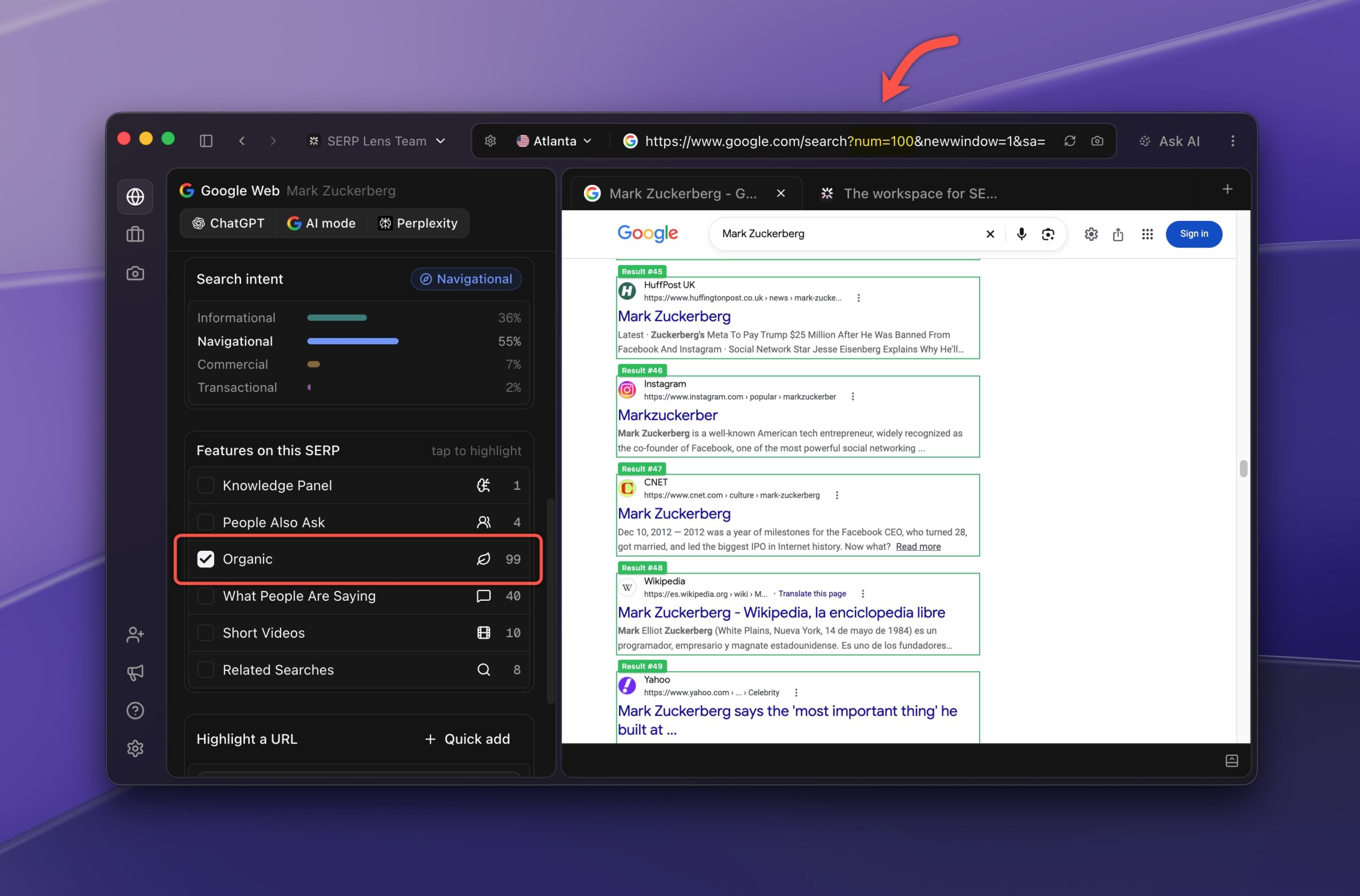
- Brodie Clark saw 99 organic results after clicking a knowledge panel result whose URL included num=100.
- The article’s author tried multiple browsers and could not replicate it. The return is unconfirmed.
- Google disabled the parameter in September 2025, and Search Console impressions and rank trackers were affected.
- Clark’s SERP Lens data suggests /goto links are bypassing earlier workarounds, which may matter for rank trackers.
Google may be restoring 100 results per page, but the evidence is thin
Search Engine Roundtable reports that Google may be bringing back the ability to see 100 Google Search results per page through the num=100 parameter. The report rests on one person’s observation, not on an announcement from Google.

Brodie Clark posted on X and LinkedIn that Google seems to have brought back the ability to use num=100 in some capacity. The phrasing is hedged. “In some capacity” points to a behavior that shows up in certain situations rather than a switch flipped for every query in Google Search.
Clark described the path he took. He ran a query in Google Search, clicked a knowledge panel result, and then noticed that the URL of the page he landed on included num=100. That page showed 99 organic results. A page set to 100 results would be expected to show close to that number, and 99 organic results is in line with it. The report does not say why the count was 99 and not 100.
Clark also posted a screenshot of the result. The screenshot documents what he saw on his own screen. It does not show whether other users, other locations or other accounts would get the same page.
Why the sighting remains unverified
The author of the Search Engine Roundtable report tried to reproduce the behavior across multiple browsers and could not. That leaves the sighting unverified. A result reached through one specific route, a click on a knowledge panel result, is not evidence of a general change.
The return of the parameter is therefore unconfirmed. The facts available include no statement from Google and no second independent confirmation. Any conclusion beyond “one SEO saw it once and a second person could not repeat it” would go further than the evidence.
What counts as confirmation
The report supplies the test implicitly: whether others can load a Google results page with num=100 in the URL and see 100 results. So far, one person says yes through a particular path, and the Roundtable writer says no across several browsers. Until more people try and report back, the two accounts stand side by side without resolution.
What the num=100 parameter does and why it mattered
A URL parameter is an extra instruction added to a web address. The num=100 parameter is a URL setting that displays 100 results on one Google Search results page (SERP) instead of the default 10. Adding it to a Google Search address meant a person, or a tool, could see the first 100 results in a single page load.
The difference is tenfold. With the default of 10 results per page, covering the same 100 positions takes ten separate pages. With the parameter, it takes one. That ratio explains why the parameter was useful to anyone collecting Google Search result data at scale.
| Setting | Results on one page | Pages needed to see 100 results |
|---|---|---|
| Default | 10 | 10 |
| With num=100 | 100 | 1 |
Google Search Console is Google’s tool for site owners to track Google Search impressions, clicks and rankings. Its figures describe how a site appeared in Google results. Because they are recorded by Google, a change in how results are requested or displayed can show up in the numbers.
Keyword rank tracking tools relied on the parameter as well. These tools check where a page ranks in Google Search for a given term, and pulling many results in one request was a practical way to do it. After the parameter was removed, tools that relied on it became less effective.
For agencies and content teams, that makes the parameter more than a curiosity. Position reports for clients come partly from Search Console and partly from third-party trackers, and both were affected by the same one-line change in a URL.
The /goto links Clark spotted may affect rank trackers
Clark pointed to a second detail. Through SERP Lens data, he noticed that /goto links are bypassing previous workarounds. SERP Lens is the data source named in the report for this observation.
According to Search Engine Roundtable, this is likely an issue for some rank trackers too. The report does not name which trackers could be affected. It also does not say how the links interact with the workarounds adopted after the parameter was disabled.
Two questions remain unanswered by the facts. One is what a /goto link does in this context. The other is whether it connects to the num=100 behavior Clark saw after clicking a knowledge panel result. All the report states is that the links appear to get around earlier workarounds.
The practical reading is narrow. Trackers built workarounds after the removal, and a link type that sidesteps them could change what those tools collect. Whether any tracker’s output has actually changed is not known from the available facts.
How Google removed the parameter in September 2025 and what changed
Google quietly disabled the &num=100 parameter in mid-September 2025. stellarising.com gives September 12, 2025, while other reports, including seo-kreativ, give September 14. Search Engine Roundtable gives only the month, September 2025. The sources agree on timing and differ only on the exact day.
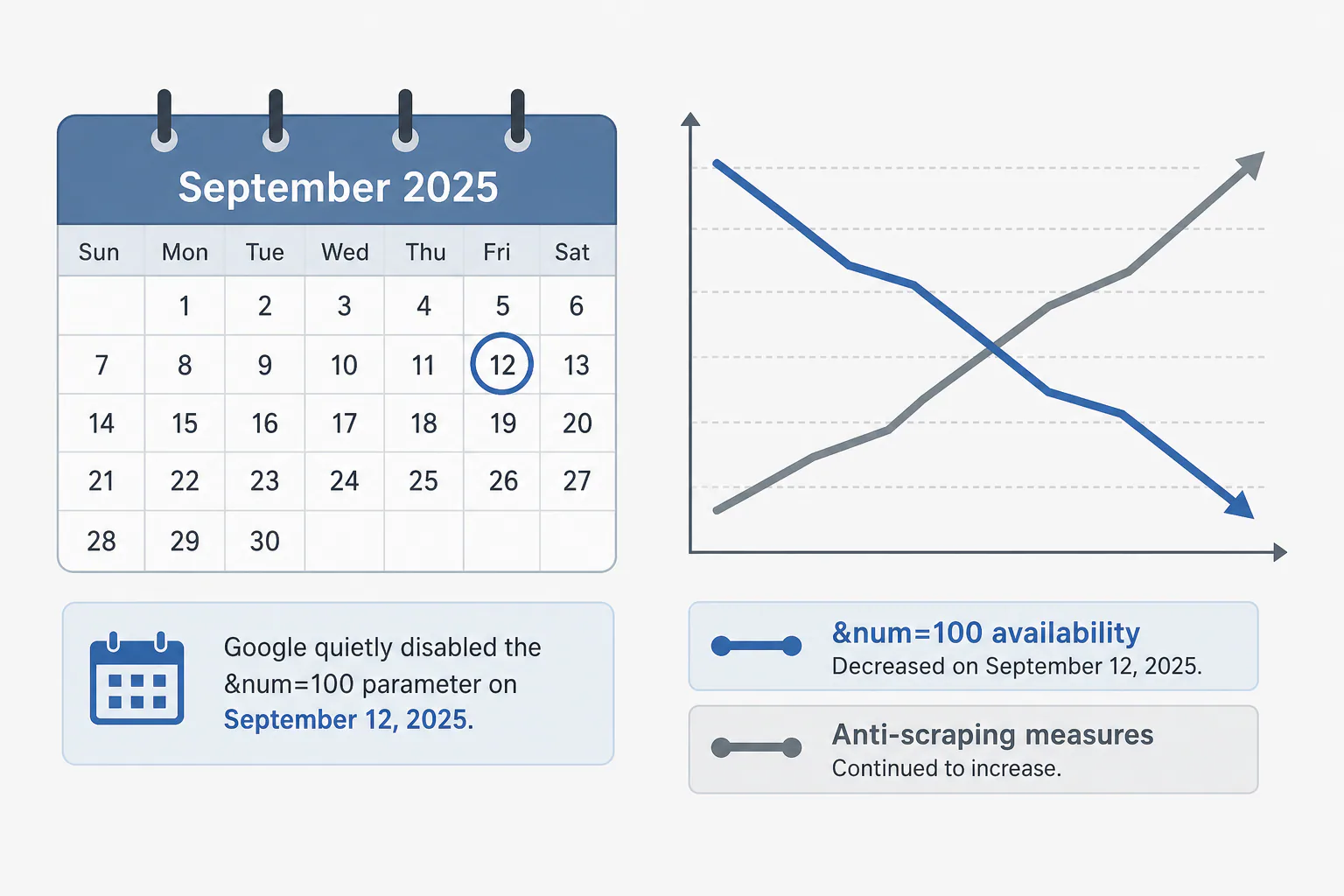
Search Engine Roundtable describes the removal as one of many methods Google uses to prevent crawlers from scraping Google Search results. A crawler is a program that visits pages automatically to collect their content. In that framing, the change targeted automated collection of results rather than ordinary searchers.
Google has not provided an official explanation for removing the parameter, according to stellarising.com. The anti-scraping reasoning comes from Search Engine Roundtable’s coverage and is not a statement quoted from Google in the facts available here.
Another explanation circulates widely in SEO coverage. Several reports connect the removal to AI systems and fan-out searches, in which one prompt triggers many background queries, each of which could pull large volumes of results through the parameter. Under that theory, bots feeding AI tools were a main target of the change. Google has not confirmed this motive, so it remains a reported theory and not an established cause. AI features are shaping other Google rules too, including a privacy policy exception for AI Mode ads that covers ad personalization.
Effects on Search Console data
From September 15, 2025, Google Search Console data started showing declines in impression data and improvements in average ranking data. The shift followed the removal within days.
One reported explanation is that some impressions counted in Search Console were inflated by bot traffic from automated tools scraping results with the parameter. A tool that loaded 100 results in one request would have caused the sites listed on that page to be counted as appearing, including sites far down the list. Once the parameter was gone, that source of counts shrank.
That reading fits both changes in the data. Fewer low-position appearances would lower total impressions, and because those appearances sat at deep positions, removing them would lift the average ranking. The stellarising.com source describes the inflation as reported, not as confirmed by Google, so it is an explanation and not an established finding.
The parameter is probably not the only cause of the shift. According to several reports, including Brodie Clark’s posts, Google later acknowledged a separate Search Console data anomaly on its data anomalies page, with effects dating back to May 2025. That issue has nothing to do with scrapers, so part of the change in impression figures may come from it rather than from the removal. Comparisons across 2025 are best read with both causes in mind.
Effects on rank tracking
Rank trackers also became less effective after the change, as noted above. Tools such as Semrush and Accuranker, which had relied on num=100, reported disruption. Those tools’ later workarounds are the ones Clark says /goto links may now be bypassing.
The workarounds came with trade-offs. Without num=100, a tool has to make ten sequential requests, using the start= pagination parameter to step through positions 1 to 100, which reports say raised collection costs up to tenfold. Some vendors turned to paid SERP API providers such as DataForSEO or SerpApi. Others switched to reporting page one by default and checking deeper positions less often. Each route trades depth, update frequency or cost against the others, which is why tracker data after September 2025 can look thinner than before.
Timeline of the reported events
| When | What happened | Source |
|---|---|---|
| Early September 2024 | The term Great Decoupling was coined as impressions climbed while clicks fell | stellarising.com |
| September 12-14, 2025 | Google quietly disabled the &num=100 parameter | stellarising.com (September 12), seo-kreativ (September 14) |
| September 15, 2025 | Search Console began showing lower impressions and better average rankings | stellarising.com |
| Latest report | Clark saw num=100 with 99 organic results; the report’s author could not replicate it | Search Engine Roundtable |
What it meant for reporting
Reports that compare periods across mid-September 2025 span a change in how the data was generated. A drop in impressions after that date, paired with a better average position, is consistent with the reported explanation and does not by itself indicate a change in a site’s performance. Teams that label figures as measured, calculated or estimated have a reason to note the date alongside any before-and-after comparison.
The removal followed the Great Decoupling in impressions and clicks
The September 2025 change came a year after another shift in how SEOs read their data. In early September 2024, the term Great Decoupling was coined as SEOs saw impressions climb while clicks declined.
Placed side by side, the two episodes show impressions moving in ways that did not match click activity. In 2024, impressions rose while clicks fell. In September 2025, impressions in Search Console declined after the parameter was disabled, while average rankings improved.
The facts do not state that the two developments are causally linked. They also do not say how much of the earlier impression growth came from automated scraping. They do report that some impressions were inflated by scraping tools using the parameter, which offers one possible reading of why impression figures changed when the parameter went away.
For anyone reading impression charts, the lesson from both episodes is the same: impressions and clicks are separate measures, and a gap between them has more than one possible cause.
Open questions about whether the parameter is really back
It is unclear whether what Clark saw is a test, a bug or a real reversal. The facts offer no confirmation of any of the three, and the Roundtable writer could not reproduce the behavior.
Google has not explained the original removal, so a return would also arrive without explanation. Further reproductions by other SEOs would show whether the sighting is isolated, as would any reaction from rank tracking vendors. If the parameter does return, Search Console figures and tracker output could shift again, and the date of any change would be the reference point for reading them.
Sources
- Search Engine Roundtable
- stellarising.com
- Google Search Console Help: Data anomalies in Search Console
Photo: Search Engine Roundtable
Frequently asked questions
Is the num=100 parameter back?
Is the num=100 parameter back?
Unconfirmed. Brodie Clark reported seeing it work to some extent, with 99 organic results shown, but the Search Engine Roundtable author could not replicate it across multiple browsers.
What does the num=100 parameter do?
What does the num=100 parameter do?
It is a URL setting that displays 100 search results on one page instead of the default 10.
When did Google remove num=100?
When did Google remove num=100?
Google quietly disabled the &num=100 parameter on September 12, 2025, according to stellarising.com. Search Engine Roundtable says September 2025.
Why did Google remove num=100?
Why did Google remove num=100?
Google has not given an official explanation, according to stellarising.com. Search Engine Roundtable describes the removal as one of many methods to prevent crawlers from scraping search results.
How did the removal affect Google Search Console data?
How did the removal affect Google Search Console data?
From September 15, 2025, Search Console data started showing declines in impressions and improvements in average ranking. Some impressions were reportedly inflated by automated tools scraping results with the parameter.
Why does num=100 matter for rank tracking tools?
Why does num=100 matter for rank tracking tools?
Keyword rank tracking tools relied on the parameter, and they became less effective after it was removed.