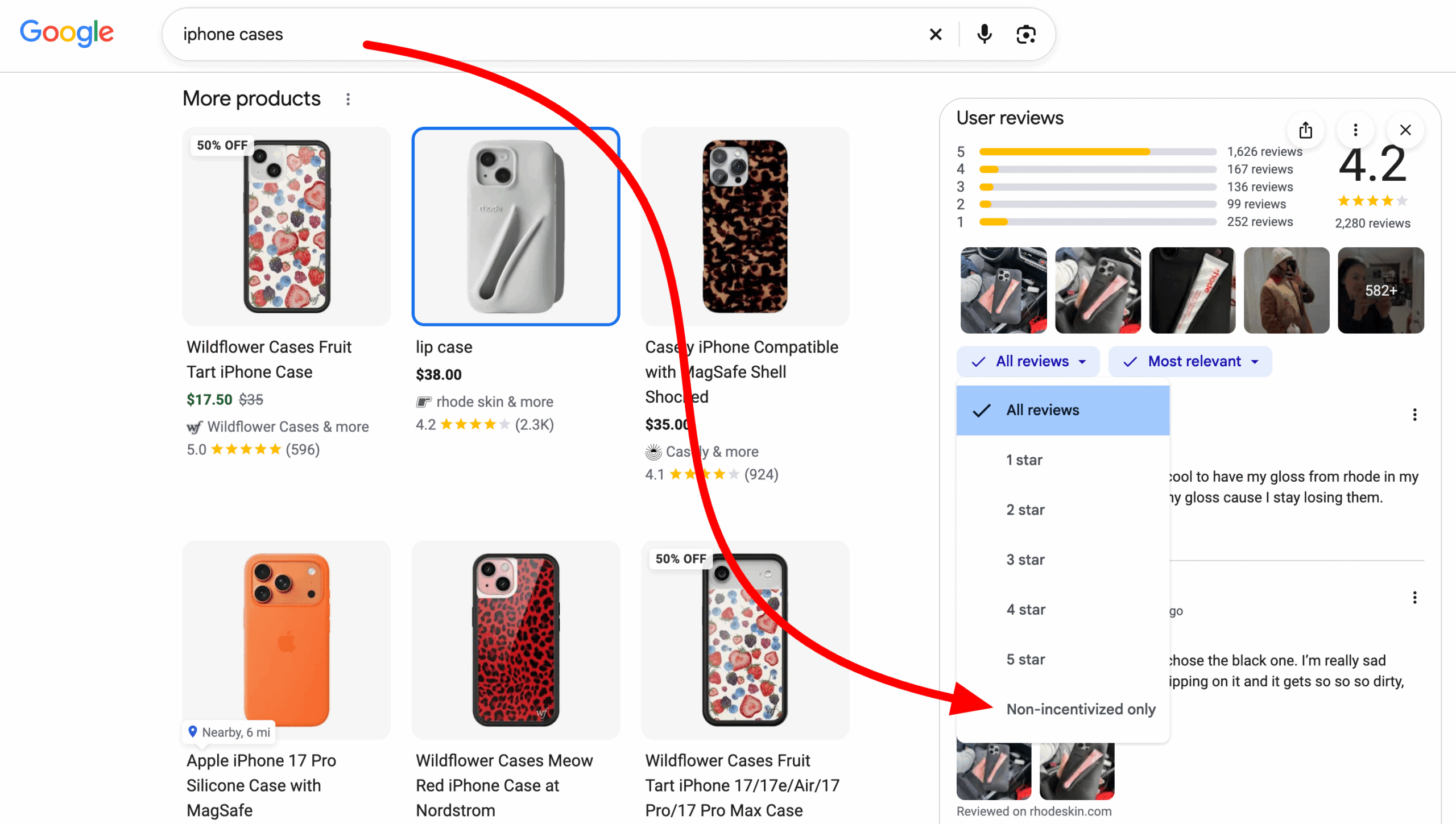
Google has added a non-incentivized reviews filter to product results, letting users narrow reviews to those labeled “Non-incentivized only”. The option works in Google Search, Google Shopping and AI Mode, according to a report published on 10 November 2026 at 12:11 UTC.
What the non-incentivized reviews filter does
The filter limits the reviews shown for a product to those carrying a non-incentivized label. Its name in the interface is “Non-incentivized only”, and it is applied by the user inside the product view rather than set globally.

Non-incentivized reviews are reviews not given in exchange for a reward. Which reviews count as non-incentivized is not decided by the filter itself: it depends on how merchants labeled them under Google’s requirement.
That makes the filter a presentation layer. It does not verify a review’s origin on its own; it exposes a label that merchants were already required to supply.
Incentivized reviews still display by default. Without the filter applied, the product panel shows the full review pool, rewarded reviews included, and the filter is a secondary option that many shoppers may never use. It changes only what the shopper sees in the panel, not which reviews merchants submit.
Where it appears
The filter sits in the product listing detail panel. That panel opens on the right side of the screen when a user clicks a product in search results.
It is available in normal Google Search, in Google Shopping and in AI Mode. The screenshot published with the report was taken in Google Search.
How widely it shows up
In the reporter’s own testing, the filter appeared for almost all product listings and queries. The word “almost” matters: the report does not claim every listing carries it, and no list of exceptions has been given.
The report describes what the reporter saw in testing. It does not describe a formal launch, a staged rollout or a list of supported countries.
The labeling requirement behind it
About a year before the report, Google began requiring merchants to label whether their reviews were incentivized or not. That step came first. The filter now puts the resulting data in front of shoppers.
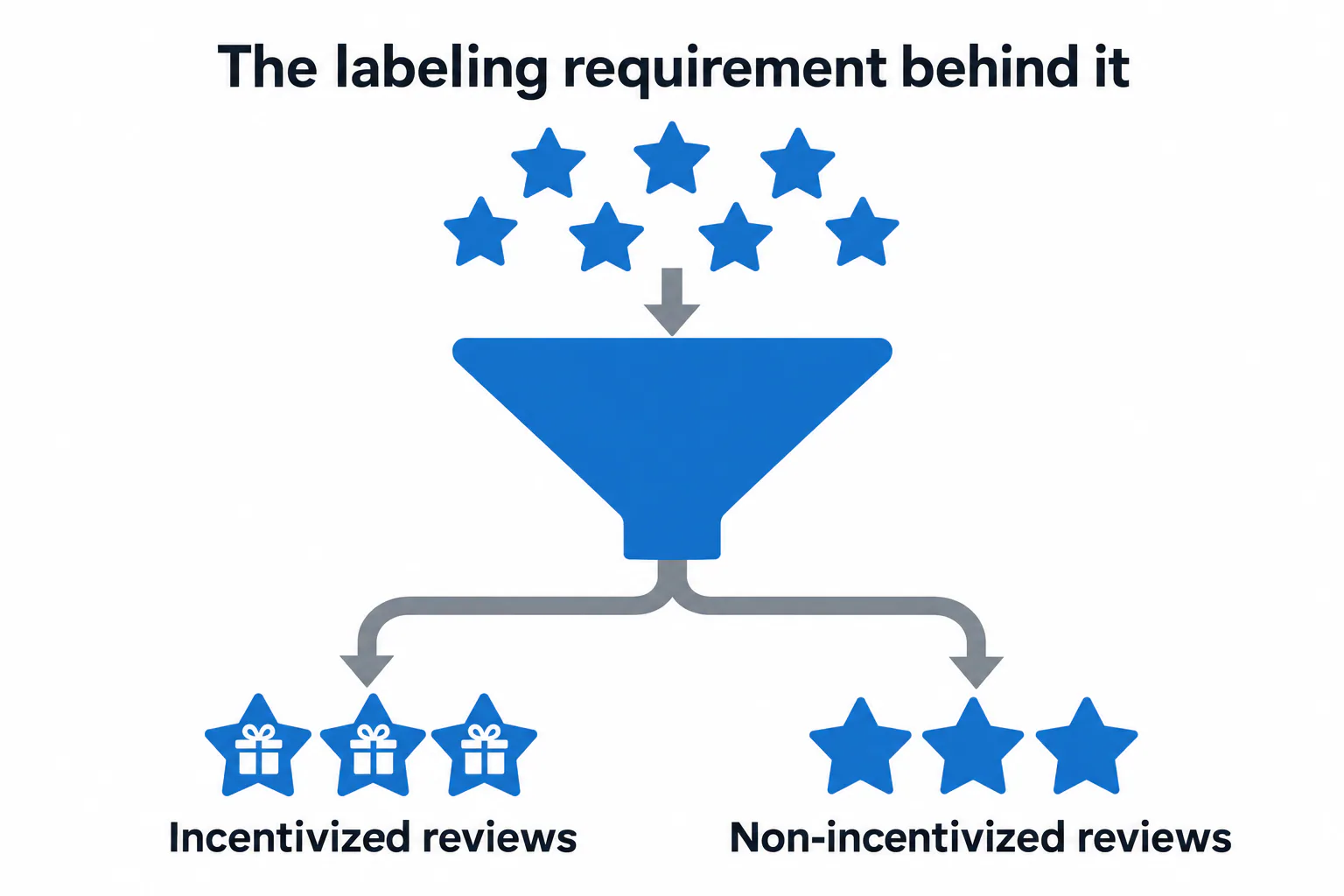
Until a label can be filtered on, it is mostly a piece of merchant-side data. Once a shopper can switch to “Non-incentivized only”, the accuracy of that label has a visible effect on what appears on the screen.
Under Google’s rules for Google Merchant Center reviews, a review counts as incentivized when the reviewer received something of value for writing it, such as a gift card, a discount, reward points or a free product. A non-incentivized review is one written without any such reward. The incentive also cannot depend on what the review says, so a merchant may not reward only positive reviews or ask for a higher rating in return.
What the filter changes in practice
Reviews that merchants labeled as incentivized are what the filter sets aside. A product whose review pool is built largely on rewarded reviews would show fewer reviews when the filter is on, and one whose reviews are mostly unrewarded would show little difference.
How the star rating itself behaves with the filter applied has not been described in the report. Whether the displayed average is recalculated from the remaining reviews is not stated.
How it relates to other Google review systems
Google runs several review systems, and the new filter sits among them. Two of them are easy to confuse with product reviews. These are Google Customer Reviews and Google Business Profile reviews.
Google Customer Reviews
Google Customer Reviews is a Merchant Center program that gathers feedback from customers through a survey after they complete a purchase. Only verified buyers contribute, which separates it from open review systems.
Merchants taking part must display a survey opt-in to all users after checkout. The resulting reviews appear on Google Shopping and Google Ads, and on merchant websites through a badge.
Its data feeds store ratings, meaning a one- to five-star aggregate score shown on search ads and Shopping ads.
Business Profile reviews
Google Business Profile reviews are a different product. They are public ratings visible on Google Maps and Search, and anyone with a Google Account can write one.
The key difference is the contributor pool. Customer Reviews are limited to verified buyers; Business Profile reviews are open to any account holder. The facts available do not say the new filter applies to Business Profile reviews, so it should be treated as a product-results feature.
Comparison at a glance
- Google Customer Reviews: collected through a post-purchase survey, verified buyers only, shown on Google Shopping, Google Ads and merchant sites via a badge.
- Business Profile reviews: public ratings on Google Maps and Search, open to anyone with a Google Account.
- Non-incentivized filter: a user-side option in product results, based on merchant labels about whether reviews were rewarded.
What it means for merchants and SEO teams
For merchants, the labeling requirement now has a visible consequence. A mislabeled review pool can mean a product looks different under the filter than the merchant expects, and the label is the only input that has been described.
Teams handling product feeds for several stores have a concrete task. They should check how review sources are labeled in each account’s Product Ratings feed and whether the labels match how the reviews were obtained. Where a store collects reviews through Google Customer Reviews, the survey opt-in after checkout is a stated requirement.
For agencies, a client report that cites star ratings now comes with a caveat. Ratings seen with the filter off may not match what a shopper sees with it on, and the report gives no explanation of how the two relate. Google’s guidelines for review snippet structured data point the same way, since fake or undisclosed incentivized reviews may not appear on the page or in its markup, while disclosed ones remain allowed.
No data on the filter’s effect on rankings, click rates or conversions has been published. Any claim about its impact on traffic or sales would be unsupported at this point.
Tagging incentivized reviews in the feed
In the Product Ratings feed, merchants mark each rewarded review with the is_incentivized_review attribute. The feed has to carry every review a store collects, positive, negative and incentivized alike. A low-star review cannot be left out because it was incentivized, and the reward cannot depend on the rating the reviewer gives.
These rules explain how the problems described above can arise. If rewarded reviews go untagged, the filter may not set them aside, though how unlabeled reviews are treated has not been described. If low-star rewarded reviews are held back, the pool leans toward praise, and the aggregate star rating can sit higher than the full set of reviews would justify. That is why the open question about how the displayed average behaves under the filter matters to merchants.
What it means for shoppers
Shoppers gain a way to read only reviews that were not given for a reward, directly in the panel where they already compare products. The filter is placed where a click on a product already leads, so no separate tool is needed.
The filter is also reachable from AI Mode, so shoppers who compare AI Mode product reviews are not left out. How well merchants label their reviews determines how much the filter can be trusted, a point the reporter did not test.
What is still not known
- Whether Google has issued an official announcement or help documentation for the filter.
- Whether the filter is available in every country and language.
- Whether the filter is ever on by default. The report describes it as an option.
- How reviews with no label, or with an incorrect one, are handled.
- Whether the displayed star rating changes once the filter is switched on.
- Whether the filter applies to Business Profile reviews. The report covers product listings only.
- Which products and queries are in the small group where the filter did not appear.
Sources
Photo via Search Engine Roundtable
Frequently asked questions
Where is the filter located?
Where is the filter located?
It is in the product listing detail panel, which opens on the right when a product is clicked in search results. The option reads “Non-incentivized only”.
Does it work in Google Shopping and AI Mode?
Does it work in Google Shopping and AI Mode?
Yes. It works in normal Google Search, Google Shopping and AI Mode.
Does the filter appear for every product?
Does the filter appear for every product?
Not confirmed for every one. In the reporter’s testing it showed up for almost all product listings and queries.
What counts as a non-incentivized review?
What counts as a non-incentivized review?
A review not given in exchange for a reward, as labeled by the merchant under Google’s requirement, which began about a year before the report.
How are Google Customer Reviews found, and how do they differ from Business Profile reviews?
How are Google Customer Reviews found, and how do they differ from Business Profile reviews?
Google Customer Reviews appear on Google Shopping and Google Ads and on merchant websites via a badge. They come only from verified buyers through a post-purchase survey. Business Profile reviews are public ratings on Google Maps and Search that anyone with a Google Account can write.
Does the available information say whether Google reviews are reliable, or how Amazon or Reddit compare?
Does the available information say whether Google reviews are reliable, or how Amazon or Reddit compare?
No. The facts cover only the filter, the merchant labeling requirement and Google’s own review programs. They contain no assessment of reliability, no rating benchmarks such as 4.5 stars, and no comparison with Amazon or Reddit.