
Google announced on 3 November 2026 that Guided Learning is now available globally in Google Classroom. A pilot in Search for student accounts follows later this month. There is a second change too. AI products will stay off on students’ school accounts in K-12 until administrators turn them on.
- Guided Learning is available globally in Google Classroom from 3 November 2026, as a 1-1 study tool anchored in class material.
- A Search version for student accounts pilots in select U.S. schools later in November 2026.
- Gemini, Gemini Notebook, Gemini in Classroom and Search will be off for K-12 school users until administrators turn them on.
- In a Sierra Leone trial, students using Guided Learning for at least 12 hours moved from the 50th to the 64th percentile in math.
- Gemini for Education is free for qualifying institutions, while Google AI Pro for Education costs extra.
Google adds Guided Learning to Search and Classroom and changes school AI defaults
Chris Phillips, Google’s VP and General Manager of Education, announced the updates in a post on Google’s blog on 3 November 2026. The announcement has two parts: Guided Learning capabilities in Search and Google Classroom, and an evolved approach to school controls.
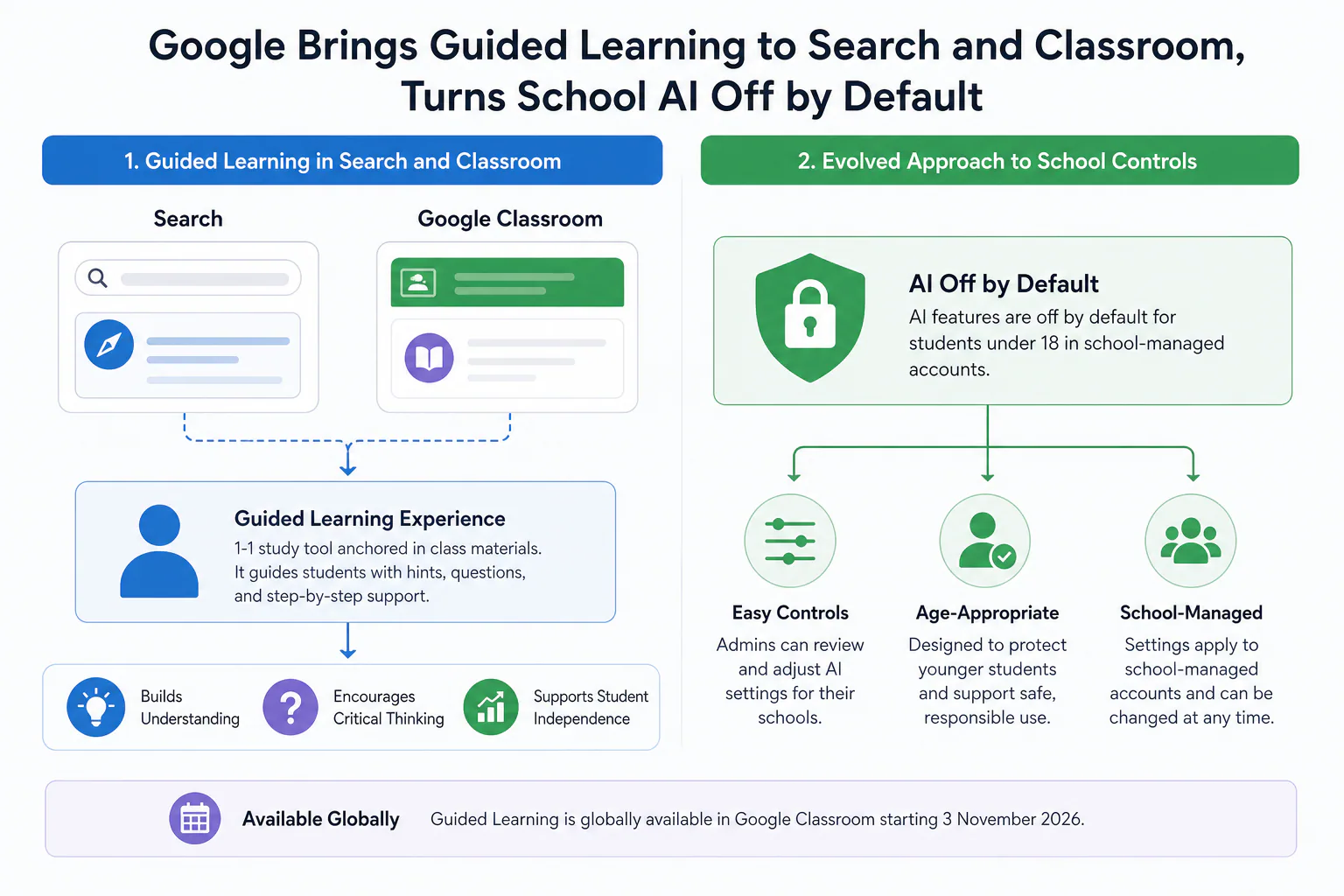
Guided Learning is globally available in Google Classroom starting on the announcement day. When a student opens a Guided Learning activity that a teacher has assigned, it works like a 1-1 study tool anchored in class material.
Teachers get something in return. Google says Guided Learning in Classroom provides real-time insights that help teachers spot where the class might need extra support.
Insights are not the only view teachers get. Reports on the launch say teachers can also read the chats their students have with Guided Learning in Classroom, so they see the questions a student asked and how the tool replied. That makes the activity closer to supervised homework than a private conversation, and students should know that what they type is visible to their teacher. Google’s privacy commitments for Gemini for Education, covered below, concern human review and model training. They do not stop a teacher from seeing classroom chats.
Google says it tested the Classroom version with schools and educators and built their feedback into the product before launch.
The second half of the announcement concerns defaults. Google is moving to a model in which AI access for younger students starts switched off and schools decide when to change that. The details are covered below, and the site has also reported on Google’s K-12 student account changes separately.
Guided Learning in Search walks students through homework without handing over the answer
Google is building Guided Learning into Search for student accounts. The aim is to walk students through homework topics step by step rather than present a finished answer.
Google gives two examples. If a student pastes a complex physics problem into Search, or asks for help writing a book report, they see prompts that encourage critical thinking instead of going directly to the answer.
That behavior differs from a typical search result, where the answer is usually the first thing on the page. For students on accounts that have the feature, the first thing they see is a question or a prompt to work through.
The change also affects the AI features students would normally encounter in Search. Under the new defaults, Search’s AI features, including AI Overviews, stay switched off for K-12 student accounts until an administrator enables them. Where a school does turn them on, Guided Learning replaces the usual answer-first result, so a summary at the top of the page gives way to prompts and follow-up questions.
Pilot timing
The Search version starts as a pilot in select U.S. schools later in November 2026. Google has not named the schools or said how many take part.
After the pilot, Google plans to expand Search Guided Learning to other school districts in the coming months. Outside the U.S. pilot schools, the facts available give no date for student access in Search.
How Guided Learning works and what productive struggle means
Guided Learning is an interactive study mode. Instead of giving final answers, it coaches students with open-ended questions and step-by-step breakdowns. In Gemini, it is described as a study tool that coaches students through problem solving.
Google describes the philosophy behind it as “productive struggle.” The idea is that students should be challenged without becoming so overwhelmed that they give up.
The model underneath
LearnLM is Google’s purpose-built model for learning, and Google says it is now infused into Gemini. According to Google Cloud, Gemini 2.5 Pro outperformed competitors on all five principles of learning science in a head-to-head evaluation. The evaluation is Google’s own, and the facts available do not name the competitors or describe the method.
Related Google tools
Two other Google learning products appear alongside it. According to learning.google, Learn About is a conversational AI-powered learning companion, and Gemini Notebook is a personalized AI research assistant powered by Gemini 1.5 Pro. Some reports call the tool NotebookLM, while Google’s post uses the name Gemini Notebook.
School AI products will be off for K-12 students until administrators opt in
Access to Gemini, Gemini Notebook, Gemini in Classroom and Google Search will be entirely off for K-12 student accounts until school administrators explicitly turn them on. K-12 refers to schooling from kindergarten through grade 12.

School administrators will have full control to enable or disable AI products for the student accounts they manage. The change reverses the starting point: schools opt in rather than opt out.
The control sits in the Admin console. According to Google for Education, admins can turn Gemini access on or off for users and review Gemini usage there.
Schools that want no AI
The opt-in model gives schools a choice, but not a clean one for those that want no AI at all. Google’s education lead said such schools would have to turn Search off entirely for student accounts, because AI cannot be fully removed from Search. Leaving Search on means accepting some AI features. Switching it off removes AI but also takes a basic research tool away from students’ school accounts.
For most districts, the practical question is which version of Search to allow, not whether AI can be stripped out of it. Administrators weighing the switch will need to decide whether the question-first approach of Guided Learning is acceptable, or whether losing Search on school accounts is the smaller cost.
What is still pending
Google says it will share more specifics with schools in the coming months, before the changes roll out. The announcement gives no date on which the default switches to off, and does not explain what happens to accounts where AI is currently enabled.
Who can use it, what it costs and which safeguards apply
Gemini for Education is free for qualifying institutions. It can also be used as a standalone app through Google for Education Fundamentals, according to Google for Education.
There is also a paid tier. Google AI Pro for Education is an add-on to Workspace for Education editions. The Google for Education page lists it at $15.00 per user/month with a one-year commitment, or $24.00 per user/month when billed monthly. Those are the prices stated on that page.
Privacy and younger users
Google says Gemini for Education does not have humans review user data or use it to train AI models. Students under 18 get a distinct product experience with extra guardrails and AI literacy resources.
Not everyone is reassured. Child advocates and some educators raised concerns about bringing AI into students’ Search results, and Common Sense Media called Google’s AI Search an unacceptable risk for students earlier in 2026. These are reactions to the product rather than part of Google’s policy, but they help explain why the off-by-default model matters to schools.
Scale
Google says Chromebooks are widely used in classrooms and that Google Workspace for Education powers teaching and learning for a very large number of educators and students. Those claims indicate how many schools could be affected by default changes.
What the research says about learning gains
Google says its research shows Guided Learning in Gemini leads to measurable learning gains for students. The supporting studies are described on the Google Cloud page.
Sierra Leone trial
Google ran a pre-registered randomized controlled trial with Fab AI. It covered 1763 junior secondary students in Grades 7 and 8 over 8 weeks.
Students who engaged with Gemini’s Guided Learning mode for at least 12 hours significantly improved their learning. The gain is equivalent to moving a student from the 50th to the 64th percentile in mathematics, which Google says equals roughly 1.8 to 2.5 years of extra learning progress by standard conversion.
UK study with Eedi
Google DeepMind and Eedi ran a 10-week study with 1,179 UK students. It compared an AI tutor, which combined Eedi’s diagnostic engine with Gemini, against expert human tutors and static support.
Students receiving AI tutoring matched the learning gains of those paired with human tutors. Gemini’s pedagogical quality improved substantially over last year’s study with Eedi, and expert reviewers approved of its tutoring far more often than before.
Earlier Eedi study
In an earlier study, LearnLM proved reliable, with only a tiny fraction of messages containing factual errors. Students who had short LearnLM tutoring sessions were 5.5 percentage points more likely to solve novel problems than students who worked with human tutors alone.
University of Tokyo trial
Google also presented preliminary results from a randomized controlled trial run with the University of Tokyo. It compared students who studied with Guided Learning against students who used conventional online resources. Google describes the findings as preliminary, and the available information does not include the sample size or the full method. Like the other studies above, this evidence comes from Google’s own presentation rather than an independent review.
What happens next and what remains unclear
The Search pilot begins in select U.S. schools later in November 2026. After collecting pilot feedback, Google will expand Search Guided Learning to other school districts in the coming months. Classroom access is already global.
Several points remain open. Google has not given a date for the switch to off-by-default AI for K-12 accounts, and more detail on school controls is due before rollout. The facts also do not say which schools join the pilot.
Google’s own research is the source of the learning-gain evidence, and the Sierra Leone result applies to students who used the mode for at least 12 hours. Independent replication is not described in the facts available.
Sources
Photo: Google
Frequently asked questions
How do I use Guided Learning in Gemini?
How do I use Guided Learning in Gemini?
In Gemini, Guided Learning is an interactive study tool that coaches students through problem solving with open-ended questions and step-by-step breakdowns. In Google Classroom, a student starts a Guided Learning activity assigned by a teacher, and it acts as a 1-1 study tool anchored in class material.
Is Gemini Guided Learning free?
Is Gemini Guided Learning free?
Gemini for Education is free for qualifying institutions and can be used as a standalone app via Google for Education Fundamentals. Google AI Pro for Education is a paid add-on at $15.00 per user/month with a one-year commitment or $24.00 per user/month billed monthly, per the Google for Education page.
How good is Gemini Guided Learning?
How good is Gemini Guided Learning?
Google says it leads to measurable gains. In the Sierra Leone trial, students using it for at least 12 hours moved from the 50th to the 64th percentile in math. In the UK study, AI tutoring matched human tutors’ gains. Google also says Gemini 2.5 Pro outperformed competitors on all five learning science principles in its evaluation.
Can students use Guided Learning in Google Search now?
Can students use Guided Learning in Google Search now?
Not yet broadly. The Search version starts as a pilot in select U.S. schools later in November 2026, with expansion to other districts planned after pilot feedback.
Will AI be turned on automatically for K-12 students?
Will AI be turned on automatically for K-12 students?
No. Access to Gemini, Gemini Notebook, Gemini in Classroom and Search will be off for K-12 student accounts until school administrators explicitly turn them on. Administrators have full control to enable or disable these products.
Where is Guided Learning available in Google Classroom?
Where is Guided Learning available in Google Classroom?
It is globally available in Google Classroom starting 3 November 2026. The Search version is separate and begins in select U.S. schools.