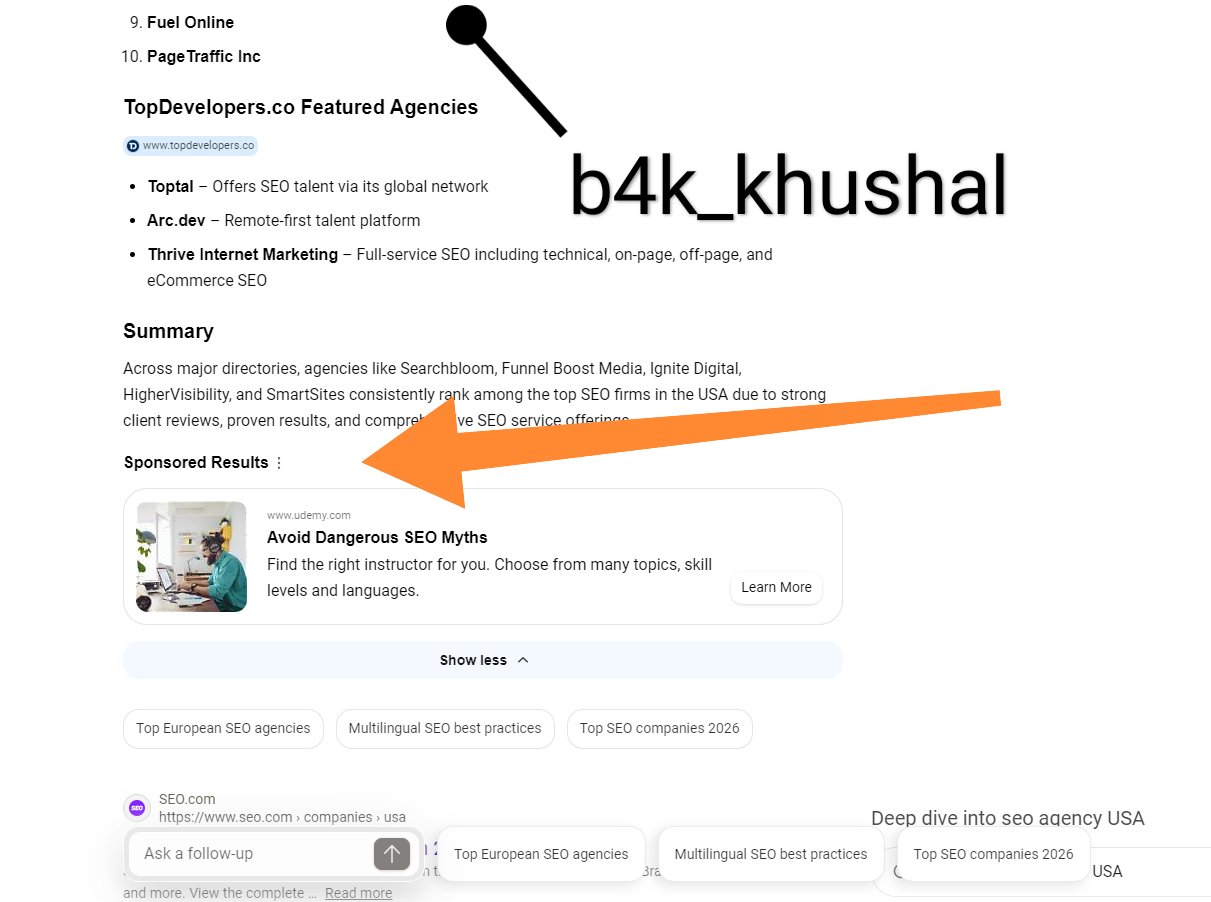
Microsoft is showing ads within Bing AI Overviews powered by Copilot, according to a screenshot shared on X. The evidence is a single image: a Search Engine Roundtable reporter could not reproduce the placement, and Microsoft has announced no wider rollout.
- A screenshot shared on X shows Bing displaying Sponsored Results inside a Copilot-powered AI Overview.
- Barry Schwartz of Search Engine Roundtable could not trigger the ads himself. The evidence is one screenshot.
- A separate report describes a test in which some users see seven or more sponsored results before any organic listing.
- Microsoft has not announced a broader rollout of ads in AI Overviews.
- Bing renamed its Copilot Search box to AI Overviews a few months before this report.
Bing is showing a sponsored result inside an AI Overview
According to Search Engine Roundtable, Microsoft is now showing ads within the Bing AI Overviews powered by Copilot. The report rests on a post from Khushal Bherwani, who shared a screenshot of an ad inside an AI Overview in Bing Search on X.
Bherwani’s caption read: “Bing is showing Sponsored Results within AI Overviews.” The screenshot is the only direct evidence of the placement in the sources reviewed.
What the screenshot does and does not prove
Barry Schwartz, who wrote the Search Engine Roundtable piece, said he had not seen ads within AI responses in Bing Search. He added that he personally still could not trigger them. That limits what the screenshot proves. It shows the placement existed for at least one user at one moment, but it says nothing about how often it appears, to whom, or for which queries.
The chain of reporting is short. An X post became a Search Engine Roundtable article, and the article’s author was unable to confirm the sighting firsthand. No Microsoft statement, help page or advertiser announcement is cited in the pages reviewed.
The reasonable reading, then, is that an ad format has been spotted in the wild. It is not a confirmed, documented product feature, and the sources do not describe how an advertiser would buy it, how it is labeled beyond the caption, or whether it replaces or adds to ads elsewhere on the page.
What other coverage says about the Copilot ad format
Other outlets describe the format in more detail, though Microsoft has not confirmed any of it and neither does the Search Engine Roundtable report. According to these third-party reports, ads in Copilot appear beneath the AI-generated response and carry “Sponsored” labels. The same coverage says the ads are triggered by the full conversational query, the whole question a person types in conversational search, rather than by a match on a single keyword.
If that description holds, Bing AI Overviews ads would be matched to intent across a longer question instead of to one search term. It may also describe a different placement from the one in Bherwani’s screenshot, which shows the ad inside the AI Overview.
The figures and claims above are reported by the outlets named. RankFlow has not measured or reproduced any of them.
What AI Overviews, grounding and CPC mean in Bing
AI Overviews in Bing are AI-generated answers shown in search results. Bing renamed its Copilot Search box to AI Overviews a few months before the Search Engine Roundtable report, so the feature name and the Copilot branding refer to the same answer experience.
The rename has a practical side effect. Google uses the same name, AI Overviews, for its own AI answers in Search, so the label alone no longer tells a reader which engine produced an answer. Anyone comparing reports about “AI Overviews ads” has to check whether the report concerns Bing or Google.
Grounding is the term for the source material and web evidence an AI system uses to support and cite its response, as defined in the Microsoft Bing Blog. It matters here because an answer built on cited sources now appears alongside a paid result, and the line between the two is what searchers and publishers will watch.
In plain terms, a grounded answer is one that points back to pages it drew on. A sponsored result inside that answer is a different kind of element: it is there because an advertiser paid, not because the page supported the answer. How Bing separates the two visually is not described in the reports.
CPC means cost per click, the amount advertisers pay for each click on an ad, according to digitalposition.com. No report reviewed says what advertisers pay for a placement inside an AI Overview, or whether it is priced differently from standard search ads.
A separate test packs Bing results with sponsored listings
A different report points to more advertising on Bing. digitalposition.com reports that some users see seven or more sponsored results before a single organic listing, and it describes this as a test. The same outlet says Microsoft is not saying much about it.
An organic listing is a result that earns its position through ranking rather than payment. Seven or more paid results ahead of the first one means a searcher may have to scroll past a long block of ads to reach it. The report gives no figure for how many users are affected, which markets are involved or how long the test has run.
The two stories differ in an important way. A single screenshot that could not be reproduced is all the evidence for the AI Overview ad. Coverage from digitalposition.com concerns more ads in standard search results, not specifically within AI Overviews. These two should not be treated as the same development.
| Point | AI Overview ad | Seven-plus sponsored results |
|---|---|---|
| Where it appears | Inside a Copilot-powered AI Overview | Standard Bing search results, before the first organic listing |
| Source | Screenshot shared by Khushal Bherwani on X, relayed by Search Engine Roundtable | digitalposition.com |
| Described as a test | Not stated | Yes |
| Reproduced by the reporter | No, Barry Schwartz could not trigger it | Not stated |
| Microsoft comment | No broader rollout announced | Microsoft is not saying much, per digitalposition.com |
What the two reports mean together
Taken together, the reports suggest Bing is experimenting with how much paid content appears on a results page, in both the classic list and the AI answer. That is an inference from two separate reports, not something either source states, and neither says the tests are connected.
For paid search teams, the practical point is limited. The sources give no ad counts by market, no query types and no timeline, so there is nothing to size or budget against yet. The one concrete number, seven or more, comes from a single outlet and describes what some users reportedly see.
What this means for publishers, advertisers and searchers
Publishers and advertisers have raised concerns that AI search can reduce traffic to publishers whose data the AI uses, according to All Things How. In 2024 Microsoft said it would monitor generative search for its effect on publisher traffic, and said initial data showed no negative impact.
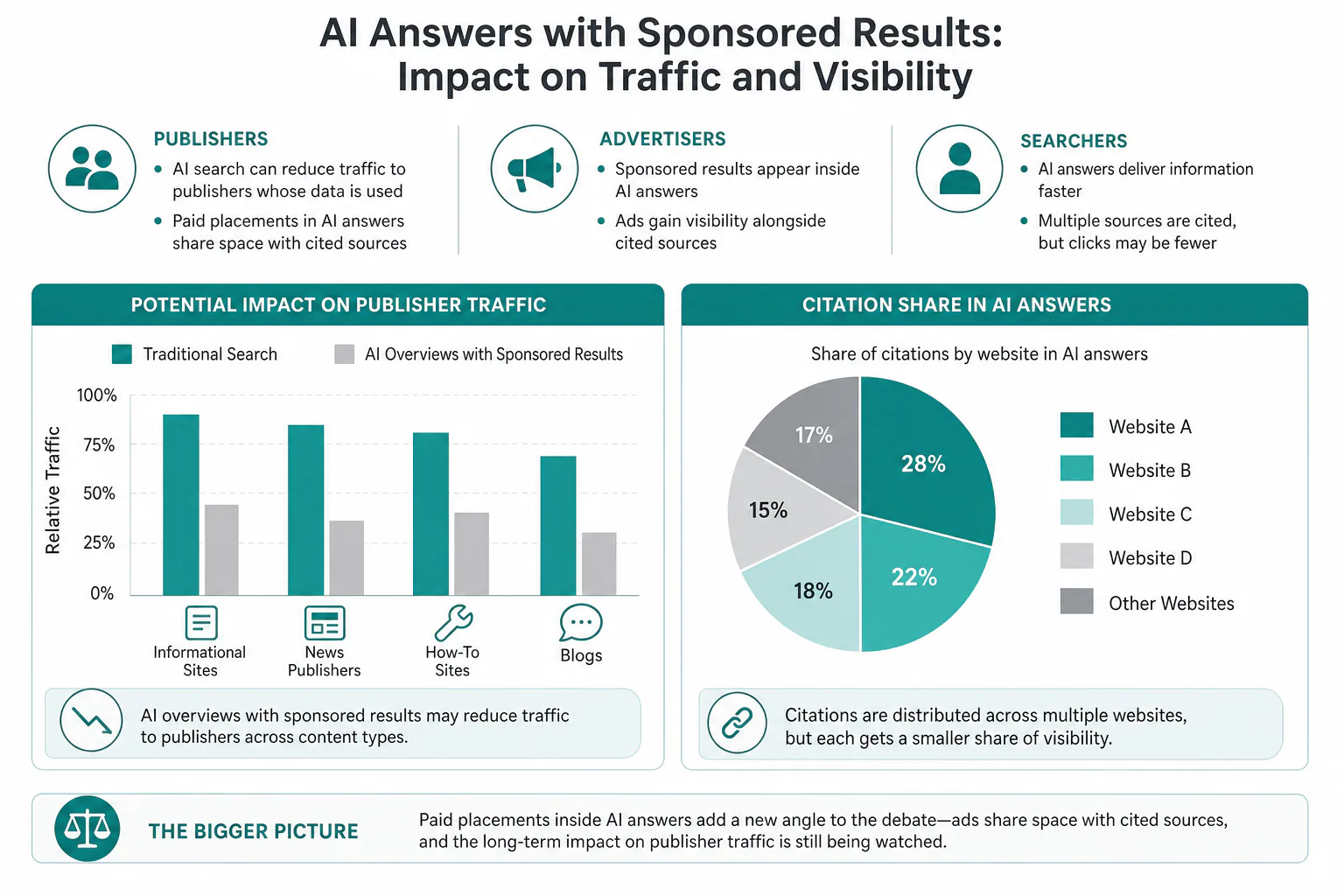
Paid placements inside AI answers add a new angle to that debate. An ad inside the answer itself shares space with the sources the answer cites, though the sources reviewed do not measure any effect on clicks to publishers or on ad performance.
Tools publishers can use to see their AI visibility
Microsoft has given publishers some measurement tools. In June 2026 Bing introduced an AI Performance Report in Bing Webmaster Tools. It shows how publisher content appears in AI-generated answers across Microsoft Copilot, Bing and select partner AI experiences.
The same month, Bing Webmaster Tools added preview features called Intents, Topics, Citation Share and Compare, rolling out globally. Citation Share is the percentage of citations attributed to a site out of all citations shown across all sites for the same grounding query.
As a hypothetical illustration, if a query’s answer showed several citations and a few of them pointed to one site, that site’s Citation Share for the query would be the portion those few make up of the total. The metric describes a site’s slice of the citations, not how many people clicked them.
The reports show citations, not ads, and nothing in the material reviewed says whether sponsored results are counted in them. Site owners can still use the data to see how often their content is cited in Bing’s AI answers, and agencies running several sites can check each one separately for changes in citations over time.
Advertisers and searchers
For advertisers, the screenshot signals a placement that may or may not become buyable. Until Microsoft documents Copilot ads, there are no targeting options, reporting fields or pricing details to plan around. The only pricing concept the sources name is CPC, defined above.
Other coverage goes further. One report on the topic says Copilot placements carry “Microsoft Advertising” and “Sponsored” labels, which would tie them to the platform that sells Bing search ads. Another says Performance Max campaigns are the route into Copilot placements. The sources reviewed for this article confirm neither claim, and RankFlow found no official Microsoft documentation on how to buy these placements. Until it appears, teams interested in Bing AI Overviews ads can only watch their existing Bing campaigns for changes.
For searchers, the issue is recognition. A sponsored result inside an AI-written answer to a conversational search is harder to separate from the answer than one in a labeled block above or beside it. The Sponsored Results caption in the screenshot indicates a label exists, but how prominent it is in the interface is not described.
The question of advertising inside AI answers is also playing out at Google. RankFlow’s earlier reporting covered Google ads in AI Mode answers and a related policy change on ad personalization for AI Mode ads.
How Bing’s AI answers compare with Google’s AI Overviews
In July 2024 Microsoft unveiled Generative Search on Bing, which combines search results with language models. AI answers appeared in the center of the page and traditional results on the right. According to All Things How, that experience highlighted references and sources more prominently than Google AI Overviews.
Google describes its AI Overviews as AI-generated snapshots in Search results, with key information and links to dig deeper. Google states that AI Overviews can make mistakes and advises users to double-check important information.
On user control, Google says AI Overviews is a core Search feature, like knowledge panels, and cannot be turned off. Users can select the Web filter to show only text-based links, according to Google’s support page.
| Point | Bing | |
|---|---|---|
| Feature name | AI Overviews (renamed from the Copilot Search box) | AI Overviews |
| 2024 layout | AI answers in the center, traditional results on the right | Not described in the sources |
| Source prominence | References and sources highlighted more prominently, per All Things How | Links to dig deeper |
| Accuracy caution | Not covered in the sources | Can make mistakes; users advised to double-check important information |
| Turning it off | Not covered in the sources | Cannot be turned off; Web filter shows text-based links only |
| Ads inside the answer | Single unconfirmed screenshot | Search and Shopping ads announced in May 2025, US desktop first, per other coverage (unverified) |
Ads inside AI answers at Google and Bing
Google has a longer track record with this format. Several other outlets report that Google announced Search and Shopping ads within AI Overviews in May 2025, starting on desktop in the US before expanding globally, and that ads shown alongside AI Overviews grew sharply during 2025. The sources reviewed for this article do not cover that rollout, and RankFlow has not verified it. If the reports are accurate, Bing AI Overviews ads would follow a format Google already uses rather than introduce a new one.
The comparison shows that the 2024 Bing design leaned on visible citations, which is the context in which a paid element inside the answer stands out. Neither product’s current ad behavior is compared in the reports, so no conclusion can be drawn on which shows more paid content in its AI answers.
Open questions about Bing AI Overviews ads and what comes next
Microsoft has not announced a broader rollout of Bing AI Overviews ads in the pages reviewed. The sources also leave several basic questions open.
- Whether the ad is a limited test or an early stage of a wider launch.
- How widely it appears, and in which markets or for which queries.
- Whether it differs by device or platform.
- Whether the seven-plus sponsored results test and the AI Overview ad are linked.
Search Engine Watch adds context to the rollout question. The outlet describes Bing testing Sponsored results within its AI Overview and Copilot results, and reports a later expansion of Copilot ads along with Copilot shopping ads. Those reports suggest Bing AI Overviews ads belong to a format Microsoft has been developing for some time, but they are not an announcement, RankFlow has not verified them, and they do not show whether the placement in Bherwani’s screenshot is part of that expansion.
Until Microsoft comments or more screenshots appear, the placement remains an unconfirmed sighting. Further reports from Search Engine Roundtable or digitalposition.com, or documentation from Microsoft, would show whether it is spreading.
In the meantime, the practical steps are limited to what exists today. Site owners can review the AI Performance Report and the Citation Share preview in Bing Webmaster Tools, and teams that buy Bing ads can watch for any Microsoft announcement before changing budgets.
Sources
Photo via Search Engine Roundtable
Frequently asked questions
Is Bing really showing ads within AI Overviews?
Is Bing really showing ads within AI Overviews?
A screenshot shared on X by Khushal Bherwani shows it. It is the only direct evidence in the sources, and the Search Engine Roundtable reporter could not reproduce it.
Has Microsoft confirmed ads in Bing AI Overviews?
Has Microsoft confirmed ads in Bing AI Overviews?
No confirmation appears in the pages reviewed. Microsoft has not announced a broader rollout.
Why could the Search Engine Roundtable reporter not see the ads?
Why could the Search Engine Roundtable reporter not see the ads?
The sources do not say why. Barry Schwartz said he had not seen ads in AI responses and still could not trigger them, which fits a limited test, but that is not confirmed.
What are Bing AI Overviews?
What are Bing AI Overviews?
They are AI-generated answers shown in Bing search results. Bing renamed the Copilot Search box to AI Overviews a few months before the report.
Is Bing showing many ads above organic results?
Is Bing showing many ads above organic results?
digitalposition.com reports that some users see seven or more sponsored results before a single organic listing and calls it a test. That concerns standard results, not AI Overviews specifically.
Can Bing AI Overviews ads be seen on Android or discussed on Reddit?
Can Bing AI Overviews ads be seen on Android or discussed on Reddit?
The sources do not say whether the ads appear on Android or any other platform, and they do not mention a Reddit discussion. The sources do not cover device differences.