
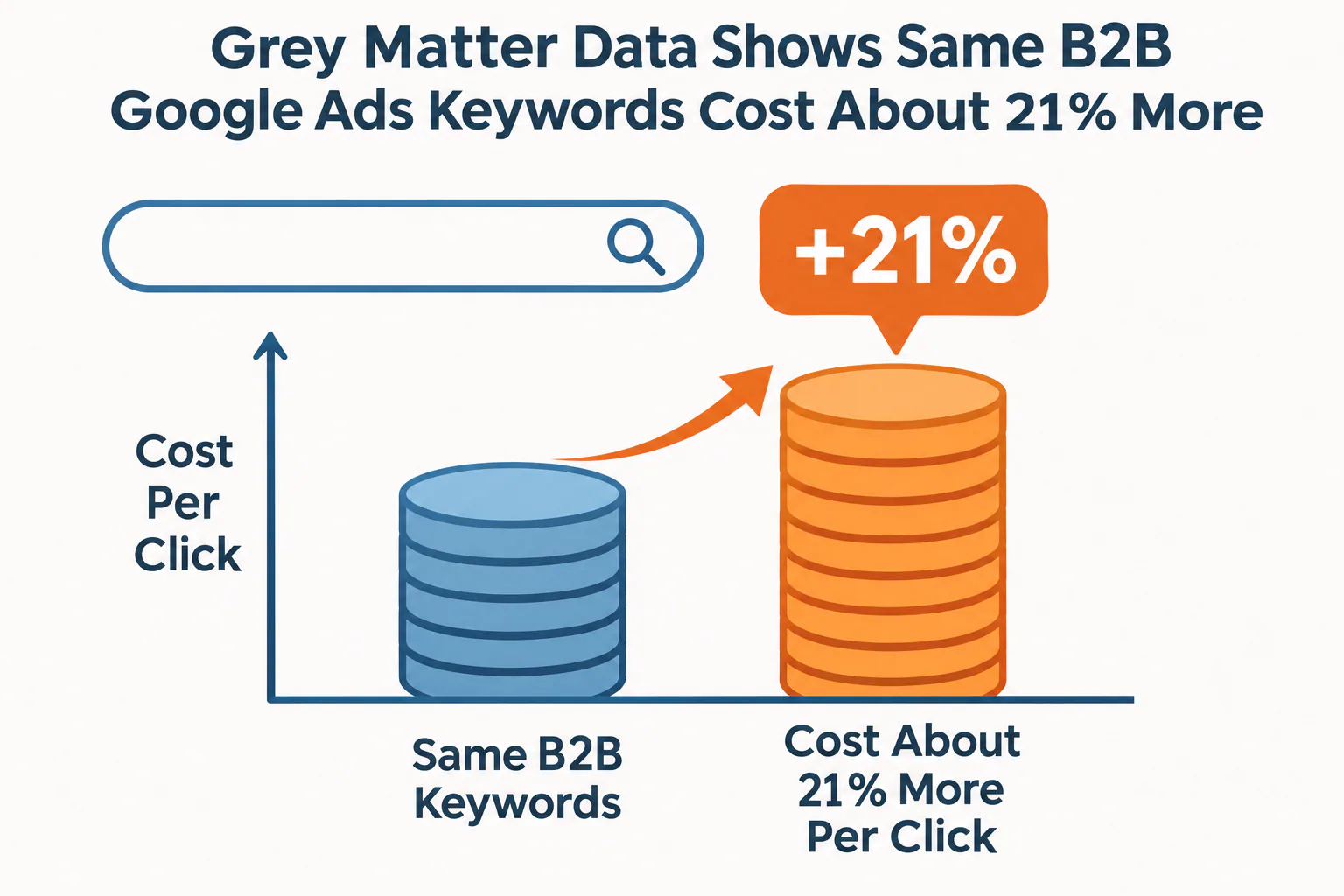
The same non-brand Google Ads keywords cost about 21% more per click for 14 B2B advertisers in April through September 2026 than in the same months a year earlier, according to an agency report from Grey Matter covered by Search Engine Journal. The estimate controls for spend, ad position and Quality Score.
- Grey Matter estimates that non-brand keywords, tracked like for like, cost about 21% more per click year over year across 14 B2B advertisers, with a likely range of 1% to 44%.
- Without controls the increase was 29%; controlling for spend, then for position plus Quality Score, brought it to 21%.
- Removing the biggest spender drops the estimate to around 17%, and including broad match lifts it to around 31%.
- Alphabet's 10-Q shows Google Search CPC up only 4% in the quarter, a gap the report's narrow sample does not explain.
- The report suggests scaling 2027 budgets gradually and judging each step by the cost of the extra clicks.
Grey Matter finds the same B2B Google Ads keywords cost about 21% more per click
Grey Matter's report estimates that a click on an unchanged non-brand keyword costs about 21% more year over year, after accounting for spend, Quality Score and ad position. Its likely range runs from 1% to 44% around that figure, so the true increase could be barely noticeable or very large.
The sample consists of 14 B2B advertisers, all of them clients of Grey Matter. The analysis compares April through September 2026 with the same six months a year earlier.
Andy Hendricks of Grey Matter says the same click most likely costs about 20% more at present, and that the true figure could be meaningfully higher or lower. That framing sits close to the 21% headline.
For agencies and in-house teams that run B2B search accounts, the finding points to a cost problem that does not come only from their own bidding choices. It describes what happens when an advertiser holds the keyword constant and still pays more for the click.
How the analysis was built and what it leaves out
The method determines what the headline figure can and cannot tell you, so it helps to know the scope and the two estimation methods before you read the numbers.
What was included
The analysis uses Google Ads Search campaign data only. Performance Max, Shopping and Display campaigns are excluded, so the results say nothing about those formats.
It tracked 1,349 non-brand Google Ads keywords, each within a single account, over six quarters from April 2025 to September 2026. Following the same keyword inside the same account is what allows the report to talk about the price of the same click rather than a changing mix of keywords.
Several keyword groups were left out of the overall estimate: broad match keywords, keywords in Maximize Clicks campaigns, and brand and competitor keywords. Those exclusions matter, because including broad match changes the result, as a later section shows.
Two estimation methods
The headline figure comes from a regression model, a statistical method that estimates how one variable moves with others. In this model every advertiser has equal weight regardless of how much it spends, so a small account counts as much as a large one.
A second technique, a keyword price index, covers 11 advertisers rather than 14. The report uses it as a cross-check on the regression and to split the increase into parts, which the next sections describe.
Grey Matter's findings rest on correlation rather than proven causation. The report also does not name the industries, markets or currencies of the advertisers involved.
How controls shrink the increase from 29% to 21%
Cost-per-click (CPC) is the amount an advertiser pays each time a user clicks an ad. Grey Matter starts with the raw change in CPC for the same Google Ads keywords and then adds controls step by step.
| Model | Year-over-year CPC increase |
|---|---|
| No controls | 29% |
| With spend controls | 22% |
| With position and Quality Score added | 21% |
Quality Score is a Google Ads measure, and the report uses it as a control variable alongside ad position. Adding them moved the estimate by only one point once spend was already accounted for.
Spend does most of the work in the controls. The regression ties every 10% increase in campaign spend to about 1.4% higher CPCs, which works out to roughly 11% for doubled spend. Advertisers that push budgets up therefore pay part of the increase themselves.
The most extreme case in the data nearly quadrupled its non-brand Search spend year over year. Its same-keyword CPCs rose 132%.
The keyword price index shows a 36% rise and a large unexplained share
For the 11 advertisers in the keyword price index, average non-brand CPC rose 36% year over year. That Google Ads CPC increase includes the advertisers' own choices, and it is higher than the 21% headline.
The report splits the 36% into parts:
- 22 points attributed to the market
- 3 points attributed to increased spending
- a 3-point deduction for changes in keywords, match type and bid strategy
- 14 points unexplained
The unexplained 14 points are a notable share of the total. The report does not say what accounts for them.
Results varied widely by advertiser. Actual CPC changes ranged from a 30% decrease to a 121% increase, and ten of the 11 advertisers paid more for the same Google Ads keywords. One account therefore saw costs fall, while most saw them climb.
How sensitive the estimate is to the biggest spender and broad match
The 21% estimate moves when the sample or scope changes. When the biggest spender is removed, the estimate drops to around 17%, with a likely range of -2% to +40%. That range includes a small decrease, so with one fewer large account the data no longer rules out flat prices.
When broad match keywords are included, the estimate rises to around 31%. Broad match was excluded from the headline, so the headline figure does not reflect that category.
The figures of 21%, about 20% and 17% reflect different methods and framing. The 21% is the model's headline estimate, the roughly 20% is Hendricks' statement of the most likely current cost, and the 17% is the result without the biggest spender.
What B2B advertisers can take from it for 2027 budgets
Grey Matter suggests scaling 2027 budgets gradually and assessing each step by how much the additional clicks cost. Given the link between spend and CPC, each increase can raise the price of every click, not only the new ones. Before raising budgets, it pays to check the search terms report and add negative keywords, so the extra money buys clicks on relevant Google Ads keywords rather than irrelevant queries.
Maximize Conversions is an automated bidding strategy that spends more budget by entering auctions it previously skipped, as the report explains. Raising a budget under that strategy therefore pushes the campaign into auctions it had avoided.
For those campaigns, the report suggests deciding what additional conversions are worth before raising budgets and setting a matching target. That keeps the bidding system from buying volume at a price the business would not accept.
For teams that plan content and paid search together, the practical point is to treat paid clicks as a rising cost line and to check each budget step against the cost of the extra clicks.
Why the figure may not apply to every advertiser
Alphabet's third-quarter 10-Q reports that cost-per-click on Google Search and other properties rose 4% year over year in the quarter. That is far below Grey Matter's 21%. The report's narrow sample does not explain the gap.
The sample is 14 clients of one agency, and the report does not name their industries, markets or currencies. Its method shows correlation, not proven causation.
The report also contains no conversion rate or cost per lead data. A higher CPC does not by itself show that leads became more expensive, so the value of the clicks is unknown.
Timing is a further limit. Grey Matter's data on Google Ads 2026 auctions stops at September and does not cover the fourth quarter, which is the period that counts most for budgets now being set.
Google Ads background and how the platform has changed
Google Ads, formerly known as Google AdWords, is an online advertising platform where advertisers bid to display ads, product listings and videos. Its services are offered under a pay-per-click pricing model and a cost-per-view model.
Google launched AdWords in 2000. In 2018 it retired the DoubleClick and AdWords brands and renamed the core product Google Ads.
Campaign types include Search, Display, Shopping, Video, App, Demand Gen and Performance Max. Performance Max runs as a single AI-powered campaign across Google's channels, which is one reason it is outside the Search-only scope of this report.
Keywords in Search campaigns also carry a match type, which determines how closely a search has to resemble the keyword before an ad can show. Broad match lets an ad appear for related searches, phrase match requires the search to include the meaning of the keyword, and exact match limits it to searches with the same meaning. Because broad match reaches the widest set of queries, it is the category Grey Matter left out of its headline estimate.
In 2024 Google Ads introduced AI-powered tools including the Ads Power Pair of Search and Performance Max. For automation, Google Ads offers the Google Ads API and Google Ads Scripts for managing campaigns.
How advertisers choose and manage Google Ads keywords
Keyword research comes before any bid. Advertisers usually start from a few seed terms that describe the product, then use a keyword research tool such as Google's Keyword Planner to find related ideas. They group closely related keywords into ad groups, so each group shares ads and a landing page. That grouping also makes it possible to follow the same keyword over time, which is the logic behind Grey Matter's same-keyword comparison.
| Match type | Searches that can trigger the ad | What it blocks |
|---|---|---|
| Broad match | Related searches, even without the keyword's words | Little, unless negative keywords are added |
| Phrase match | Searches that include the meaning of the keyword | Searches unrelated to that meaning |
| Exact match | Searches with the same meaning as the keyword | Searches that add a different intent |
Negative keywords stop ads from showing for queries that have nothing to do with the offer. The search terms report lists the actual queries that triggered ads, and irrelevant ones can be added as negatives. Clicks wasted on the wrong queries still add to spend, and the report ties higher spend to higher CPCs.
Sources
Photo: Search Engine Journal
Frequently asked questions
How much more do B2B Google Ads keywords cost according to Grey Matter?
How much more do B2B Google Ads keywords cost according to Grey Matter?
The report estimates the same non-brand keywords cost about 21% more per click year over year, with a likely range of 1% to 44%.
How many advertisers and keywords does the analysis cover?
How many advertisers and keywords does the analysis cover?
It covers 14 B2B advertisers, all Grey Matter clients, and 1,349 non-brand keywords tracked over six quarters from April 2025 to September 2026.
Does the 21% figure apply to all Google Ads campaign types?
Does the 21% figure apply to all Google Ads campaign types?
No. The analysis uses Search campaign data only and excludes Performance Max, Shopping and Display. Broad match, Maximize Clicks campaigns, and brand and competitor keywords are also left out of the overall estimate.
How does the report's figure compare with Alphabet's reported CPC change?
How does the report's figure compare with Alphabet's reported CPC change?
Alphabet's third-quarter 10-Q reports a 4% year-over-year rise in cost-per-click on Google Search and other properties. The report's narrow sample does not explain the gap to 21%.
Should advertisers raise budgets in 2027?
Should advertisers raise budgets in 2027?
The report suggests scaling gradually and assessing each step by the cost of the additional clicks. For Maximize Conversions campaigns, it suggests deciding what extra conversions are worth first and setting a matching target.
What is Google Ads and how is it priced?
What is Google Ads and how is it priced?
Google Ads, formerly Google AdWords, is an online advertising platform where advertisers bid to show ads, product listings and videos. It is offered under a pay-per-click model and a cost-per-view model.