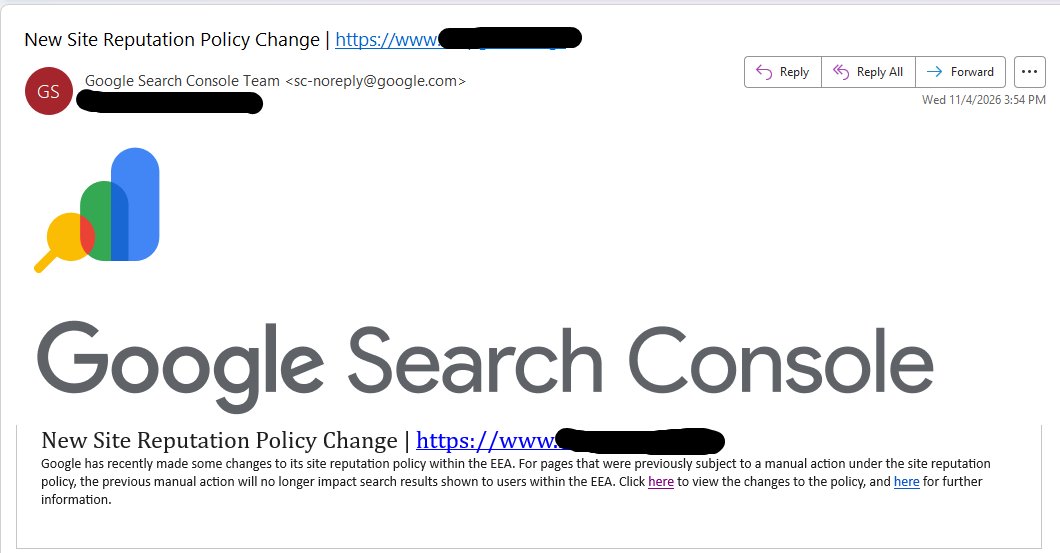
Google has told some sites that their past site reputation abuse manual actions will no longer affect search results shown to users in the European Economic Area (EEA). The change took effect on August 30, 2026, and the emails reached owners about two months later.
- Google emailed some sites to say earlier penalties under the site reputation abuse policy no longer affect what EEA users see in search.
- The change took effect August 30, 2026, and notices arrived through Search Console about two months later.
- Glenn Gabe posted the email, titled “New Site Reputation Policy Change”, and noted it seems to have reached sites whose actions are already gone.
- The policy, introduced with the March 2024 core update, targets parasite SEO in Google Search. Europe saw enforcement from January 2025.
Google tells sites past manual actions no longer apply in the EEA
Google sent emails to some sites that had received manual actions under its site reputation abuse (SRA) policy. The message states that those manual actions will no longer impact what users in the EEA see in search.

The email carries the subject line “New Site Reputation Policy Change”. Glenn Gabe posted it on X, and that post is how the notice became public.
The central passage concerns pages that were previously subject to a manual action under the site reputation policy. For those pages, the email says, the previous manual action will no longer impact results for people within the EEA.
The wording is narrow. It addresses the effect of earlier manual actions on results for people in the EEA, and it speaks only of pages that were previously affected. The facts available contain no broader statement about the policy itself, which Google introduced in 2024.
For publishers, the practical point is that a penalty once applied by a Google employee, and visible in Search Console, is described as no longer shaping what European users see. Whether rankings change as a result is not stated in the email as reported, and nothing in the facts promises that formerly penalized pages will rank better or return to any earlier position.
The notice also says nothing about users outside the EEA. The sentence describing the change is limited to results shown to people within the region.
What still applies outside the EEA
Outside the EEA, the picture is different. Industry coverage of the email points out that site reputation abuse manual actions still directly affect search results for the affected portion of a site everywhere else. Only the effect on results shown to EEA users stops.
| Aspect | Outside the EEA | Inside the EEA |
|---|---|---|
| Effect of a past manual action on search results | Still affects results for the affected portion of a site | No longer affects results since August 30, 2026 |
| Notice about the change | No notice described | Email and Search Console message sent to affected sites |
The change took effect August 30, 2026, with notices two months later
The effective date of the change is August 30, 2026. Google began notifying site owners about two months afterward through Google Search Console. That is the free tool in which site owners see how Google handles their pages and receive messages about problems.
The sources give no conflicting dates. The gap between the effective date and the emails still matters: the change was in force for roughly two months before owners were told. Any shift in how affected pages appear to EEA users could therefore predate the notice. A traffic change in September or October may line up with the change rather than with anything the site did.
The end of the EEA effect does not automatically return affected pages to their earlier positions. Rankings are still determined by Google’s regular systems, and SEO practitioners note that Google may evaluate a previously affected section separately from the main domain. A cleared subfolder or subdomain can therefore perform differently from the rest of the site. We suggest comparing that section’s EEA traffic on its own rather than looking at the whole domain’s numbers.
Where to find the notice in Search Console
Inside Search Console, a message labeled “View related messages” is shown in the Manual Actions report. That is where owners can find the connected notice about the policy change.
Agencies and teams that manage several sites need to check that report for each property. Messages in Search Console go to the registered account, so the notice may sit with whoever holds access for a given site rather than with the team that handles content day to day. Even if the email has not yet turned up in an inbox, the message may still appear in the report.
How site reputation abuse and manual actions work
Google’s spam policy defines site reputation abuse as publishing third-party pages on a site in an attempt to abuse search rankings by taking advantage of the host site’s ranking signals. Ranking signals are the factors Google uses to judge how well a page should rank. In plain terms, content from an outside party is placed on an established site so that it can borrow that site’s standing in search.
The practice is commonly called parasite SEO, because the third-party content feeds on the ranking strength of the host site rather than earning its own.
A manual action is a penalty applied by a Google employee after reviewing a site for spam policy violations. It differs from an automated ranking adjustment because a person assesses the content and makes the decision.
Google has said the site reputation abuse policy is not algorithmic. The company notifies violating publishers manually, after a Google employee carries out a human review of the flagged sections. Site reputation abuse manual actions therefore always rest on a person’s decision, and owners receive them through their registered Search Console account.
Notification and reconsideration
Site owners who receive a spam manual action are notified through their registered Search Console account. They can then submit a reconsideration request, which asks Google to review the site again after the owner has addressed the problem.
The new EEA email follows a similar route. It reaches owners through Search Console, the place where they already see manual action notices, and it points to related messages in the Manual Actions report.
Which sites are affected and what it means for them
Glenn Gabe wrote that the emails went out to sites that have been impacted by site reputation abuse manual actions in the past. He also noted that they seem to have gone to sites that no longer have such actions, although those sites had them at some point.
That detail suggests the emails are tied to a site’s history rather than its current status. A site with a cleared action can still receive the notice, which tells it that the earlier action no longer affects results for EEA users.
The kinds of publishers the policy covers
Google’s examples of violations show which publishers have been in scope. They include educational sites hosting reviews of third-party payday loan providers and medical sites hosting a casino review page.
Other examples are movie review sites hosting unrelated content, sports sites with third-party workout supplement reviews, and news websites hosting third-party coupon content.
The common thread is an established site carrying commercial pages from outside parties that have little to do with its main subject. Agencies and content teams handling several sites can use these examples as a reference when judging whether a section of a client site follows the same pattern.
What the email means for any single site depends on its history. Sites that never received site reputation abuse manual actions are not described as part of the mailing, and the facts give no indication that the policy has been relaxed for them.
How the policy developed from 2024 to the EEA change
Google introduced the site reputation abuse policy with the March 2024 core update, aiming at parasite SEO. A core update is a broad change to Google’s ranking systems, and this one carried a new spam policy with it.
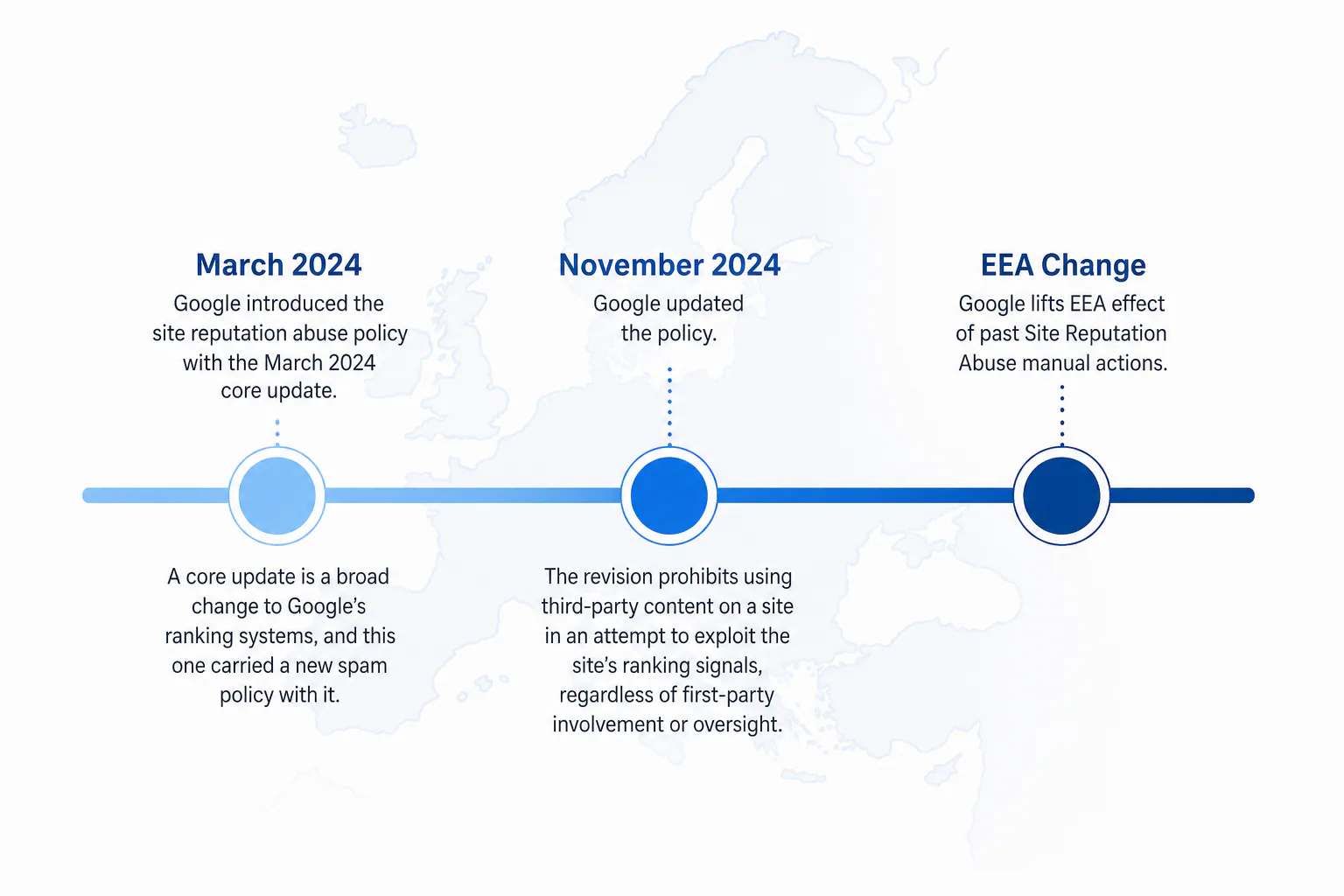
In November 2024, Google updated the policy. The revision prohibits using third-party content on a site in an attempt to exploit the site’s ranking signals, regardless of first-party involvement or oversight.
Google’s updated wording adds that no amount of first-party involvement alters the fundamental third-party nature of the content. A host site that edits, reviews or supervises outside material therefore does not change how the policy classifies it.
In January 2025, Google began enforcing the policy in Europe. The August 30, 2026 change, communicated to owners about two months later, now limits the effect of earlier manual actions for EEA users.
| Date | Step |
|---|---|
| March 2024 | Policy introduced with the core update |
| November 2024 | Policy updated to cover third-party content regardless of first-party involvement or oversight |
| January 2025 | Enforcement begins in Europe |
| August 30, 2026 | Past manual actions stop affecting results for EEA users |
The timeline shows that the new notice concerns only one part of the policy: how earlier manual actions play out in one region. The rules on third-party content set in 2024 are not described as changed.
Open questions about enforcement in Europe
The email, as reported, does not explain the change. No reason is given in the available facts, so the motive behind it is not known.
Some industry reports tie the change to a mandate from, or discussions with, the European Commission, and some SEO publications place it in the context of the Digital Markets Act, the EU law that sets obligations for large platforms such as Google. Those links come from outside coverage, not from Google. The email Glenn Gabe posted does not state a reason, and Google has not confirmed any regulatory cause.
It is also unclear whether sites with current actions, or sites with visibility outside the EEA, are treated differently. The email addresses only pages previously subject to a manual action, and it describes the effect on what people within the EEA see.
Whether Google will publish further guidance on the policy in Europe has not been stated. Until it does, the email and the Search Console messages are the only official description of the change.
Sources
Photo: Search Engine Roundtable
Frequently asked questions
What did Google change about site reputation abuse manual actions in the EEA?
What did Google change about site reputation abuse manual actions in the EEA?
Google told some sites that previous manual actions under its site reputation policy will no longer impact search results shown to users within the EEA.
When did the EEA change take effect?
When did the EEA change take effect?
It took effect on August 30, 2026. Notification emails followed about two months later.
How are site owners being notified?
How are site owners being notified?
Google is sending emails through Google Search Console, with the subject line “New Site Reputation Policy Change”. A “View related messages” message also appears in the Manual Actions report.
What is site reputation abuse or parasite SEO?
What is site reputation abuse or parasite SEO?
It is the practice of publishing third-party pages on a site to take advantage of the host site’s ranking signals and manipulate search rankings. Parasite SEO is the common name for it.
Who receives a site reputation abuse manual action and how can they respond?
Who receives a site reputation abuse manual action and how can they respond?
Owners of sites reviewed by a Google employee and found in violation receive it through their registered Search Console account. They can submit a reconsideration request.
When did Google start enforcing the policy in Europe?
When did Google start enforcing the policy in Europe?
Google began enforcing the site reputation abuse policy in Europe in January 2025.