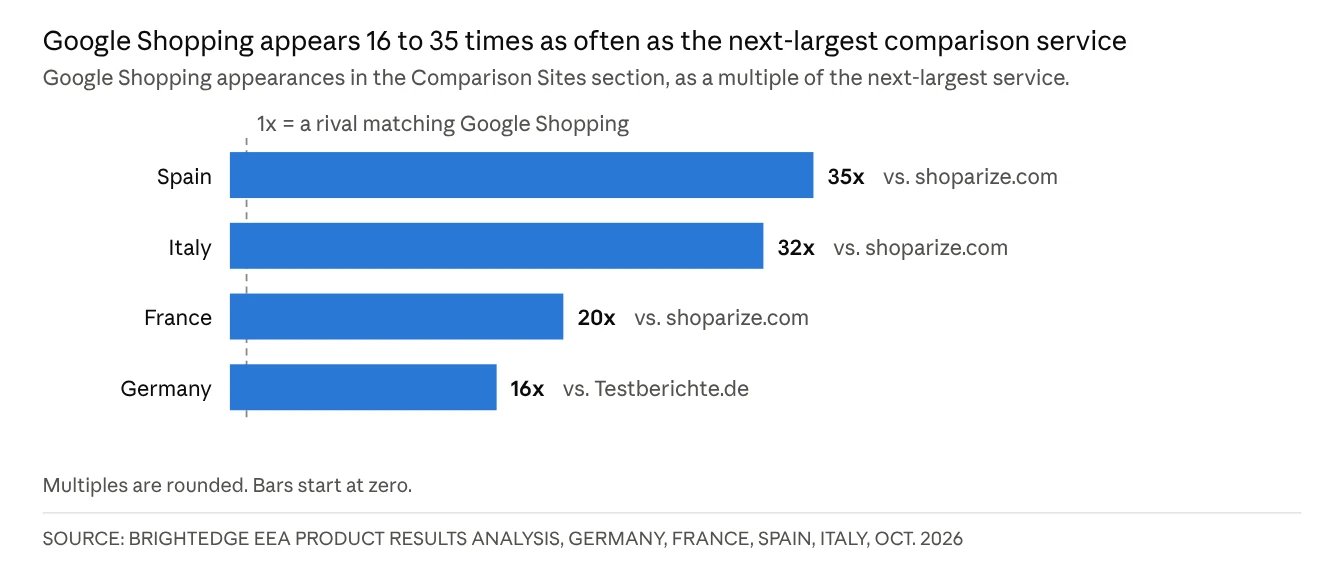
The Google Shopping box appears 16 to 35 times as often as the next-largest service in product results in Spain, Italy, France and Germany, BrightEdge data shows. The figures come after Google dropped its free product listings in Europe, a step the report links to the Digital Markets Act.
- BrightEdge finds the Google Shopping box appears far more often than any rival service in product results.
- Most Comparison Sites appearances land in the top four positions, with France lowest and Spain and Italy highest.
- The data covers Spain, Italy, France and Germany, after Google dropped free product listings in Europe under the Digital Markets Act.
- Google called the change the biggest reduction in search quality in its history.
- Retailers feed Google Shopping through Google Ads and Merchant Center.
The Google Shopping box dominates product results in four European markets
BrightEdge, a company that analyzes search results, found that the Google Shopping box shows up 16 to 35 times as often as the next-largest service in product results. In plain terms, for every appearance of the runner-up, Google’s own box appears many times over.
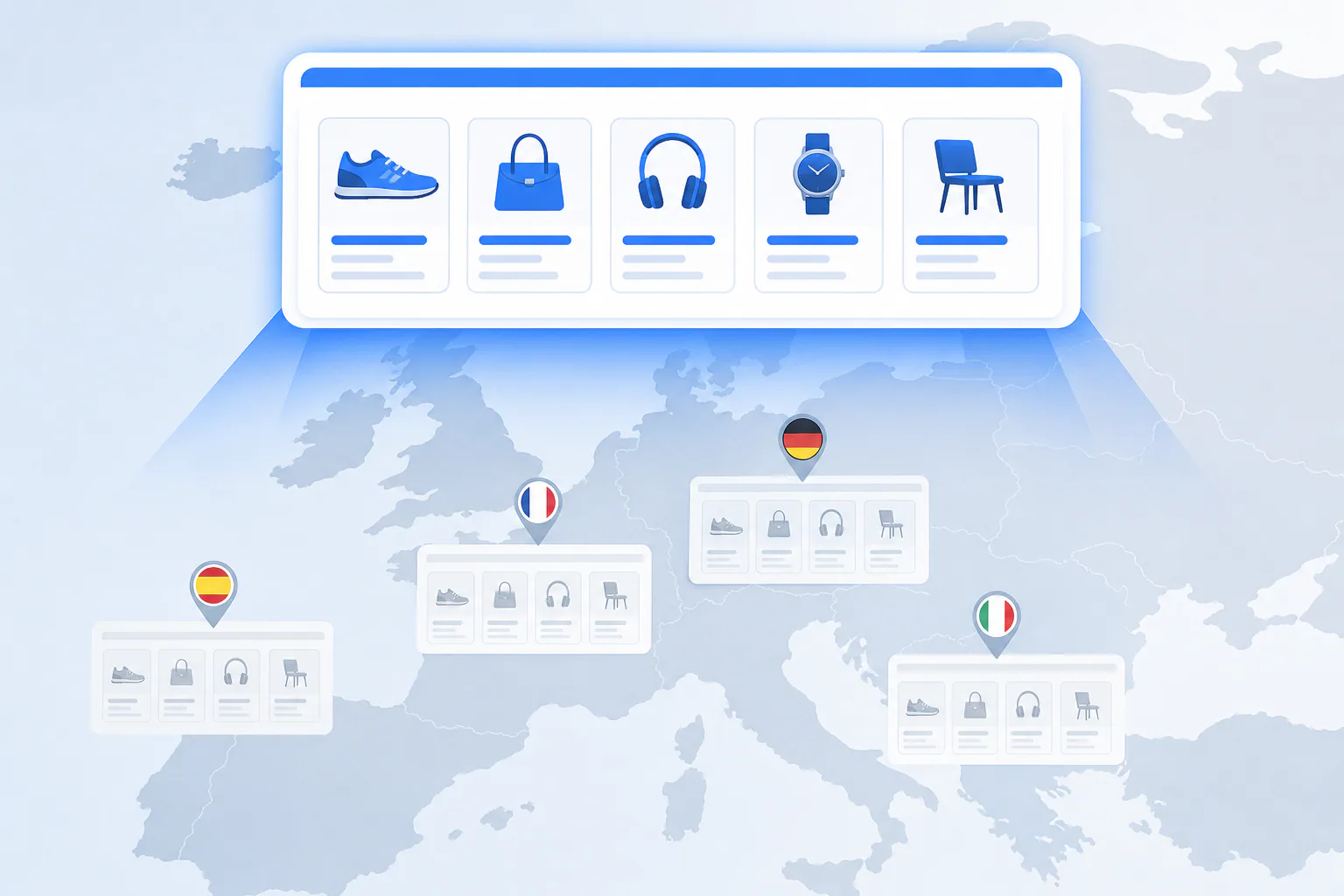
The data covers four markets: Spain, Italy, France and Germany. The report states the gap as a single range, and the information published so far does not break it down by country. Which market sits at the low end of the range and which at the high end is therefore not known.
A span that wide still carries a clear message. Even at the low end, Google’s own box appears far more often than its nearest rival, so the difference is a wide gap rather than a narrow lead. The report gives no further detail on the high end.
BrightEdge described the Google Shopping box as leading the new box and as premium space. The wording points to a product block in the results page that has taken on a new form in these markets, with Google’s own service holding the most prominent position inside it.
One user’s observation points the same way
Anecdotal evidence fits the measured picture. Mike Ryan, who is based in Austria, said on X that he had never seen a comparison shopping site spotlighted except Google Shopping. His remark comes from one person’s searches in one country. It is not a measurement and carries none of the weight of the BrightEdge figures, but it describes the same pattern from a user’s side of the screen.
What the data covers and what it leaves open
The published findings describe how often services appear. They do not say how many clicks Google’s box receives, how many sales it produces or how much traffic rival comparison sites lost. Those questions are beyond the scope of the data.
The findings also do not name the next-largest service in each market. The comparison is made against whichever service ranks second by appearances, so the runner-up may differ from one country to another.
Comparison Sites appearances land mostly in the top four positions, with gaps by country
BrightEdge also looked at a category it labels Comparison Sites, meaning services that compare products from different sellers. Across the four markets analyzed, 71% of their appearances land in the top four result positions, the report shows.
The share varies by country. France recorded the lowest figure, 61%, while Spain and Italy shared the highest, at 76% each, according to the report. Germany’s share falls between those two figures, but its exact number was not published in the information available.
| Market | Comparison Sites appearances in the top four positions |
|---|---|
| France | 61% |
| Spain | 76% |
| Italy | 76% |
| Germany | Between 61% and 76%, exact figure not given |
| All four markets | 71% |
The gap between France and the two highest markets is 15 percentage points. In Spain and Italy, roughly three in four appearances of comparison sites sit in the first four slots. In France the figure is closer to six in ten, which leaves a larger share of appearances lower on the page.
The two BrightEdge findings answer different questions. One compares how often Google’s own box appears against other services. The second describes where comparison sites sit on the results page when they do appear. A comparison site can therefore appear rarely, yet when it does, it is usually near the top.
The two findings do not contradict each other. Concentration in the top four positions says that visible slots are the ones that count, and the appearance gap says who is occupying the most visible of those slots.
These appearances happen in what BrightEdge and Search Engine Roundtable call the Comparison Sites section, the box that now sits in product results in these markets. It is filled by third-party comparison services such as idealo, PriceRunner, Kelkoo and Twenga, which draw on their own catalogs of retailer offers rather than on a retailer’s Google feed.
Why Google dropped free product listings in Europe
According to the report, Google dropped its free product listings in Europe because of the Digital Markets Act. In the four markets, the Product Grid those free listings used to fill has given way to a box for comparison sites, so product results look different from what retailers and shoppers had seen before.
The Digital Markets Act is the EU rule that the report links to Google dropping the free listings. The report draws the connection; the information available does not spell out which provisions of the rule were involved or how Google reached its decision.
Google’s own assessment
Google called the change the biggest reduction in search quality in its history. That is the company’s own characterization of what removing the free listings in Europe means for its results. It is a statement of position, not a measurement, and the BrightEdge data does not test it.
The statement matters for how the story is read. Google, which made the change, describes it as a loss in quality, while the data shows the box that remains leading product results by a wide margin. Both statements describe the same situation from different angles: one is about the quality of results, the other about who appears in them.
What the numbers cannot show
The BrightEdge figures describe product results after the removal. They do not show how results looked before it, so the data does not measure the size of the change itself. Anyone comparing the old and new layouts would need before-and-after data that is not part of the published findings.
Nor does the information available describe how Google’s decision affects markets outside the four named, or whether Google Shopping in Europe shows the same pattern in other countries. The report covers Spain, Italy, France and Germany and goes no further.
How Google Shopping works and what retailers need to feed it
Google Shopping is a Google service that lets customers search for, view and compare products. It was formerly known as Product Listing Ads, a name that still appears in retail and advertising discussions.
Where products appear
Products can appear in the main search results page or under the Shopping tab. The first placement puts product information alongside ordinary results for a search. The second is a dedicated area where shoppers browse and compare products directly.
The tools behind the feed
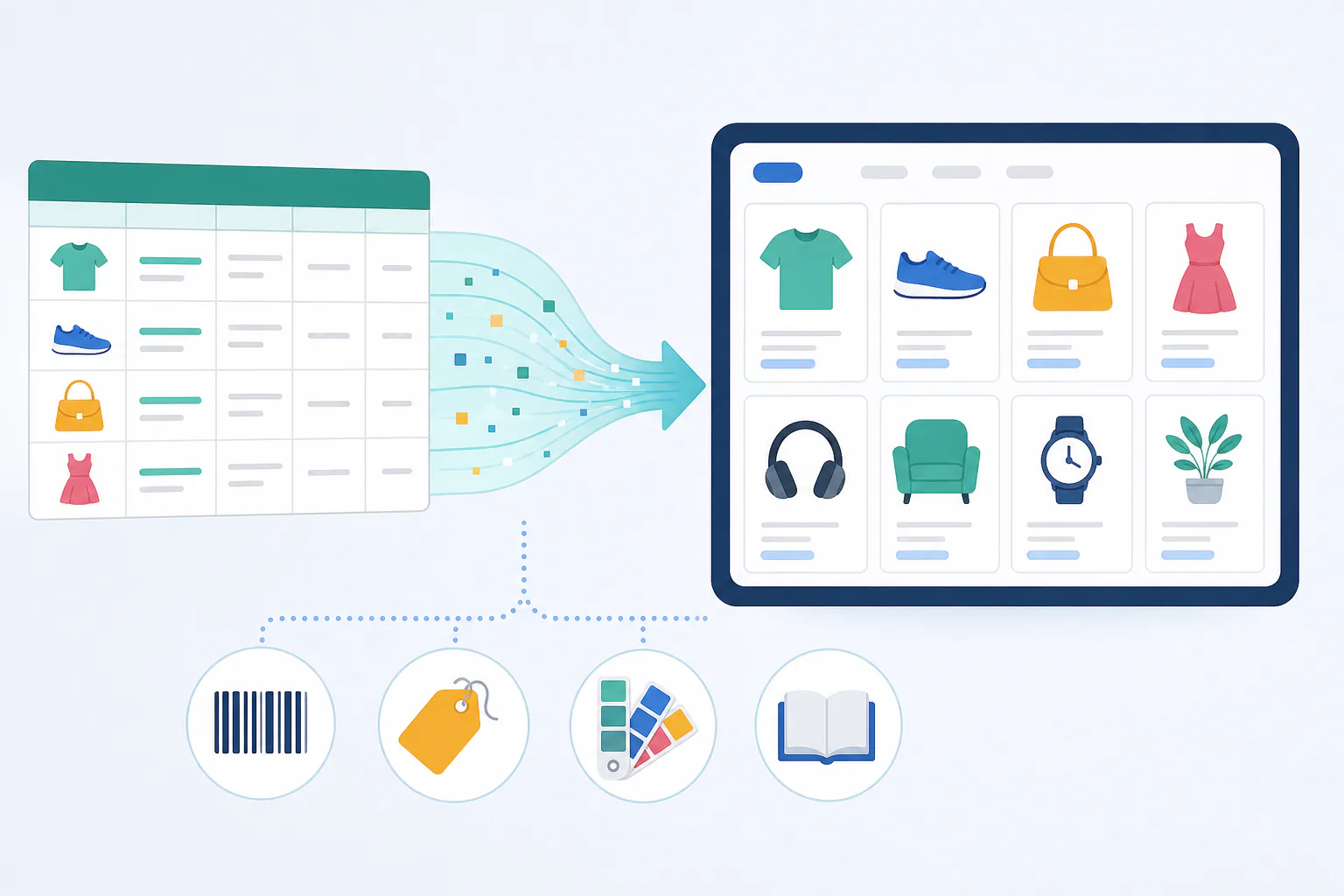
Retailers use Google Ads to run shopping campaigns. They use Google Merchant Center to manage the product feed. Merchant Center is the Google tool where retailers keep that feed, and the feed is the structured list of products that shopping campaigns draw on.
The split between the two tools is practical. Campaign settings are handled in Google Ads, while product data is maintained in Merchant Center. A retailer that wants products shown through Google Shopping works in both.
What the feed contains
The product feed includes attributes such as EAN, price, color and ISBN. An EAN is a barcode number that identifies a product, and an ISBN is the number that identifies a book. Price and color describe the item itself.
| Element | Role in Google Shopping |
|---|---|
| Google Ads | Used for shopping campaigns |
| Merchant Center | Where retailers keep the product feed |
| Product feed | Includes attributes such as EAN, price, color and ISBN |
| Local Inventory Ads | Let retailers include products sold in brick-and-mortar stores |
Selling in physical stores
Local Inventory Ads let retailers include products sold in brick-and-mortar stores. The feed-based approach therefore reaches shops with a physical presence as well as online-only sellers.
What is not specified
The information available gives these attributes as examples of what a feed includes. It does not set out a full list of feed requirements, so the complete specifications are not covered here.
What this means for shoppers and retailers
For retailers in the four markets, the route into the Google Shopping box runs through shopping campaigns in Google Ads and a product feed kept in Merchant Center. Since the free listings are gone, the feed and the campaign setup are the working levers. Accurate attributes such as price and identifiers such as EAN are part of what the feed holds.
Campaigns are not the only route into product results. Comparison shopping services (CSS) build their listings from their own catalogs of retailer offers, so retailers can check which CSS represents their domain and which ones carry their priority products in each of the four markets. Choosing a CSS market by market decides where a retailer’s offers can surface beyond Google’s own box.
For rival comparison sites, the situation is tighter. Google’s box holds the premium space, and the comparison sites that do appear are concentrated in the top four positions. That leaves them competing for a limited number of prominent slots, and the 15-point difference between France and Spain or Italy shows the pressure is not equal everywhere.
Shoppers searching for products in these markets are, on this data, far more likely to see Google’s own shopping box than any other comparison service. Whether that helps or hurts the quality of what they see is the point on which Google’s own assessment and the measured figures part ways.
Chrome price tracking is not offered in the four markets
Chrome price tracking is available for users in Australia, Canada, India, Japan, or the US. Spain, Italy, France and Germany are not among the markets named for the feature, so shoppers there are outside the list.
The information available does not say whether the feature will reach other regions. For shoppers in the four markets covered by the BrightEdge data, price comparison therefore stays within the services that appear in product results rather than in a browser-level tracker.
Sources
Photo: Search Engine Roundtable
Frequently asked questions
Why did Google remove free product listings in Europe?
Why did Google remove free product listings in Europe?
According to the report, Google dropped them because of the Digital Markets Act, the EU rule the report links to the removal. Google called the change the biggest reduction in search quality in its history.
What are the requirements for the Google Shopping feed?
What are the requirements for the Google Shopping feed?
The product feed includes attributes such as EAN, price, color and ISBN. Retailers keep it in Google Merchant Center. A complete list of requirements is not part of the information available here.
How does Google Shopping search work?
How does Google Shopping search work?
Google Shopping lets customers search for, view and compare products. It was formerly known as Product Listing Ads.
What is Merchant Center?
What is Merchant Center?
Merchant Center is the Google tool where retailers keep their product feed. Shopping campaigns themselves run through Google Ads.
Where does Google Shopping show products?
Where does Google Shopping show products?
Products appear on the main search results page or under the Shopping tab.
Where is Chrome price tracking available?
Where is Chrome price tracking available?
It is available for users in Australia, Canada, India, Japan, and the US.