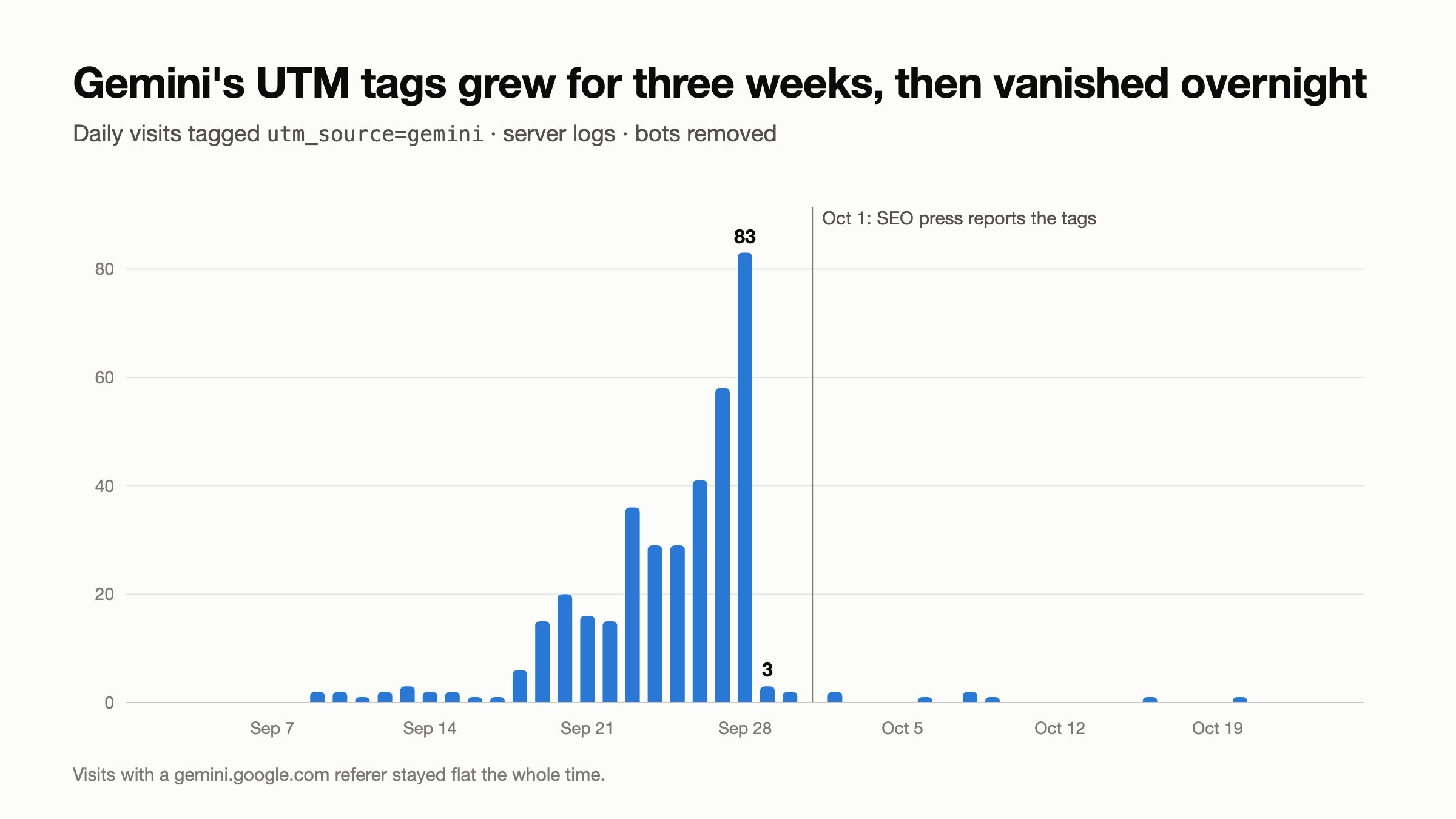
Google appears to have stopped appending UTM parameters to the links Gemini cites in its AI responses, about three weeks after it began adding them. The change matters to site owners and analysts because the tag was one way to identify visits coming from Gemini, and without it some of that traffic has no clear label in analytics. The details come from Search Engine Roundtable.
What changed with Gemini UTM parameters
Google started adding UTM parameters to links in Gemini in early September 2026. Around September 28, it stopped adding them.
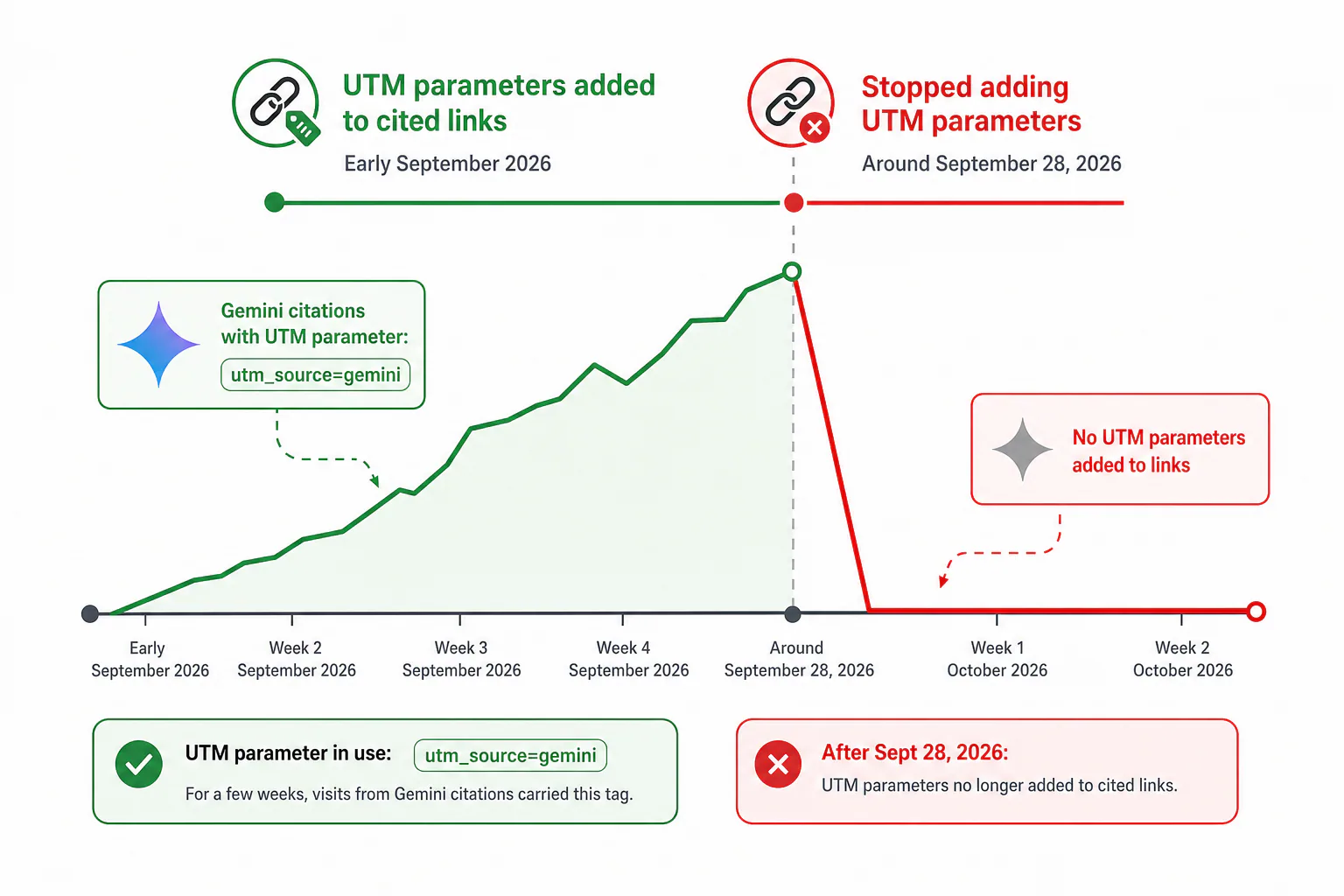
The parameter in use was utm_source=gemini. The source describes only this utm_source value and does not say whether a utm_medium value was set alongside it. Gemini is Google’s AI assistant, and its answers can cite web links, so the tag was attached to those cited URLs. For a few weeks, a visit that started from a Gemini citation could therefore carry its own source label inside the address a visitor clicked.
What the graph showed
Natzir shared a graph showing that visits with Gemini’s UTM tags grew for three weeks and then vanished overnight. According to Natzir, visits with a gemini.google.com referer stayed flat the whole time.
The flat line is the notable detail. While the tagged count rose and then fell, the referrer-based count did not move. What the tag offered analysts was a second route to Gemini traffic, and that route appears to be closed.
Timeline of the reports
- Early September 2026: Google begins adding UTM parameters to Gemini links.
- Around September 28: the parameters stop appearing.
- October 27, 2026: Natzir posts about the drop on X.
- October 28, 2026: Natzir posts a test comparing the iOS app and the web app.
John Mueller commented on Reddit that he had seen the UTM parameters on Gemini links a month or so earlier. His comment indicates the tagging was visible to people outside the original report while it was active.
How the tracking terms work
UTM parameters are tags added to a URL, such as utm_source, that let analytics tools identify where a visit came from. They sit in the link itself. So they travel with the click, whatever browser or app ends up opening it.
A referrer is data a browser sends that tells a website which page the visitor came from. It depends on the browser or app passing that information along, which is why it can be missing even when a visit clearly began somewhere specific.
GA4 is Google Analytics 4, the analytics tool where these visits were tracked. When a visit arrives with neither a UTM tag nor a referrer, GA4 has no source to report and files it under Direct.
What a link fragment loses
UTM tags sit in the query string, the part of a URL after the question mark, so the server and GA4 receive them with the page request. A fragment is the part after the hash sign, such as the scroll-to-text part (#:~:text=) that can send a visitor straight to a quoted passage. Browsers never send the fragment to the server, so neither server logs nor GA4 ever see it.
A cited link can therefore keep its UTM tag and still lose the exact passage Gemini quoted. The referrer, the query string and the fragment each carry a different piece of the story, and only the first two can reach your reports.
How Gemini traffic shows up now
Gemini traffic now reaches analytics through different paths depending on where the click happens, and only one of them still leaves a clear label.
Desktop web
Google still passes referrer data from the desktop web version of Gemini. Visits from that version can therefore still be attributed through referrer data pointing to gemini.google.com, with or without the UTM tag. Workspace and enterprise Gemini users may see a different utm_source value, such as geminiforbusiness, although the source does not confirm this.
iOS app
The Gemini iOS app opens links in its own WebView, an in-app browser, and sends no referrer. In GA4, such visits land in Direct. In-app browsers on Android, including WebViews, can drop the referrer in the same way, although the test in the source covered only iOS.
The only trace of Gemini iOS app traffic is the GeminiiOS user agent in server logs. A user agent is the identifier string a browser or app sends with each request. Counting these visits means checking server logs, because GA4 reports will not separate them from other Direct traffic.
This is also the context for Natzir’s October 28 test, which compared how the iOS app and the web app handle links.
What it means for SEO and analytics teams
Gemini visits are now split across channels. Desktop web visits can be traced by referrer, and a GA4 AI Assistant channel, where your property has one, can only pick up these referrer-carrying sessions, while iOS app visits still appear as Direct. Reports that relied on utm_source=gemini during the three-week window will show a break around September 28.
Figures from that window need careful reading. A rise in tagged visits followed by a sudden drop may reflect a change on Google’s side, not necessarily a change in how many people clicked Gemini citations. Since referrer-based visits stayed flat according to Natzir, the tag’s disappearance should not be read as a fall in desktop referrals.
Direct traffic in GA4 may include Gemini iOS visits that cannot be separated there. Any estimate of Gemini’s share of traffic is therefore incomplete unless server logs are checked, and such an estimate should be labeled as an estimate, not as a measured figure.
Teams that filter or build segments on utm_source=gemini should expect that segment to stop growing after September 28. Segments built on the Gemini referrer domain continue to work for the desktop web version.
One mistake to avoid while repairing these reports is adding utm_source=gemini to your own canonical URLs. A canonical URL is the address search engines and other sites link to, so a tag placed there travels with every visit, from organic search, social posts, email and Gemini alike. GA4 would then label all of that traffic as Gemini, and the numbers would grow while meaning less. Keep the tag out of canonical tags, internal links and sitemaps, and base your Google Gemini analytics on the signals that really come from Gemini, which are the referrer domain on desktop and the user agent in server logs.
What is still not known
- There are no reports of Google explaining why it added the parameters or why it removed them.
- It is not known whether the removal is intentional, a test or a bug; the source says only that Google appears to have stopped.
- It is not known whether the tags will return.
- The source does not say how widely the tagging was rolled out or whether it covered every user or platform.
- A visit tagged utm_source=gemini does not prove that Google added the tag, since anyone can append it to a link.
Sources
Photo: Search Engine Roundtable
Frequently asked questions
What is Google Gemini in simple words?
What is Google Gemini in simple words?
Gemini is Google’s AI assistant. Its answers can cite web links, which is what the UTM story concerns.
Does Gemini still add UTM parameters to links?
Does Gemini still add UTM parameters to links?
Apparently not. Google started adding utm_source=gemini in early September 2026 and stopped around September 28.
Can Gemini traffic still be tracked?
Can Gemini traffic still be tracked?
Partly. Google still passes referrer data from the desktop web version of Gemini. The iOS app sends no referrer, so those visits appear as Direct in GA4.
How can iOS app visits be identified?
How can iOS app visits be identified?
The only trace is the GeminiiOS user agent in server logs.
Who reported the change?
Who reported the change?
Natzir posted about the drop on X on October 27, 2026, and shared an iOS app versus web app test on October 28, 2026. John Mueller commented on Reddit that he had seen the parameters on Gemini links a month or so earlier.
Is Gemini free, and how is the app installed?
Is Gemini free, and how is the app installed?
The available facts do not cover pricing, downloads, installation or why the app may be on a given phone, so those questions are not answered here.