
Anthropic posted quarterly revenue of nearly $17 billion, twelve times its year-earlier level, according to reporting summarized by The Decoder, but $17.5 billion in operating costs outpaced that revenue and the quarter ended with a net loss of $23.3 billion. The figures come ahead of the planned Anthropic IPO (initial public offering) and show how much the company is spending to secure computing capacity.
- Revenue for the quarter reached nearly $17 billion, a twelvefold jump from a year earlier.
- Costs of $17.5 billion outpaced revenue and produced a $23.3 billion net loss, up from $12.1 billion a year ago.
- Anthropic points to $5 billion in short-term compute and $2 billion in employee donation matching as main cost drivers.
- Its updated prospectus shows $895 billion in compute and data center commitments.
- The IPO could raise around $100 billion, with up to $3.5 billion from Japanese investors.
Anthropic’s revenue jumped twelvefold but costs produced a $23.3 billion loss
Anthropic brought in nearly $17 billion in the quarter, according to Bloomberg, as summarized by The Decoder. That is twelve times what the company took in during the same period a year earlier.
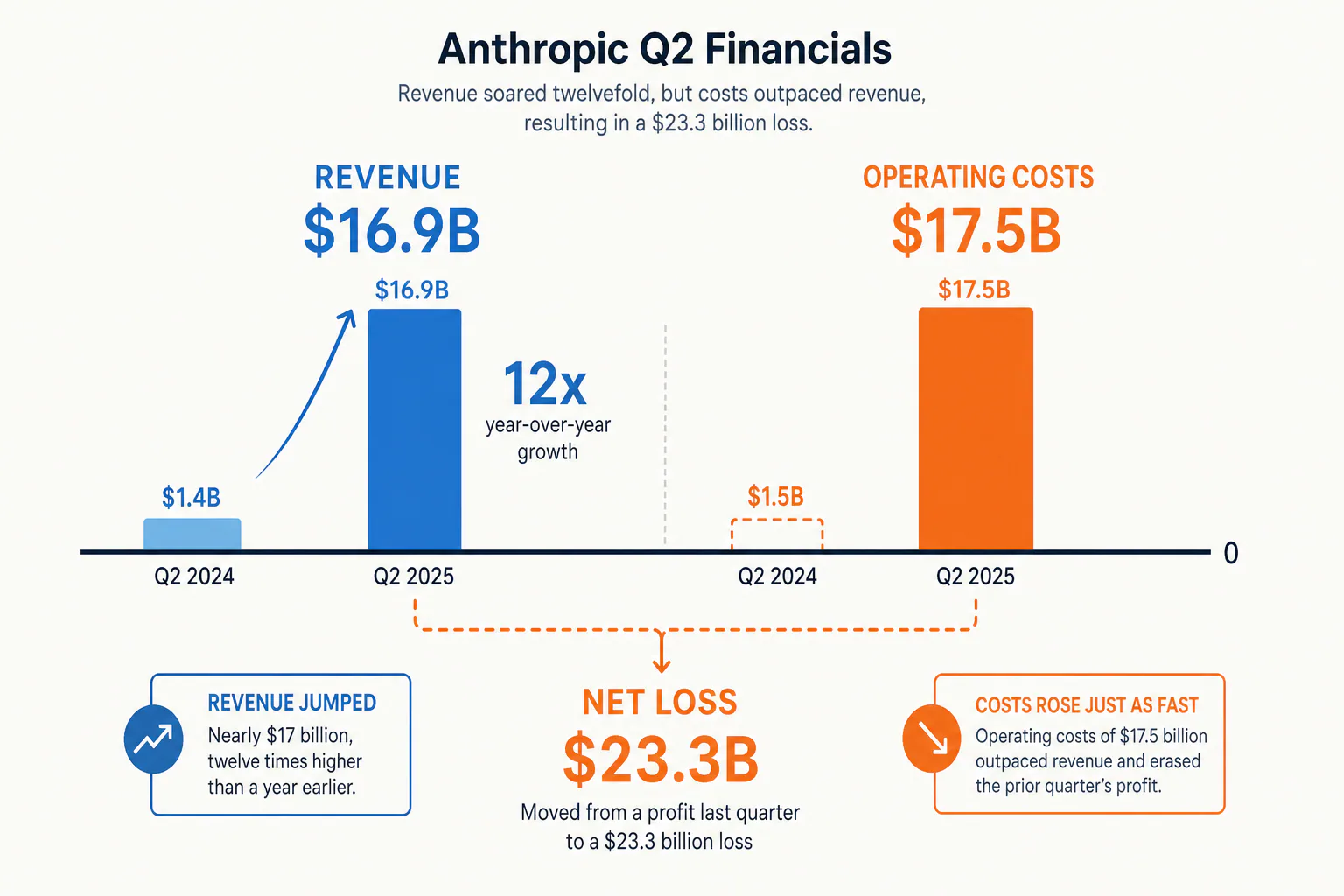
Spending rose just as fast. Operating costs of $17.5 billion outpaced revenue, according to The Information, and they erased the profit Anthropic had reported in the previous quarter. The company therefore moved from a profit to a loss within a single quarter.
According to The Decoder’s summary, the net loss for the quarter was $23.3 billion, up from $12.1 billion a year ago. The loss has grown to nearly twice its earlier size even as revenue multiplied.
| Item | Figure | Reported by |
|---|---|---|
| Quarterly revenue | Nearly $17 billion (twelve times the year-earlier level) | Bloomberg |
| Operating costs | $17.5 billion | The Information |
| Net loss, this quarter | $23.3 billion | The Decoder summary |
| Net loss, a year ago | $12.1 billion | The Decoder summary |
One detail stands out in the numbers. Operating costs exceeded revenue by only a narrow margin, yet the net loss is far larger than that gap. The reporting does not explain which other items account for the difference, so the path from the operating figure to the net loss remains unclear.
The results arrive ahead of the planned Anthropic IPO. For prospective investors, the quarter shows a business whose sales are expanding at a pace few companies reach, alongside spending that is expanding with them.
Short-term compute and donation matching drove the cost spike
Anthropic named two items as main drivers of the cost increase. The first is $5 billion for short-term compute capacity that the company locked in. Compute capacity refers to the computing power needed to train and run AI models, and buying it on a short-term basis is one way to add supply quickly.
The second is $2 billion in employee donation matching. The reporting gives no detail on how the program works, who is eligible or how the amount was calculated, so only the size of the charge is known.
Taken together, the two items come to well under half of the quarter’s operating costs. The remaining spending is not itemized in the available reporting, and Anthropic’s description covers only the items it called main drivers.
Why the capacity was needed
The backdrop is a supply problem. Anthropic has been grappling with a compute crunch since late last year, meaning the capacity available to it fell short of what it needed. Short-term purchases fit that pattern: they fill a gap while longer arrangements are put in place.
That short-term compute spending shows the price of closing the gap in this quarter. Whether similar purchases will recur is not stated in the sources, and no forecast for future quarters accompanies the figures.
How Anthropic is securing compute and power
Since the crunch began, Anthropic has signed dozens of deals with Amazon, Google, SpaceX, chipmakers and former crypto miners, according to the New York Times as cited by The Decoder. The list spans cloud providers, hardware makers and companies that already operate facilities built around heavy power use.
No terms for the Anthropic compute deals are given. Nor does the reporting say which partner supplies how much capacity, what each deal costs or how long each one runs.
What a gigawatt measures
Capacity in this context is expressed in gigawatts. A gigawatt is a unit of power, and here it serves as a yardstick for the compute capacity Anthropic can access. More available power means more computing hardware can run at the same time.
Power access this year and next
Anthropic is expected to have access to more than 3.5 gigawatts of power this year. It plans to double that next year, which would put access at more than 7 gigawatts.
| Period | Power access | Status |
|---|---|---|
| This year | More than 3.5 gigawatts | Expected |
| Next year | More than 7 gigawatts | Plan |
The second row is a plan, not capacity already in place. Reaching it depends on the agreements Anthropic has signed and on any it adds.
The prospectus shows $895 billion in commitments
A prospectus is the formal document a company files for an IPO, describing its finances and risks. It shows what a business has promised to pay for in the future as well as what it has earned and spent to date.
Anthropic’s updated prospectus shows $895 billion in commitments for compute and data center leases. The amount measures the obligation the company has taken on to keep its capacity growing.
Set beside the quarter’s results, the scale is plain. The commitments are many times larger than the quarter’s revenue and its operating costs. A single quarter’s figures describe only a small part of what the company has agreed to pay for.
The sources leave several points open. They do not say over what period the commitments run, how they are scheduled or how much falls due in any given year. Without that, the annual burden of those commitments cannot be worked out from the reporting available.
The prospectus is also described as an updated version, which means an earlier filing existed. Its earlier commitment total is not reported. The sources also do not summarize its risk factors, so we cannot say how it treats customer concentration, client contracts or AI risk.
The Anthropic IPO could raise around $100 billion
The offering could raise around $100 billion, according to the New York Times as cited by The Decoder. The figure is a press report of a possible outcome, not an amount Anthropic has announced as final. The size of the raise depends on the valuation investors put on the company, and that valuation is so far only reported, not confirmed.
Up to $3.5 billion of the IPO is expected to come from Japanese investors, according to the same report. Those investors are not named, and the reporting does not say how the amount would be allocated.
For readers searching for Anthropic stock, the short answer is that the IPO is still pending. The reporting available contains no listing date, share price or ticker symbol, does not say whether the shares would trade on the Nasdaq or another exchange, and describes no trading. The details that will matter to buyers of shares come from the prospectus, which Anthropic has updated and which sets out the finances and risks.
If you want to take part in the Anthropic IPO, expect most shares to go to institutional investors first. Some brokers give individual clients access to IPO shares, but allocation is never guaranteed, and many buyers can only purchase once trading begins. Before you buy, read the prospectus, in particular its financial statements, its risk factors and how the proceeds will be used.
A raise of around $100 billion would compare with $895 billion in commitments, though the sources do not say how proceeds would be used or whether any of the money is earmarked for those obligations. Those links are left unstated in the reporting.
How an IPO moves from filing to trading
The sources describe an updated prospectus but not the full timetable. A US listing usually follows these steps:
- The company submits a confidential filing, a draft registration statement that the SEC reviews in private.
- The public S-1 filing follows. This registration statement on Form S-1 carries the prospectus, and updated versions can come later, as Anthropic’s has.
- Lead underwriters, the investment banks that run the offering, syndicate the deal among other banks and take the company on a roadshow to meet large investors.
- The share price is set after the roadshow and is not final until it is announced.
- Shares are allocated to investors, mostly institutions, and no buyer is guaranteed an allocation.
- Employees and early investors can sell once lock-up periods expire, often in stages.
The reporting does not name the banks running the offering or give a pricing date, so for the Anthropic IPO these steps describe the usual path, not a confirmed schedule.
What Anthropic is and how its public benefit status shapes the picture
Anthropic is a Public Benefit Corporation (PBC), a designation that requires it to balance the financial interests of shareholders with benefit to the broader public. As the Anthropic IPO approaches, that is a formal obligation on top of the usual duties to investors.
Anthropic’s 2026 Public Benefit Report takes stock of its public benefit work, according to the company’s site at Anthropic.com. The sources used here do not summarize its findings.
The company also maintains a Responsible Scaling Policy, described as a voluntary framework for managing catastrophic risks from advanced AI systems. Because the framework is voluntary, it is a commitment the company has set for itself, not a rule imposed from outside.
Questions the sources do not settle
Several common search questions about Anthropic fall outside the facts available. The sources do not compare Anthropic with ChatGPT or any other product, and they do not state where the company is headquartered. They do not describe a product called Anthropic Ultra, and they do not address controversies about the company.
What they do show is the use of its Claude models: summarization, subagents, browser use, agentic coding and knowledge work, as described in the next section.
New Claude 5.5 models aim to cut customers’ costs
Anthropic’s model lineup includes three 5.5 releases, and each is described in terms of speed, capability or cost. Claude Haiku 5.5 is the company’s fastest, most capable small model, built for high-volume work such as summarization, subagents and browser use.
Claude Sonnet 5.5 is a clear upgrade over Claude Sonnet 5. Anthropic says it runs 30%+ faster and costs up to 30% less for most work.
Claude Opus 5.5 leads in agentic coding and knowledge work. On typical workloads, Anthropic says, it costs 40% less to run than Opus 5.
| Model | Described as | Stated change |
|---|---|---|
| Claude Haiku 5.5 | Fastest, most capable small model | Built for high-volume work |
| Claude Sonnet 5.5 | Clear upgrade over Sonnet 5 | 30%+ faster, up to 30% less cost for most work |
| Claude Opus 5.5 | Leads in agentic coding and knowledge work | 40% less to run than Opus 5 on typical workloads |
The cost and speed claims come from Anthropic itself, and the sources give no independent testing. For teams that pay for model use at volume, including content and SEO teams that run AI-assisted drafting, the stated savings apply to the 5.5 models relative to their predecessors. Nothing in the reporting links the releases to the quarter’s results or to the company’s compute purchases.
Sources
Photo: The Decoder
Frequently asked questions
What is Anthropic’s IPO expected to raise?
What is Anthropic’s IPO expected to raise?
The IPO could raise around $100 billion, according to the New York Times. Up to $3.5 billion is expected to come from Japanese investors, and the offering is still pending.
How big was Anthropic’s quarterly loss?
How big was Anthropic’s quarterly loss?
The net loss for the quarter was $23.3 billion, up from $12.1 billion a year ago. Revenue in the same quarter was nearly $17 billion.
Why did Anthropic’s costs jump?
Why did Anthropic’s costs jump?
Anthropic pointed to $5 billion for short-term compute capacity it locked in and $2 billion in employee donation matching as main drivers. It has faced a compute crunch since late last year.
What is a prospectus?
What is a prospectus?
A prospectus is the formal document a company files for an IPO, describing its finances and risks. Anthropic’s updated version shows $895 billion in commitments for compute and data center leases.
What does Anthropic’s public benefit corporation status mean?
What does Anthropic’s public benefit corporation status mean?
As a Public Benefit Corporation, Anthropic must balance the financial interests of shareholders with benefit to the broader public.
How much power will Anthropic have access to?
How much power will Anthropic have access to?
Anthropic is expected to have access to more than 3.5 gigawatts of power this year. It plans to double that to more than 7 gigawatts next year.